
What are your thoughts on the challenges of merging figurative study…
“What are your thoughts on the challenges of merging figurative study and landscape study to create better illustrations? I've spent most of my life studying figurative work and while I still have a long way to go, I'm realizing one of the biggest weaknesses in my illustrations is the lack of environments or figures not feeling truly grounded in their environments, both compositionally and well as in color/value. To that end, I'm becoming more interested in studying landscapes to create more holistic narrative images. You share quite a bit of both landscape and figure studies, and obviously you combine both in your Sin of Man & MTG work, but I'm curious if you even think of them as separate crafts that took effort to combine, or if it's all illustration (composition, form, value, & color) no matter what you're painting.”
Figure painting is hard, landscape painting is hard, and combining them is harder than either of them.
I learned them separately but also together. I've done plenty of no-background figure drawings and countless figure-less landscapes. But then, I also combined them in many illustrations, both personal and professional. Their combination is a damn pain, though. Because you are likely to be better at one than the other. And it will be your worse skill that dictates the level of a piece.
So for many years my figures lagged behind. I tried to keep them as minimal as I could and used whatever cheap tactics of photobashing or tracing that I could to make them look at least somewhat decent. It worked well enough but it also kept me from exploring a lot of paintings and subjects that I wanted to tackle.
After my cancellation, I got into figure drawing and painting. I started with a lot of no-background work.
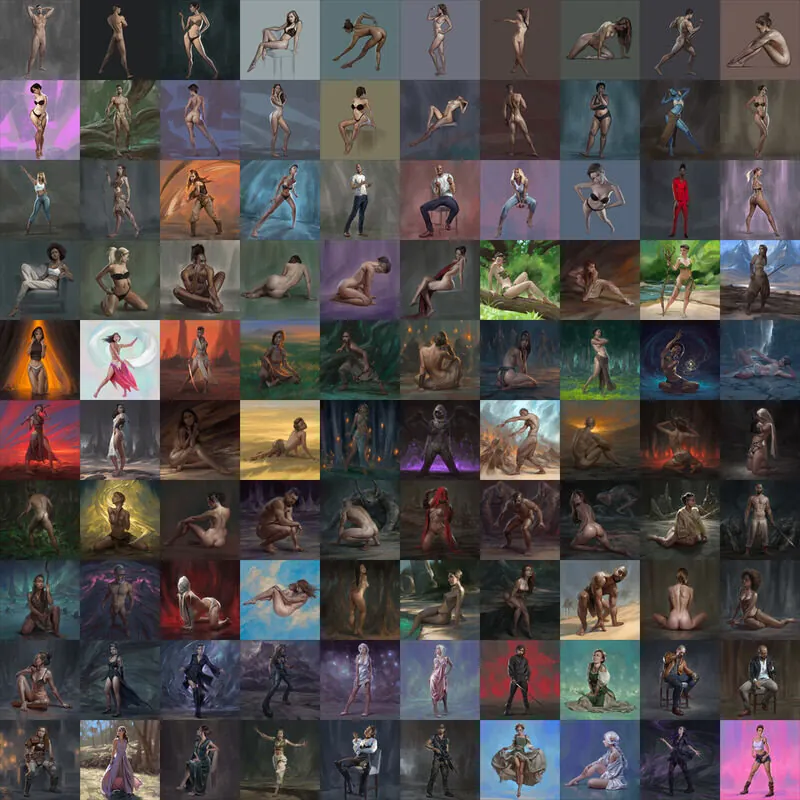
I continued to do a lot of almost-no-background work during this time, but at a certain point I was curious how to make a figure exist in a space. How to, at least, incorporate the values and edges of an environment to make a more cohesive picture.
It wasn't a comfortable process and I often still struggle with it. Because it's hard!
Art is always a symphony of a bunch of different skills, applied simultaneously. Figures in environments only make that harder. It's why I have a special admiration for artists who do it well (Sargent, Sorolla, etc.).
So I guess I do see them as different skills. They have overlap, of course. Values work like values, no matter what you're painting. But the peculiarities of each are immensely deep subjects and should be studied individually—and together.