Black Friday Sale: up to 50% off courses, books, reference & prints — See all dealsShop prints

noahbradley.com

Q&A

Answers to reader questions on art, freelancing, and painting.

“How's the balancing act between life, art, and caring for your child?”

— Raul

Unbalanced!

This baby girl has exceeded our expectations in all sorts of ways. She is absurdly cute and she is also absurdly intense. We've certainly never met another baby quite like her.

That's been a lot of fun, of course, but also has wrecked havoc on the rest of our life. We're finally getting back to the point where we can take care of ourselves and have some social life. But work? Oh man, that's still not happening much. We had the naive expectation that I would be back to working 20~ hours a week in the first few months. Now here we are at about 8 months and I'm still lucky to manage a few hours a week of real dedicated work.

I know it's just a season and I don't resent it, but sometimes I do wish I could sit down and just paint. I know it'll happen again someday.

In the meantime, I'm cherishing this opportunity to spend most of my days playing with this darling child.

“Every artist has a favorite palette of selected colors, and one particular color that keeps popping up in everything. For Bob Ross, it's white. No matter what he's painting, white shows up. Do you have one?”

— Deunan

I guess it would be Burnt Sienna—now I use Transparent Red Oxide, but they're pretty much the same color. I'm not sure if I can imagine ever feeling comfortable painting without that one on my palette. It's so perfectly versatile. Mix it with the right blue and it's a generic dark-ish color. It looks incredible when you tone a canvas with it and doubly so if you're painting a landscape on top of it. It's sorta a neutral earth-tone but also can be an incredibly vivid orange. It's the pop of warmth I want in my paintings.

“I've noticed that recently, you seem to do less fantastical and other-worldly environments/pieces of art. I thought that maybe your interests have changed over time, but I realized that it was probably because most of your personal work is going into your new landscape book. So I'd like to ask, do you feel like the subjects you're interested in painting has changed over time, or do you feel what originally interested you is still the same?”

— Justin

You're right: part of the reason I've done less fantastical stuff for the past couple years has been my efforts for this book.

But I do find my interests shift—I guess I can see more value and find more personal joy in painting more mundane/real things these days. There's a lot of beauty to be found. And there's also the practical consideration: I might be pushing my work more towards fine art in the coming decade and, well, I might not be able to do as much fantasy work? Or maybe I can?

I don't think fantasy is ever really going away, though. It'll always have a place in my work. I love looking at it and I love making it.

“What I’m actually curious about is what you do as a consumer of social media, rather than as a creator. Advice on making content is everywhere... less so on consuming it diligently. I just think a lot of artists underestimate how important “feed hygiene” is—for lack of a better term. First, in terms of minimizing stuff that waste your time, attention, and even emotional energy. And second, in terms of shaping a feed that actually supports what matters: learning and growing as an artist, getting inspired, connecting with the right people, etc. So yeah, I’m interested in the tactics, habits, or just underlying mental framings you use—or think artists should use—when curating their social feeds.”

— Simon

Had a follow-up to the question about curating our social media feeds—because I got it completely backwards what he was asking. So here we go again:

I'm fairly strict with the content that I put out there—but I'm much, much more strict about the stuff that I consume.

I ruthlessly block, mute, and avoid anything that doesn't serve me. If I follow someone and they start posting things I don't want to see, I'll either unfollow them or mute them. I slam the "not interested" button constantly on X. If I do happen to look at something that I don't want filling my feed, I'll make a note of not liking or commenting on it.

Because of all this, my social media feed is a pretty wonderful place. It's thoughtful discussions that I enjoy and then quite a lot of really nice art. I generally feel encouraged when I use it.

But doesn't this mean I live in a bubble? Yes. Absolutely. Happily. We're all in bubbles, whether we realize it or not. And this self-constructed bubble is the healthiest one that I know how to make. My life will not be best if I am constantly distracted by whatever dramas and disasters are occurring in every corner of this planet. I can't do anything about almost all of it. So I don't benefit from seeing it. I've chosen my path in life and those are the things I'm going to put my energy towards.

So if you, too, would like a nice social media feed, start culling. Look at each feed on your timeline and decide if it's something that benefits you to see. No? Then mute, block, or at least hit "not interested." If you notice someone posting a lot of things that don't do you any good, but you follow each other? Time to mute them.

Things will improve quickly but it requires a lot of diligence to keep up. It won't be hard for social media to start shoving more rage-bait in front of your face again. It's a daily fight—but when you get it working, it's a pretty great influence in your life.

“What is your process to stop and rest, do you feel an obsession when you stop your work at the end of the day and it's not finished yet. What is the perfect moment to leave it suspended and ready for the next day?”

— Mauro

You need to stop—or at least break—when you don't know what to do in your painting. But I like to stop for the day even when my painting is going well and I know what needs to be done. I love the feel of coming back to a painting. Your eyes are fresher and you've got something familiar to work with. The problems stand out a little starker and the solutions feel closer to hand.

I guess sometimes I've been obsessive about my work, but I think most of that came with the pressures of clients and deadlines and the like. With my own work, I've tried to use the extra time to my advantage. Even when I could do a painting in a day, I'd rather do it over the course of two days and let the process simmer overnight. The results tend to be better.

Leaving a painting is not terribly hard but coming back can be tricky. You don't want to start on something too difficult or too easy. If it's too difficult, you're likely to struggle to get into the painting. But if it's too easy, you're unlikely to immediately work with bold confidence when you're just starting your day of painting. So I like to start in an area that's moderately interesting and try to make things a bit more interesting and a bit more clear. Usually more clear. It's a rare painting that does not benefit from some cleaning up.

So I suppose I prefer to leave a painting when it's going pretty well than when it's going poorly. But few of us set out to screw up, so that's not always possible.

“And if you need a question to answer for an upcoming letter, I think your audience would appreciate your advice on the importance (and skillset) of maintaining a solid social feed as an artist and freelancer (one that tends to hit the middle part of the useful, positive/uplifting, enjoyable venn diagram).”

— Simon

I'm years out of the game of using social media to get work as an artist—but I'd assume it still gets you jobs. Being seen, wherever and however that happens, is key to working as an artist. When art directors constantly encounter your work, see that it's good, and even see that other people think it's good, they're probably going to hire you. That's how it always worked for me. I put my work everywhere I possibly could and work slowly rolled in.

Nowadays I don't freelance (much) and so art directors aren't really my target audience. But I do still sell resources/education to artists and so I like to get my stuff out there. I also always like to put my work out there for people who just likemy art, perhaps in the hope that maybe they'll buy a print or something someday.

Now, how do you do this? Well if you're trying to appeal to artists, be useful, show interesting process, and be inspiring or relatable. All of those can work. Most of those, notably, do not require you to be the best artist in the world.

If you're trying to appeal to non-artists, make work that they're going to enjoy and share it in shareable, likeable ways. What's shareable and what's likeable? It depends on the platform. Every site has a different "flavor" and tone and those things change with time. The ways I would get viral tweets five years ago are very different from what works now. There are no hard and fast rules, just vibes and feelings. You have to feel those things out. Part of that can be a bit analytical—see what's doing well and try to imitate the feelings of those posts, in your own way.

It's all a game. We're all clambering to be seen and it's a bit of a vain scramble. But just because you don't want to sully your art by playing that game, don't discount it entirely. You probably don't have to completely change who you are to do well.

“I have a question that I hope is not out of line. I think you might be uniquely qualified to answer it. The art world leans to extremes and I struggle to know when to voice my values and when to keep silent. I love my art friends but I’m afraid they would turn on me if I voiced my beliefs. So now I keep my mouth shut (mostly). I just want to make art! I just want to talk about art! But people keep making things political. And a part of me also wants to stay true to my values. So I guess my question is: How do you balance relationships with friends and loved ones if you have deep ideological differences, especially these days? Is it even possible to find likeminded artist friends when everyone is afraid of speaking their true mind? Help!! Signed, A lonely artist who doesn’t think the world is ending just because of politics”

— Alex

Yeah, things are a bit nuts. And, shockingly, we've arrived at a point where saying that things are a bit nuts is potentially a justification to ostracize someone because we could probably infer the rest of someone's political beliefs from that one statement.

I don't share a lot of my political opinions because, well, that's not what I'm here for. I just want to make art and talk about art. Stupidly, refusing to talk about politics will offend some people. But if you just stick to that hard line of not addressing things, I find that that noisy minority will probably leave you alone (eventually). You don't need to have an opinion about everything nor do you need to say something about whatever the issue of the day is. It's ok. You have my permission to just make art and share it. It's cool.

I disagree intensely with a lot of my friends & family. Most of them probably aren't aware. I find it's pretty easy to surround yourself with friends & family of diverse opinions when you don't feel a need to change anyone's mind.

I'll use this opportunity to plug What's Our Problem? again. It's the best book for developing a mental framework of understanding of how things currently are and how they got that away—as well as, I suppose, what we can do about it.

“I have a few questions about your book: 1. Is it a reference or how-to book on painting? 2. When would it be available and where can it be purchased?”

— Sam

“You do seem to have been working on this book for a loooooong time? Did you work on your figure book for a similar period and if not why is the landscape version taking a lot longer? Are you avoiding finishing it for some reason or are you massively more invested in landscapes with so much more to say?”

— Ella

I've had a couple people email me to ask about the landscape book, so I thought I'd try to answer them.

It's definitely going to be a how-to book. There's a whole lot of art in it (along with illustration, process images, and all that), but it's got a ton of writing as well.

I've been working on it for a long time. I guess it was 2023 when I got serious about painting for the book and starting to draft it. Part of the desire for the book came from a question: could I, as a professional landscape painter, get noticeably betterat landscapes if I spent some time practicing? The answer is obviously yes, but it didn't feel so obvious at the time. After a decade of illustrating landscapes, my work felt stagnant. I liked my work but it hadn't progressed much in many years. Hell, sometimes I'd look back on older work and prefer it to the newer stuff.

So I set about practicing and now, a few years later, I like my paintings a lot better. It worked! Along the way, I wanted to write a book on landscapes. The figure book, in many ways, was a practice run for this book. I'm not some great figure painter but I practiced and figured out a lot of things and I wanted to share that with people. And I wanted to make a book so that I would feel comfortable making more books.

As it turns out, I have a lot to say about landscapes. All of the lessons, all of the books I've read over the years, all of my personal, hard-won knowledge. I've tried to cram nearly all of that into this book. And I'm pretty sure it's turning out well.

So yes, in a way, you're totally justified in asking if I'm avoiding finishing it—I know I've said I'm close to finishing it for a long time now. And I have been! It's just we're definitely entering one of those "when you're 95% done with a project, you're 50% done with a project." These last little bits are taking a long time to fill in. It feels close, but every day I work on it and realize just one more thing that I need to do for the book. And as I'm more and more invested in the book and the quality feels pretty high, I can't justify half-assing things.

A baby on the doorstep is also a factor. At this point I think I'll be able to get the book 99% done before she arrives. But we obviously don't know exactly when this little girl is entering our lives nor am I very good at estimating how long things will take me to finish. So that's a guess.

So I guess my vision, at this point, is to launch a Kickstarter this summer. You'll be able to buy digital and hardcover editions of the book. Once the campaign ends, it usually takes a few months to get the books printed and shipped to me, then a matter of weeks to get them shipped out to everyone. So I guess that means the books in your hands by this fall?

Fingers crossed.

“I have a relatively small studio space and have been working with gouache. I have the chance to increase my studio space and I've been debating making the jump to a different medium. I know the classic atelier method is to jump into oils, but is there any merit to acrylic for classical style paintings?”

— Andrew

Acrylics are the most underrated medium.

I love oils and I rave about oils all the time. They're my favorite medium. You will never regret working in oils and you'll probably love them. Hell, your paintings might even sell for more money just because they were painted in oils. It's silly, but it's kinda how things go. Oils are phenomenal.

But acrylics are also excellent, just in different ways.

I used acrylics for a lot of my early years of painting. I used them for nearly all of the plein air work I did, for my early illustration attempts (before switching primarily to digital), and for underpaintings for more pieces than I can count.

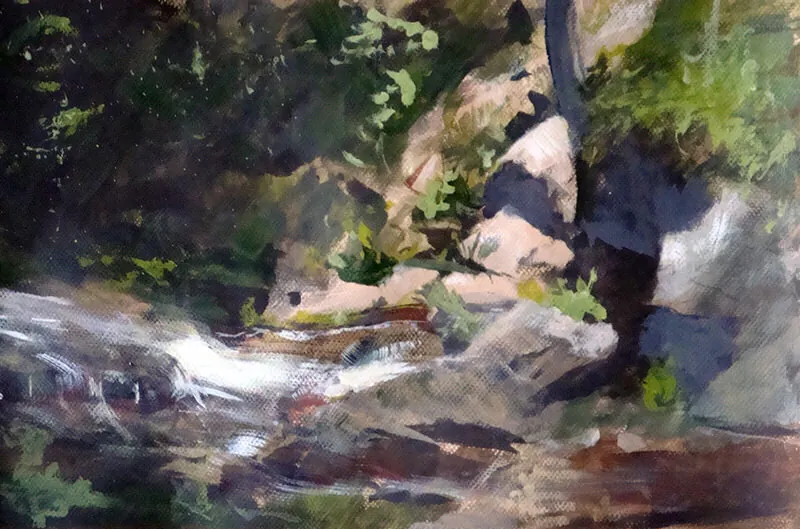
Early plein air painting by Noah Bradley

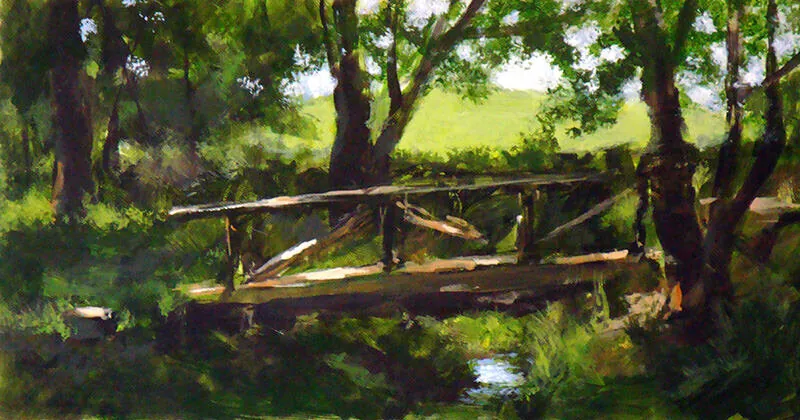
Early plein air painting by Noah Bradley

Early plein air painting by Noah Bradley

Acrylics are fast, easy, cheap, and versatile. You can mix accurate color quickly and they don't suffer nearly the same value-shift you're going to get from mediums like watercolor & gouache. You don't need any fancy materials or surfaces. You can paint on a cardboard box and it'll work great. Once the paint is dry, it's durable as hell. Any sort of brushes or tools will work. I used paper plates for my palettes for all of the plein air paintings above.

You can work transparently or opaquely. You don't ever really have to worry about your paintings cracking or smudging or anything. What you see is what you're gonna get. By the time you're done, it's probably going to be dry enough to throw around without concern.

And, yes, you can get some very classical looks with acrylics.

Any of their "bad" qualities—for some, the fast drying times, and for others, the less-than-stellar surface quality of the finished piece—can be remedied by getting some different mediums and/or varnishes. They've got acrylics that stay wet longer, palettes that keep moisture trapped in there with the paint so you can reuse paints, and varnishes that give a bit more luster to otherwise plastic-y finishes to your pieces.

So I suppose I'm always going to advise you to paint in oils. You won't regret it. But too many people are prematurely dismissing acrylics and I wouldn't be too surprised if they make a bit of a resurgence in the next decade.

“I've been following you for a while now and I guess it'd be cheeky of me to ask you to look back at your life choices (both the good and the bad) and to answer the eternal question of 'What do you think the meaning of life is?' This question comes from a more existential part of me now that I've started to wonder if I'm making the most out of my life as someone who's slowly reaching the age of thirty. I suppose a well traveled person such as yourself could give some insight for a young corporate man like myself.”

— Jas

Nice, easy question to start off my day.

We'll skip all the obvious disclaimers about how I don't know what I'm doing and I'm just a guy and I'll just try to answer the question.

One time I was interviewed on a podcast and I showed up to the interview a bit early. Another guest was being interviewed when I arrived and was sharing his story about him surviving cancer and the amazing charity work that he spends his life working on. I was very excited to try and follow that and explain how I spend my life painting pretty pictures.

In that interview, I was asked what I think makes a good life. And honestly I still think the answer is a pretty good one: to leave the world a little better than you found it.

Now, as an artist, I'm not drastically changing the world. I'm not curing any diseases or discovering new technological breakthroughs or any of those sorts of things. But I think that the act of painting is its own sort of contribution to human legacy. I know that I would be pretty sad if humans never made art again. We artists, in our own small ways, get to bring a little more beauty into the world than when we arrived.

I don't know if leaving the world better than you found it is the meaning of life, but it seems like as good a reason as any and I reckon it can serve you well. There's more to it than just that—there always is—but maybe that mindset will steer us in the right direction.

“When trying to paint landscapes from a reference, I often have trouble with simplifying forms. Things like a rocky/pebbly river bank or very noisy bushes tend to trip me up. Any advice or resources on learning how to paint these things in a readable way?”

— Rachel

Oh man, the chaos is hard. It is, in fact, probably one of the most uniquely challenging aspects of landscapes. Everyone who has ever tried to paint a landscape has quickly realized that there's just too damn much to paint it all.

What has helped me the most is, first, to see the really big shapes first. There are a million details but they average out to a certain color. Try to get that in the right ballpark first. Once you can kinda squint as your thumbnail and you can more or less guess what's going in that area, you're probably headed in the right direction.

Obviously getting the shape/silhouette of all that mess of detail is important too. Especially with shrubs—get those soft edges right where you want them.

But then the last key (and the really important one), is finding the points of darkest dark within that area and putting down the most important ones. You'd be amazed how, if you paint those few little dark blobs correctly, the rest of the area starts to come together. It'll probably take more work, but that's the priority for me every time. Find those little shadows and paint those super accurately.

And then, beyond those things, there's the annoying fact that some subjects just require more time than others. Some paintings just take a long time. If my painting is all about a bunch of rocks by a stream, it's never going to look right until I paint a bunch of rocks. We're always taught to simplify and see the big picture, but some pictures are focused on those little fun details. So you've gotta spend a stupid amount of time actually painting them.

“I'm starting an old fashion, offline art selling. I don't know where else would be the best fit for me... besides selling my work on the sidewalk or on the streets. I want to avoid art galleries. They charge 50% on average for putting your work out there on their walls plus the selling time is far too slow. I wanted to sell my work at art shows, first locally, then abroad. But here in my local corner of the world there is no such thing as art shows. I was thinking of selling it in a restaurant where there would be a lot of tourists eyeing my work. And I'm not sure if this idea is outdated at a time of AI. But I got to start somewhere and I'm on an island in the Caribbean and I have never seen anyone in my small little art circle do it successfully.”

— Lou

I think there's quite a lot of potential for making money by selling your art offline. It's definitely not easy but living in a tourist hotspot is definitely a good thing in this case. In many tourist towns, you'll spot an artist with a prominent gallery selling their work directly to collectors. And, seemingly, making a good living from doing that.

A good artist to look at for inspiration on this would be Andrew Tischler, who is set up with his own gallery space down in New Zealand.

While I don't live in a tourist town, this sort of model is something I've been incredibly interested in pursuing. I, also, do not really want to go down the traditional gallery path because, well, I'm me and I like doing everything myself. So I like the thought of running my own studio & gallery space to sell my work directly through. Maybe in the coming years I'll take a shot at that.

Along with that, if I had to provide any advice, it would be try anything and everything you can—put your work in restaurants, try to get in the local paper, share your work with anyone locally who might help you do this. Find any other artists who are trying to do similar things.

“What’s your process for writing the newsletter? I imagine it would be most efficient to bulk prepare sections and cobble an email together from scavenged parts and then schedule send them (I see a lot of people do this), but yours often seem to relate to stuff currently going on in your life. Where in your week do you fit time to write for your mailing list? Is it a passive and relaxing experience, or are you crunching to a deadline? You strike me as a very organized person. How do you ensure you don’t repeat yourself or write irrelevant nonsense? I’d love to see a “BTS” segment. ”

— Brandon

It would definitely be more efficient to bulk prepare sections ahead of time and have a whole system to write these newsletters. But I don't.

My system, as it were, is very loose. I have a calendar reminder to write a newsletter and each week, after I finish one, I drag it to the next week and forget about it. When that day rolls around, I open up the newsletter page and start chipping away at one. Adding whatever thoughts, images, etc. come to mind and whatever I've done in the last week. I tend to do them in the morning when I'm still sipping coffee or puttering around.

The very lack of structure is fairly important to me and I think is why I've kept up with these for so long. It doesn't feel like a chore because, well, I have very low expectations for these. I'm not measuring open rates, I'm not trying to get X numbers of sales, I'm not trying to grow the list particularly, I'm not even trying to come off as someone wise or special or whatever. I'm just writing these like I would write an email to someone I knew.

Most of the inspiring art I share is from bookmarks that I make on X as I'm scrolling through there. I'm quite pleased with the algorithm these days and get some real gems popping up on there pretty regularly.

That's about it. Nothing magical. I guess I'm just humbled and pleased and surprised that people are still reading them and, apparently, enjoying them. That's pretty cool. Thanks.

“I have a relatively small studio space and have been working with gouache. I have the chance to increase my studio space and I've been debating making the jump to a different medium. I know the classic atelier method is to jump into oils, but is there any merit to acrylic for classical style paintings?”

— Andrew

Acrylic has gotta be one of the most underrated mediums.

They're pretty affordable. You can work transparently or opaquely. You can paint thick or thin. You can work on any surface known to man without issue. Your painting will always dry quickly. If a part of your painting isn't working, it's easy to paint over it.

The issues that people have with acrylics are usually 1. the fast drying speed making wet-into-wet looks pretty tricky and 2. the surface tends to look plastic-y when it dries. The former can be remedied with certain slow-drying additives. And then you can change the look of the surface either with varnishes after the fact, mediums while you're working, or even switching to a kinda-in-between thing like acrylagouache.

I quite like acrylics. Even though most of my experience in recent years has been using them for quick underpaintings, a lot of my early landscapes were done in acrylics. I always found that they were the medium the nearest to a digital painting experience.

All of that said, though, if you get the chance and have the space for it, I think you should go for oils. I think acrylics are great but oils remain my favorite medium. They are so supremely versatile, beautiful, and enduring. They can be finicky and annoying, but once you get a handle on the basics even their quirks aren't too bad. I don't think anyone will regret learning to paint in oils.

“I've generated some AI images using my uploaded art as reference with no prompt to mix and match and see what AI comes up with. Interesting stuff but what I want to do next is to order a canvas print and paint acrylic on that to get rid of any AI slop and improve the design. Very collaborative with technology I think and an ethical way to use AI. What are your thoughts?”

— Joseph

I gotta crack open the can of worms that is AI every once in a while, so here we go.

I still think that, well, AI ain't going anywhere. It's here to stay. We can make it more moral or better or whatever, but we're not going to eradicate it. So the artists out there crusading against every whiff of AI are, simply put, fighting a losing battle. A lot of them are probably doing so for noble reasons—but they still won't win. And are they really going to be happy with the absolute-best-reasonable-outcome of models created solely with licensed content? I highly doubt it. They're making a stand against the technology itself? I don't see them ever winning that fight.

So then it comes to the images that AI is producing. My biggest issue with AI images in the past year are that they look really, really boring. There are maybe one or two artists I know who are using AI in interesting ways and producing some interesting work. But they're obviously already interesting artists—so no matter what tools they're using, they're going to make something that still contains a bit of themselves. That's essential. Whatever you do, however you do it, you still need to make the work yours.

I think your idea for a process might have a lot of promise. It's got a good mix of new technology and enough of your personality that it might work out. I actually toyed with a process many years back where I did my digital sketch as I always do, had it printed on canvas, and then did the oil painting on top of that. I could see doing more of that. It was like one hell of a nice block-in to start with.

But if it were me trying this process of incorporating AI in the process, I think I'd choose one of the older models to generate your images. All of the stuff I see these days is so painfully same-y. There's a look that AI can't seem to escape from right now. The older ones were a lot worse at making a sensible image but man they could do some fun weird stuff. The images were much, much more abstract. So it gave you the opportunity to put more of yourself in it.

“What are your plans for the inevitable decreased time you'll have for work once your little one gets here, if you have any plans? I have 2 daughters, 3 years old and 11 months, and I struggled early on with the amount of work that I couldn't do. It may have hit me harder because I typically only have time after my day job to do meaningful work and that already didn't feel like much, so I'm assuming your experience might be a bit different.”

— Seth

I'm definitely expecting to have less time to work. That's unavoidable, I think. But if I'm being honest, I could be a lot more efficient with the time I have. I recognize that I waste a lot of time and drag my feet more than I have to. When I need to work efficiently (to a hit a deadline, etc.), I work quite quickly and can pack a lot of work into a small amount of time. I expect some of that will happen when our little one shows up.

I'm also hoping to not have to work too hard and feel more free to take some time mostly off. We're having kids because, well, we want to have kids. And I'm excited to be in a rare position where I can be around for the whole thing. It's more than a bit depressing how little paternity leave is common. I'm damn grateful that I'll get to take that time to be around for those early days of her life.

The balance is hard and it's going to be harder and I'm not even sure if I can plan for anything right now—I'm sure parenthood will be quite unlike whatever I'm expecting. But I imagine I'll be able to carve out the time I need to do the work I need to do. It will definitely take intentional effort. But Rachel and I are lucky to have each other and to be in this together, able and willing to share whatever burdens come with the role.

I reckon my work schedule will look a lot like waking up even earlier than I normally would and getting in a few hours of painting before the day begins for everyone else. That's the hope, anyway. When life has gotten crazy in the past, those early mornings have been a good time for me to get things done. But flexibility will be the main key, I imagine. Finding time to work wherever there is time to be found.

“Any tips for artists with sleep problems? Like getting too excited over a work in progress or getting stuck at a piece and being too fussed up about it that it affects getting into sleep and waking up on time.”

— Baowei

Man I wish I got this excited about my art. I sadly can't relate to this exact problem. But I can certainly relate to not sleeping and that's something I've worked on a lot in adulthood. And, honestly, the things that help anyone sleep would probably help you sleep when you're getting too obsessed by your work.

First you probably need to stop painting right before bed. Or doing anything too stimulating. It's hard to transition from intense work or passive entertainment to somehow turning your brain off.

And then all of the other things help: low lights, no phones (I keep mine in another room when I sleep), ear plugs & sleep mask, very cold bedroom, magnesium supplements, etc. They all add up to me sleeping pretty well these days. Which is a hell of a relief, because I used to sleep terribly.

“How are you preparing for the dad life?”

— Andres

Mostly by recognizing that I can't do that much to prepare for it. One of those things that I probably have to be in before I can really comprehend what I need to know and figure out. There are just too many unknown unknowns right now.

I'm reading books, of course, on parenting and fatherhood and all that. I'm sure I'll be youtube-ing and asking AI for all sorts of "what do I do when X happens" sort of questions.

But mostly I guess I'm doing my best to set up life so that I'll get to be present for it all. Rachel and I are unbelievably fortunate to get to do this independent artist thing and I'm especially thankful for that right now as we go into this new season. I'm glad that both of us are going to be present and active in this little girl's life. That's pretty special.

My own dad—who does a damn good job of being a dad—one time told me that the secret of being a good dad is mostly to just not be a bad dad. So hopefully I can manage that.

“Do you need to master realism art before you make stylized art like cartoons and anime?”

— Igor

Probably not, but it also probably wouldn't hurt.

I think too many people learn certain styles by imitating those artists who work in those styles—and often they are, unknowingly, copying an artist who took that same path themselves. There's nothing wrong with picking up the affectations of a certain style by imitating it because you like it, but I think you need to bring more to the table if you want to make truly interesting work. The obvious source is working from life yourself. Only in observing the world ourselves can we find our own interpretation of it. If you've drawn a lot of figures from life, you may stylize your anime work, say, differently from someone who exclusively drew anime-ish figures.

That said, you probably don't need to master it and you also don't need to do so before moving on to other things. I imagine the pursuits would be best undertaken in unison.

“With regards to finding your style as an artist is this something that came naturally to you through workflow or was this something you had to push? I’m at a point where my work is technically good now but I’m not sure how to find my style, do I need to work in a direction to make it look like something or should I let it come naturally as I continue to make art?”

— Doug

Most of the time, style will just happen to you. As you develop your work and get better and try continually to make the best work you can, you'll eventually find yourself drifting into your style. You will find your way of doing things, informed by practice and looking at a lot of art, that you think is the best way that you can make a picture.

You will not necessarily love your own style, though. They don't tell you that part. If I had to pick a style off a shelf, I don't think I'd reach for mine right away. I don't hate it, but it's just not that interesting to me. Even when I try to get away from it, I find that I still do my sort of work. Style is funny like that.

I suppose you can influence it a little by imitating other styles or by studying great styles, but it'll have a limited influence on your own style, in the end. I always have some way that I wish I could push my work and I try to do that, but it still ends up looking like I painted it.

So if I had to suggest anything, it would be to not worry too much about style. Just try to make really good art and it'll probably come. I'd suggest studying art that you like, though, so that you're well informed on the ways of making art that you like. Then you've got a shot of ending up with a style that you both enjoy making and looking at.

“What's the highest-impact Halloween costume you've done? Do you decorate your home / yard?”

— Lexi

I usually just feel guilty around Halloween because I'm pretty lazy about putting costumes together. I guess I just never got that itch that inspires me to go all-out on costumes. Not sure why. My mom made me some pretty darn cool costumes when I was a kid, but that hasn't really carried on into adulthood.

A couple years back, Rachel and I went to a party dressed as a fairly passable Daenerys and Khal Drogo. And I guess it was the wrong crowd because literally no one knew who we were supposed to be. Not even when we said who we were. Nor even when we said it was from Game of Thrones (keep in mind, this was at the peak of its popularity on tv). So I don't know.

We don't decorate much for it either, aside from usually a pumpkin outside and sometimes we'll carve it.

All of this, I imagine, will change a bit with kids. It seems like the sort of thing that's much easier to do when you do it for the benefit of kids.

“I am just curious - and you may have mentioned this previously, but, have you always loved art from a young age, and whether or not, did you have any influences (e.g. parents, relatives, etc.)?”

— Sam

It was probably in my early teen years that I got into art. I did a little drawing before that, but nothing too notable.

Pixel art was one of my main influences and interests early on. I owned just about every Game Boy and had an SNES in the house, so my childhood involved a lot of games with pixel art. I wanted to make games and I liked the aesthetics of them. So I spent a lot of time on pixel art forums, learning how to do it better. That eventually led me to learning about the emerging (sort of) field of concept art. I was blown away by the paintings that these folks were making for games and, well, I was inspired to go down that road.

Eventually I would find that illustration was a better fit for me than concept art—I liked the rhythm of work a bit better and my skills were more suited for it. But it was always that early influence of nerdy art that guided me. It was only after years of pursuing that direction that I found landscapes and began to merge that interest with the illustration/game stuff I wanted to do.

I didn't have too much artistic influence in my family—at least not in the drawing/painting sense. But my folks have always been creative in their own pursuits and my dad managed to support our family by running his own business, so their influence definitely affected my own approach to life and work and creativity. They were also immensely supportive of my decision to be an artist, which feels almost ridiculous in hindsight. Their blind faith in my ability to make it work out will always feel like a blessing.

“Some environment paintings are clear on where the focus is (maybe a shining tree, a flying rock or something similar), but when it comes to more like evenly lit scenes (like some of your early MTG land paintings or some of the paintings you do after your trips taking natural scenery as reference) or scenes with multiple points of contrast (like, for example, your paintings named "The Coming Darkness" or "The Day God Died"), how do you decide and/or manage the hierarchy of focal points in your painting? I specifically struggle with this in more evenly lit scenes with no obvious element like a house in the middle of the landscape or the classic stick salesman.”

— Jose

This is a problem I've been grappling with a fair bit while writing my book on landscapes. There are a lot of landscapes that have clear focal points and function similarly to an illustration in that way. But then there are other—equally successful—landscape paintings that just seem to be interesting scenes without any clear focal point. It's like you need a focal point, sometimes, but other times you really don't. I've struggled to make sense of it.

A landscape needs to be about something. That something can be a thing—like a castle or a cool rock or whatever—or it can be more general, about effect of light or color or the feel of a forest or a winding river. If a landscape is not about anything, it will probably fail. So when you paint a scene, decide why in the hell you're bothering to paint it at all.

Regardless of what your landscape is about, it should be conveyed clearly. The values and shapes should be designed in a pleasing way. You must simplify, accentuate, and remove elements to come up with a nice arrangement. Nature will not paint a pretty picture for you. Decide where to place your strongest contrast, your sharpest edges, your biggest shapes. Those are not necessarily your focal points; sometimes it's better to obscure your focal points in quieter areas of the piece.

Unfortunately, the more I think and write on landscapes, the more I see how much comes down to developing a feel for landscapes and how you want to paint them. That feels develops, mostly, from an intentional study of masters & nature. And of course a whole lot of painting.

“Lately, I’ve noticed many creators and mentors emphasizing the importance of storytelling in art. Personally, I’ve always been drawn to making art for its vibes, beauty, and open interpretation—but it seems like society treats narrative as the most essential element. I’ll admit, I find it a little off-putting when people force grand stories onto simple visuals. I tend to prefer artists who let the work speak for itself rather than relying on elaborate explanations. Maybe that’s just me, though. Your work rarely feels explicitly narrative-driven, which I really appreciate. Do you care about storytelling at all? Do you think it’s something worth pursuing, or is it better to focus on other fundamentals first? I’m trying to figure out if storytelling just 'isn’t my thing' or if I’m being stupid and ignorant. I’d love to hear your perspective!”

— Oleg

Storytelling in art is cool, but it's not the only way for art to be good or meaningful.

I suppose I try to tell stories with some of my art—mostly my more illustrative work. With that work, whether for a client or for myself, there's more of a reason for storytelling. Illustration is, generally, inherently tied to stories. That's why it exists in the first place.

But for the rest of art? Storytelling is more optional. You still see it in fine art—particularly in older fine art. But contemporary fine art tends to be less concerned with it, instead focusing more on those things like beauty and vibes that you mentioned. A story is good, but for a piece of fine art to be great, it needs to be more. Fine art should inspire continued meditation and appreciation. You can usually enjoy a good illustration in a few seconds—a great work of art can live in your house for years without getting old.

It's all good, it just depends on what you're after. Pursue the sort of work that you enjoy making.

“Dumb question: if you were going to illegally spray paint the work of another artist on the side of a building, which artist would it be?”

— Jake

I'm going to go with Thomas Moran. His work suits epic scale more than most. And I think we could all do with a bit more awe of nature in our lives.

“I wanted to ask if you’ve ever had your confidence in your art shaken or have it evaporate entirely and what you thought to do about it. I’ve been heavily struggling with my art for the last year and a half. I couldn’t figure out why until I started going through my old artwork (process videos included) and saw how confident I was in it. Then I scrolled through my more recent work and watched that confidence crumble in real-time with each image and video. I was struggling to figure out why it happened in the first place and I think it started when I tried to change my style and process. I knew my process before, but when I draw lately, I’m almost confused as to what to do next. At first, this change in process was almost freeing. It hasn’t felt freeing in a long time. The lack of confidence in my art has made me feel like I don’t want to do it at all most days. I struggle with sketching, posing, and other very basic things that didn't feel difficult to even attempt before. Do you have any advice or can you share what you’ve done in this situation if you’ve experienced it?”

— Jordin

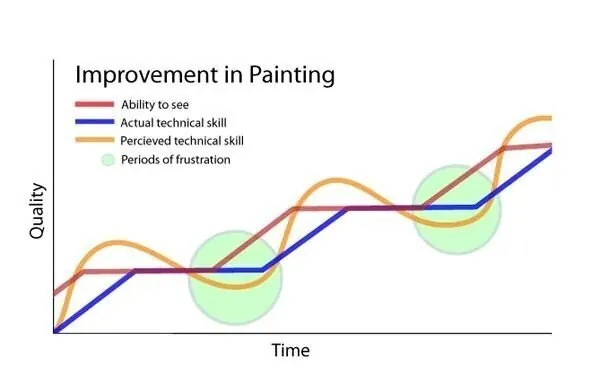
We've all seen this chart (or one like it):

Illustration by Noah Bradley

It's quite a good illustration of the rising and falling levels of confidence in our work. But I think it's missing something. It doesn't account for the quality of work we are producing.

If you were to chart the quality of your work, it would be a really noisy graph. While I wish technical growth was even close to as linear as that chart is, it at least generally does go up. Quality, however, is all over the place. One day you might make something great, the next day something terrible. You might make something that'll take you years to consistently get to that high level of skill. And conversely, you might produce something you'd have been embarrassed to have made years ago.

Nor does it really show us our changing perceptions of the work we used to make and how good/bad it was. This chart pretty much just reflect current perceptions. But we're all really bad about that and will compare ourselves constantly against who we were before and the work we made back then and how we think we remember about how we used to feel. That's a whole bundle of scattered feelings to take into account.

One of the struggles with doing art for many years is looking back on these massive fluctuations, false memories, and even our current feelings on future prospects. It's a special sort of misery to look back on art that I made over a decade ago and wonder why I don't make images that are that good any more. Or why my brushwork was so good back then. Or how my color sense seems to have gotten worse.

All of these factors, I think, can affect our confidence.

Confidence requires blind faith and naive optimism. An unshakeable—if unfounded—belief that we're doing the right things and that it'll all work out in the end. But with growing skills, a growing legacy of work behind us, and the inconsistent nature of creative work and the fluctuations that are inherent in our work, it's easy to have that confidence chipped away at, again and again.

How, then, do we build (or, rather, rebuild) confidence?

Getting better will help. Because, quite simply, success is a hell of a boon for a feeling of confidence. But it's not really prescriptive advice, because to get better we kind of need some of that blind faith that comes with confidence.

Sometimes I've tried to go back and do things like I used to. I'd try to imitate my old process as closely as I can. I'll even break out my old digital painting brushes sometimes.

Sometimes I try to do things totally differently. I'll use a new tool or process or something like that. That can, weirdly enough, break me out of the funk.

Sometimes I try to focus on just doing each fundamental step a bit better. If I'm finding that I lack confidence in some area of the process, I'll do some very-basic studies in that area. It usually feels like I shouldn't have to do thisbecause I should be past these things, but, inevitably, I take a step backward to refocus on the fundamentals and I end up more confident.

Sometimes I'll avoid looking at my past work or thinking about it (as well as I can). If past successes are haunting you, avoid them.

Sometimes I'll just do the work anyway, despite how I feel about it. Making art while you're confident is quite nice. There are fewer blocks between you and making the work. But you can still make the work even when it doesn't feel like you can. So push forward regardless of your feelings, doing each step as well as you can.

It ain't easy.

“Since you just worked through it, do you happen to have any insights working with chaotic scenery specifically, things to keep in mind, or problems you dealt with? I do a lot of forest-floor scenery, and refs are always a big mess of tiny sticks & debris. In my paintings, the focal parts are detailed, but the noisy underbrush parts always end up too lost and mushy—but Your noisy parts are mainly in focus. Even your main focal points have a ton of visual noise, but it still isn't competing with noisy areas directly next to it... To me, I see a lot of edge control, and I see places that you are creating tonal separation, and I feel like there's a lot of plane-simplifying, even though that plane is filled with multiple textures. Maybe you can expound on that if you're willing?”

— Clinton

Chaotic scenes are notoriously tricky, which is why you see most artists wisely avoid them. Because you can't communicate all of that chaos with just a few brushstrokes. These are the landscapes that I talk about sometimes that relyon details to succeed. Not all landscapes need tons of details—most probably don't—but these sorts do. But balancing focus and clarity between focal points and the rest ain't exactly easy.

I suppose the first thing that I try to do is, obviously, make sure that the entire image and value scheme is strong. A chaotic composition will not make painting chaotic detail any easier. We keep the overall value shapes as clear as we can so that we can go a little crazy within that arrangement.

The general approach with painting landscapes is that everythingis in focus. If there's detail everywhere, then the detailed non-focal-point areas won't be terribly distracting. But if you do leave some areas too squishy and not-detailed, then they will tend to draw the eye a bit too much. An essential element of painting landscapes is painting the boring areas well enough and detailed enough so that nobody looks at them.

Use texture whenever you can—you can get away with painting less if your brush is doing some of the work for you.

Look for the few key details. A tiny cast shadow, painted precisely. An interesting highlight. Often you'll see that what looks initially like "detail" in my pieces is not terribly well painted form but rather one or two well observed indications of something being there.

And then lastly it's just a whole lot of patience. Those chaotic scenes are not something I ever did when I was younger because I just didn't have the patience to endure it. Now I've apparently cultivated that skill in myself and I can devote the time to them. They're a fun little challenge for me because they're not particularly easy.

“What happened to old-school art from the ’80s and early 2000s? For example, in Magic and Warhammer, you used to see the iconic old-school art. Now it’s all been replaced with a more generic, brighter-colored, marketable look. Now not all of modern art is bad, their still a lot of beautiful and unique pieces. There is however a trend to change styles. Why do you think this is the case? Do you hope we’ll return to industries that value more unique and iconic styles?”

— Ethan

I see this complaint a lot—and I feel it a lot too. I often wonder the same things.

First and foremost, we have to acknowledge the skewing effects of simple nostalgia. It's the inherent bias towards the way things were when we fell in love with them. Or even if they came before our time, looking back with fondness on "the way things used to be." I'd say quite a lot of art is given too much credit simply because it's old.

Because, quite frankly, a lot of old fantasy/game art from back in the day was quite bad. Some of it is even awful. But its oldness makes it more charming than anything.

There is something so damn nice about it, though. A life, vitality, freshness, and vigor to it. A unique quality of cool-ness that too often seems lacking these days. So let me consider a few of the reasons that might've happened.

Some folks blame it on digital art. I think the critique is overblown—I can't tell you how rarely supposed "art fans" will misidentify a traditional piece for digital and vice versa. But there's still a bit of merit to it. The innate grittiness to traditional work isn't easy to replicate. And so for a lot of quick digital work, we're left with these overly slick pieces that don't have that gritty character of traditional work.

Sometimes it might be the drop in pay. Most illustration rates haven't matched inflation since the 80's. And not just to blame stingy companies other—there's just a whole lot of artists trying to get work these days. A drop in pay means artists need to crank out work more quickly. Quick work leads to safe work.

There's been a Blizzard-ification of nearly everything. I'm glad the Blizzard style exists but goddamnit, it doesn't have to be the only style. Same for Riot. I don't want everything to look that way.

I do think art direction is partly to blame. Gaming companies are trying to appeal to so many people now. In trying to make sure that everyone likes it, it tends towards safe, predictable, boring styles.

Too many artists are only looking at their contemporaries for inspiration. When gaming art got its start, those artists didn't have this massive pile of art to be influenced by. Instead, they were looking back to art history, they were coming in from other sorts of art. Now, I wonder if too many artists are just looking at their peers and imitating what they're doing. Everyone's trying to be like everyone else. Places like Artstation are hell for that. A good 90% of work I used to see on there was seemingly made by the same artist.

What do you think? Has art gotten worse? Why?

“How do you proper artists capture something that looks so real in the medium of paint? I imagine that a huge portion of it is a million hours of practice and refining your technique for years, but is there also a special technique or brushwork that makes that possible? Ever since I was a kid, I've always marveled at how artists make the texture of skin or marble or something look so real with PAINT—almost like it's not even a painting! Every time I hear about somebody using a spatula to smooth out their paint or something like that, I'm always like 'is that how they do it??' Thoughts?”

— Jake

Art's a bit magical like that. A great artist can paint something so damn real that it looks like you can reach out and touch it.

Sometimes the paint application is so precise and careful that even with your nose up against the canvas, you can't really see any brushwork. But just as often, the most seemingly naturalistic painting can be a jumble of brushstrokes up close.

Creating a believable illusion is pretty much the mundane—yet magical—application of fundamentals at a very high level. Drawing goes without saying; if something's poorly drawn, it'll never look quite right. Then it comes down to expertly observing and painting blobs of colors in the right place and putting the right edges on those blobs (this is especially key for conveying certain surfaces, materials, etc.).

That is, unfortunately, most of the magic of it. Those artists are just very, very good at what they do.

There area few tricks that can make original paintings a bit more striking. Oils, in particular, can be applied semi-transparently, so that light will bounce intoa painting and then out again, which can give some jewel-like effects to works. But you don't strictly need to use any sort of technique like that to make marble, for instance, look like marble. It just might help.

Paint application seems, mostly, to be whatever works for a particular artist. Some are chunky and bold, others delicate and tickling. Both work, as long as you're applying the fundamentals correctly.

“I have been freelancing for a couple years now and I struggle with finding time to meaningfully progress outside of work. I usually work 8 hour days, often more (freelancing, you know how it is) and I can't really take long breaks as I need to pay the bills. Learning while doing this is very challenging. By the time I'm done with work I am so exhausted and just want to hang out with my family or relax. Being a student was hard, but this is hard in a different way. How do you consistently improve yourself and step out of your comfort zone when you are a busy professional?”

— Oliver

“I’m feeling stuck: Have been freelancing for a while and thankfully, I got enough work to fill the gaps and earn some coin to pay the bills and maybe get some good coffee. Sometimes I feel I have superpowers and that I can draw basically whatever people throw at me, but it often happens that these superpowers die quite quickly and I hit a concrete wall a full speed with my mouth open and all my teeth fly away. Basically I’m unable to improve, unable to get some artworks to work, have to redo them and even then I feel I lack knowledge but I feel I can’t improve because I’m working all the time and don’t have enough energy to keep drawing and painting after drawing and painting for so long. So, the question might be, how did you handle this in the past? How did you get to improve when it was artwork after artwork after artwork?”

— Esteban

Thought these questions had enough overlap that I'm going to combine them.

It's a problem and a problem I know all too well. When I was grinding out freelance work, it was hard to find time for any other art in my life. Here are a few thoughts that helped me:

Try to attend some sort of weekly life drawing, plein air, etc. session (ideally with other people). Keep it on a schedule and make your attendance mandatory. Not a choice each week but an absolute requirement. Even just one session of life drawing every week will keep your drawing skills sharper and your thinking clearer.

Take on less work (and raise your rates?). There's nothing wrong, per se, with taking on too much work. In freelancing, sometimes that's just the nature of it. Good projects roll in, all at once, and it's damn hard to turn any of them down. But at some point, saying no to some of that work makes more sense. And sometimes raising your rates will do that for you—higher rates act as a nice filtering mechanism to keep an overabundance of work at bay.

Do one specific little study for each project. The more you can incorporate learning into your professional work, the easier it'll be. So for each new piece you work on, identify something that you're likely to struggle with. Maybe the lighting is a bit weird or you're drawing a type of tree you've never drawn before or maybe the hands are going to be really tricky. Whatever it is, before you set out, do a quick study of that thing to prepare yourself. It'll be a better study because you'll pay more attention and also use that knowledge almost immediately. And it will make your freelance work better too.

Always have a personal piece in progress. No matter what. It doesn't have to be completed quickly. Think of it as portfolio building, though. It'll help to keep you sane and give you a place to keep pushing yourself. It was always when I neglected personal work that I realized I was heading straight for burnout.

Teach a bit. People shit on teaching a lot but it's a perfectly reasonable way to make money. And it'll teach you a lot by forcing you to understand what you're doing and perhaps also give you an excuse to do more studies yourself.

“How do you find motivation to do stuff when it feels impossible to do things?”

— Edd

It feels like that a lot. Despite all evidence to the contrary, I've always been a procrastinator, an avoider, and generally a slow and demotivated person. There are flashes and moments when that's not the case, but it's been the general trend. I don't really enjoy being that way or what results from it, so I tend to do whatever I can to fight against it.

I do everything I can to trick myself into doing things. The usual tricks. Some of them work for me, some of the time. I try schedules, timers. Minimum amount of time that I'll be working that day, rather than counting the results. I'll work with somebody else. Streaming used to work for me well in the past. Even recording my art-making sometimes succeeded. I'll make promises to others—financial ones worked the best. If someone has already paid me for something, I'm probably going to get it done (if, perhaps, not quickly). I'll sometimes remind myself that I'm going to die someday and I shouldn't waste my life like that. That's a good one for a kick up the ass, from time to time.

Mostly I rely on stubborn persistence. I often don't feel like doing the work. Don't assume that every time I sit down to paint, I'm antsy to get started. Man, when it happens, it's amazing. But most of the time it's just sitting down to work.

So I guess I treat it like a professional, in a way. The feelings are there, good or bad, but the work still has to happen. Because in the end it does matter to me to have done the work. If I don't get to look back on what I've done with pride, then I'm not very proud of myself as a person. So I'm sticking to this dogged discipline as an investment in my future joy, no matter how I feel today.

“What is your opinion of the book: 'The French Art of Not Trying Too Hard' by Ollivier Pourriol?”

— Scott

Ok I'm going to try to answer this without reading the book, which feels kinda wrong but I'll do my best.

I'm quite fond of working hard and also of not trying too hard. I read and enjoyed The Inner Game of Tennis a while back, which seems to suggest a similar approach to learning and performing.

I think my critique is that from what I've seen and experienced, the flow-y, nonchalant approach to learning and playing and painting and everything else is best accomplished after and in conjunction with working very hard.

My art and career has tended to be a happy mix of binging work, obsessiveness, trying-too-hard, and then, blissfully, going with the flow, relaxing, working when I feel like it, and accepting whatever comes. These two have taken turns in phases and things have generally shifted from trying very hard in the beginning to trying to relax a more nowadays.

But I'm glad that I worked so damn hard when I was younger. That intensity and devotion paid off and I'm still reaping the rewards. Maybe it's a matter of temperament, but I don't think not trying too hard would've worked well for me back then. I was already too inclined to laziness and procrastination. Encouragement in that direction, even for noble reasons, I think would've been a poor choice for me. I needed to work hard, for a while. I get to work less hard and try less now because I worked so hard before.

I'm sure the book makes a better argument for these things than I'm giving it credit for. But I do like the notion of it. I agree that too many people have a death-grip on trying hard and working themselves weary in a vain effort to get somewhere faster. But I think there's a lot of merit in working hard, still.

“Which one of your old pieces for MTG do you like most, so that you would not chance anything about it? Do you have such a piece?”

— Franziska

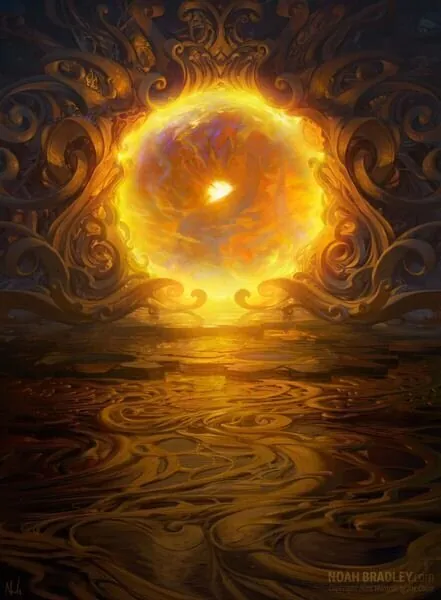
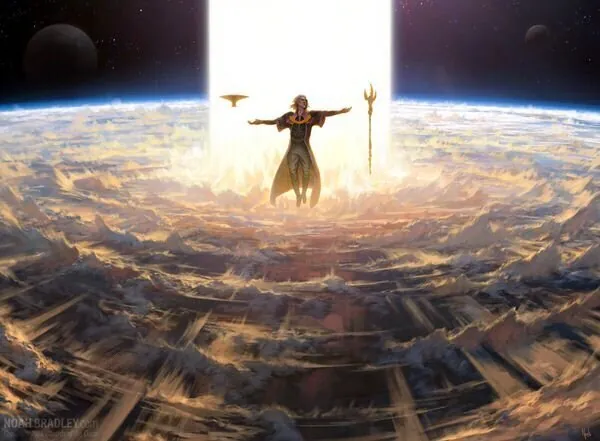
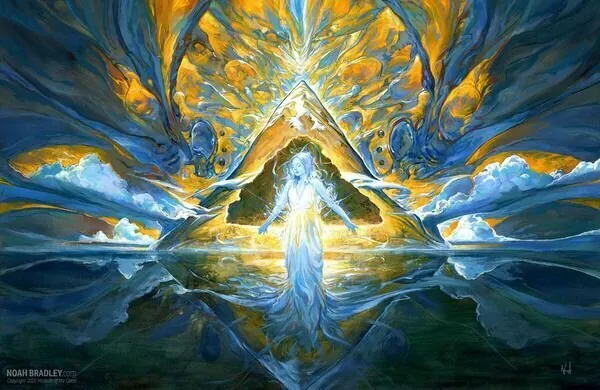
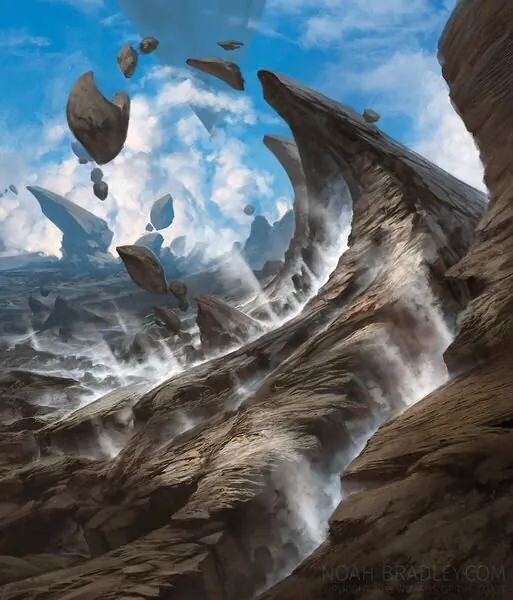
Of the 127~ paintings I did for Magic: the Gathering over the years, there are just a few that I consider truly fantastic pieces. A few times it all came together and I made something I'm damned proud of and I still think is really strong today. There's a few pieces here or there that might also fit into this position, but these are all definitely in:

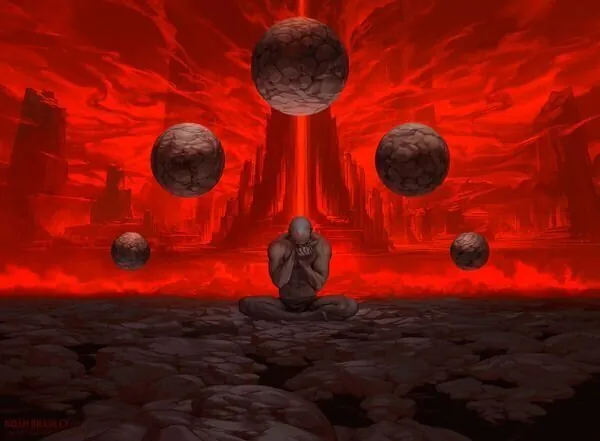
Doomsday by Noah Bradley

Extraplanar Lens by Noah Bradley

Urza's Ruinous Blast by Noah Bradley

Song of Creation by Noah Bradley

Steam Vents by Noah Bradley

Winds of Abandon by Noah Bradley

But even though these are some of my best paintings for Magic and I think they're great, I would paint all of them differently if I had to repaint them. There aren't any pieces so wholly perfect that I wouldn't redo at least some part of them. Perhaps that's a sign that I've grown as an artist or perhaps it's just the way art is—we're never totally satisfied with just about anything that we make.

“How do you push past fear when it comes to artwork? For instance, I’m currently working on something for the first time in weeks. I keep finding myself afraid of doing something with my own artwork. I’m not sure if it’s fear of failure or fear of drawing/painting horribly. Growing up, I was the “talented one.” I also write and play music. But I gained attention that way without trying and I suppose it caused me to have this fear of not living up to what others expect of me as the “talented one.” What if I mess it up? What if it’s not the same quality as some of my other work? What if people don’t like it or the changes in my style? There’s just so much fear there and it’s partly responsible for my recent art block. Is there some way to help myself get over that fear or at least a way to manage it? I don’t want to be stuck and unable to create simply because I can’t shake this fear that I’m going to somehow fuck it up.”

— Jordin

Rachel and I were both "talented" kids, so we can definitely relate to this. I was a precocious child and did well academically. I was not, perhaps thankfully, too remarkable at art at a young age. But when I started to take classes and treat it more seriously, at about 15, then I started to stand out. And then at 18 I decided to pursue art with the intention of it being my livelihood. From that point on, the fear really settled in.

For the next few years, the fear was centered on whether I would fail or not—whether I could really make it as an artist or whether I would be a sad failure. Once I achieved some amount of professional success, the fear became more about producing bad work. My worst pieces were ruthlessly criticized and any attempts to branch out or work on my weaknesses in any public way were similarly scolded. I felt a need to onlyproduce good pieces, which left my work to stagnate in an area of "good" for far too long, not experimenting or pushing hard enough to really grow much. Since my cancellation in 2020, the fear has been that I will never achieve a modicum of my former success, that I am wasting my time by still pursuing art, that I'm now and will always be a washed up has-been who is too delusional to just quit and find something else to do with their life.

But still, somehow, someway, I've made art in all of these times. Fear has been my odd companion through all of it.

At its best, fear has motivated me. At its worst, fear has almost crushed me. Sometimes I've tried to ignore it, other times I've tried to use it as fuel.

But no matter the role it takes, it doesn't seem to go anywhere. I feel, constantly, the pressures and anxieties of what I'm doing or what I should be doing. I question and second-guess everything. I fear the backlash and irrelevance and a slow diminishing of my career moving forward.

So if it's not going anywhere, I guess I'm learning to live with it. I do what I want to do despite the fear. I don't always succeed to move forward while fear is hounding me, but I do it often enough that I'm still going after all these years.

It requires the presence of mind to notice feelings for what they are. But if you can successfully see those feelings, you can learn to live with them. To work alongside the fear. I still wish there was a better way—some way to not have this fear—but I don't think there is. There's just learning to live and paint alongside it.

“I wanted to hear your thoughts on the practical usage of metaphors and symbolism in visual media, particularly when designing for games/movies. I was at first quite dismissive of these ideas, thinking that anyone talking about "hidden meaning" or about how something "feels" were just engaging in phony intellectual play and making connections where none exist. However now, after listening to many of my favorite designers, I feel like I've completely gone the opposite direction with it and see it as a vital consideration to any creative work. The book "Metaphors we live by" , by Lakoff, was particularly persuasive in altering how I looked at communication in general, visual art being no exception. And while I didn't find any visual-art specific explorations into the subject, I found enough carry-over information from things like the Writer's Journey ( And work by Joseph Campbell) pertaining to the entertainment industry/story telling. So at this point, I do believe that this subject can play a strong role in what we do. However, I didn't even hear about it in these terms until after I graduated and worked a few jobs. I stumbled upon it almost by accident from watching a workshop by Mike Hill about designing for Hollywood. And I do believe everyone incorporates it intentionally or not, at just about every stage of design. Sometimes fundamentally by altering the form of the subject to evoke particular feelings ( shape design ), or picking particular colors or patterns to form associations with emotions or purpose, and so forth. Even the way things sound and move can evoke feelings or elaborate some further information on the subject, and those things must be then supported by the visual design. To cut it short, I'd like to know how you look at this subject, and if/how you go about incorporating it into your work. Part of me worries that perhaps I am attributing undue value/depth to it, or that it doesn't need to be formalized in any way for it to be incorporated.”

— James

I think a lot of it is overblown, but there's merit in doing it anyway.

I guess I see it a bit like grids in graphic design. Grids are great! They instill a subtle order to your design and help to make it cohesive. But also designers get way, way too into grids and into the specific mathematics and proportions of them and I think attribute too much to them.

It seems the same for metaphors and using specifics colors and all that other stuff. I don't think that it's going to make your work particularly profound—but it does mean that you're thinking about and considering what you're doing and trying to instill certain feelings. And even in trying to instill those feeling, I think you've already partially succeeded.

Any basis these things have in us I suppose is a bit like a shared language. There probably are some conventions we can all agree on and those might help us to make better art. But I think the effect is going to be fairly small and you can safely ignore or embrace these things, depending on where your whims take you.

“I have been looking into building a website for showing and selling my art. With all the website builders out there it has been overwhelming trying to figure out which one to go with. I know you own and run multiple sites, what do you do for your websites? And what are the most important things you've learned while running them?”

— Andrew

I've used Wordpress for many years now and most of the sites I've ever made have used that. I don't know if it's the best option right now but it certainly works.

I use Shopify for my store. Again, sometimes it doesn't feel ideal—but it does what I need it to and works fairly well. I tried some other options in the past but they were a bit too buggy or didn't do what I needed them to do.

I also really like Payhip, which is what I use for ref.pics and some of my other online stores. It's less good for selling physical products than Shopify, but it's great for selling digital things or even physical things if you're not selling a ton of anything.

Whatever you do, avoid using a platform as your portfolio (at least without using your own domain name). Domains are cheap and if you're serious about all of this stuff, you should do whatever you can to cultivate your own presence that you control. I had a pretty big following on artstation but then I was banned. You never know when things like that will happen. Social media sites and platforms die all the time. Better to have your own domain so you can move to a new platform as the need arises.

“I've been working for a while, even studied animation and everything, but I don’t live in a country where there are actual industry professionals doing art classes or workshops or anything and my education was pretty poor. Basically any youtube video has been better than most of my education. Because of this I feel I lack that professionalism, I feel I need proper education or professional mentorship to get where I want to be. But I don’t have the means to obtain it due to my geographical and financial situation. What do you think of this? Anything you would recommend/advice or think would help a third world fella looking for a 'Professional Push'?”

— Esteban

Well thankfully the stuff available on youtube these days is excellent. It's amazing the amount and the quality of education out there. When I was starting out there was pretty much one company who made DVDs of a few artists showing their techniques. But now there's so, so much.

But I get it, it can feel like it's not enough when there's even better stuff out there. There's great classes and teachers and workshops and all sorts of awesome things out there. You can get mentored by killer artists! That's incredible. But not cheap. And, hell, I get that. It's damn hard to afford and even worse when currency differences make it even worse.

So I think the thing I would suggest for anyone who feels on the borderline but unable to afford any options that might help them break into being a "professional:" start just being a professional on your own. Start making stuff! Professionally. Make a game, paint covers for books, work with some friends and put together a collection of work. Design the concept art for a whole world. Aim to make money with it because that will push you to make it better.

The goal is not to have this project be a tremendous success, though it might. It's to teach you. And you'll find out mighty quickly if your work doesn't stack up to where it needs to be.

Beyond that, I think getting involved in smaller online communities is your best bet. Try to find a few other artists who will push you to be better. Discord communities are probably your best bet for finding people like this. It won't be easy to find but it will make a huge difference. I was luckily invited to a small critique group of illustrators when I was just kicking off my career and they were an amazing influence on me in my early years.

“Does our taste as artists hold us back in some ways? And by taste, I mean the informed aesthetic that all artists develop through the process of studying and consuming art. When we look at art, we’re approaching it with an informed eye. We can often assess the genres/illustrators who influenced the composition, colors, rendering style, etc. And through that taste, the artist seeks to innovate, rather than copy. Or at least leave their own unique stamp on a work. The sketch you and Rachel shared with your family has far more personality that the AI image they ultimately chose. But to the average viewer, the AI sketch may look more like a “product” to them. Generic art they would see on a shirt in Target or Walmart, but with a customized theme. Maybe the average consumer doesn’t want our personality and tastes. All of us have countless stories of giving a client an awesome piece of art and the feedback can be distilled to 'this is too cool. Can you make it crappier?'”

— Gerimi

Yeah, probably.

I think that's the case with just about anyone too far into a pursuit. The sort of people who are really into something rarely have the same taste that strangers to that thing will have. The guy who's super into music will probably be into some really niche bands. The person into fashion will eventually start dressing obviously like a Fashion Person.

I think the reason is two-fold. First, as we become familiar with an art form, we become very used to seeing the same sorts of things. After seeing about ten thousand drawings by teenagers copying some photo of a celebrity or an eye or something in graphite, it gets really boring. We know that drawing, we've seen it before, so we want something different. After a couple decades of looking at art intently and constantly, it's going to be rarer and rarer to come across something new and delightful. So we end up down these esoteric rabbit holes and everyone is confused why we're down there.

The second reason is that only the practitioner is analyzing the merits and faults. The flaws drive us crazy and the merits impress us. But most people just look at a thing and think "that looks nice." I know this is true. I listen to music and if it sounds good to me I keep listening to it. I know absolutely nothing about what's going on or how technically good or bad any of that music is. I just know I like it.

A friend remarked to me about this one time and it always stuck with me: customers at conventions aren't coming by and critiquing your drawings—they're just gonna go "oh shit that's a cool dragon."

I don't think there's anything wrong with lacking taste, necessarily. We don't need to be highly sophisticated in everything we consume. But also we should keep making the best work we can. While, perhaps, if we care about things like success and money, make them appealing to tasteless folks too.

“What’s your opinion on comic art? Would you ever consider being a part of a project for a comic? It being a cover or being a part of the story? Writing?”

— Ernesto

Love comic art. I've gone through several phases where I thought that making a comic was an awesome idea and I should totally do that. But it never panned out.

The problem with comics is that they take a tremendous amount of time. I am in continual awe at the passion that comic artists pour into their work. They might put months into painting a single comic that I can read in one sitting.

I think it's that investment that I struggle with. I'd love for it to exist, but I don't think I would actually enjoy doing the work. The same goes for a lot of types of work and artforms. I love them. But I don't think I would love doing them. I make the work that I quite enjoy looking at and that I also have a good time doing. Unfortunately, that's not comics.

I could see doing a cover for one or commissioning an artist to do one or being involved in writing one, but none of those have happened (yet). But you never know what the future will bring.

“I would love to hear you talk about purpose in art. So much of the online content focuses particularly on art needing to bring in income, or needing to progress endlessly, but can it be a purpose in and of itself? Is joy enough of a reason, perhaps even the truest and best reason, to make art?”

— Zachary

I wish art was more of a normal, fun hobby. It's perfectly fine—and often preferable—to just enjoy making art for the sake of it.

I do think that most people, even doing it as a fun hobby, will want to get better at it, though. I think that's part of the joy of any hobby. I don't think very many people are going to get into cooking, for instance, and never try to improve or try new things. The growth is an essential part of the journey. It doesn't mean you have to have aspirations of being the best or making loads of money or anything. But learning is fun, or at least I think it is.

You might get to a point where you don't care about learning more and that's ok too. Maybe you arrived at a point where making art is fun and that's all it needs to be. Congrats. You've achieved a level of satisfaction in your work that I rarely see in professional artists (myself included).

I talk a lot about getting better at art and making money from it because I'm interested in those things and those who read my stuff are usually also interested in that stuff. But it doesn't mean that's the only way.

I think it's the same in just about any hobby. There are some shitty people who try to gatekeep the whole thing. But you'll usually find the people are truly committed to the pursuit just want other people to experience some of that same joy. Gym rats are excited to see newbie lifters. Black belts love seeing people try out martial arts. And artists love seeing people pick up a pencil and try to draw something.

“How to prioritize creative projects? I have game art as a job, personal pieces as ambitions, boring practice for artistic growth and a bunch of non-drawing aspirations. Often I obsess over a single thing, that others suffer. Do you schedule your different projects daily or go with the natural flow? I know myself perfectly well to understand I won't do half of them.”

— Oleg

I'm slowly learning that a part of adulthood is always feeling like you're failing. Even most tremendously productive days, if I actually sit and think about it, I'll feel guilty about all of the things that I didn't do. The annoying thing about doing things is that it means you're not doing other things.

Sitting with that discomfort is the best (only?) thing to be done. When you accept that it's just a feeling and it might always be there and you can do anything you'd like despite that feeling, suddenly it all feels more alright. Yes, you're going to drop the ball, but that's ok. You're always dropping them. And you always will. And so does everyone else on the planet.

I use whatever tricks I can to squeeze as many of my priorities as I can into my days. I do most things with Rachel—so my marriage gets the time it deserves. We listen to books while we paint, so I get to read as much as I'd like. I try to focus towards one Big project at a time so I'm not just wandering from whim to whim.

Sometime if I do need to squeeze in a few different projects on the same days I'll try to block out time for each of them. I find that an hour a day, for instance, of dedicated work on each project will give you plenty of time to make substantial progress. It's not the same as wholehearted devotion to one project, but it's not bad either.

Stack up your priorities, focus on the cornerstone ones that you need to have, and then accept, fully, the feeling of failing at everything else.

“At what point did the focus of your work transition from a technical goal, (i.e, how can I get this shading/color theory/form/anatomy/etc to do what i want) to "what am I saying in this picture or what am I trying to express or achieve beyond the technique?" Do you even think that way or create a picture and let the subconscious tell the story and interpret in retrospect? If you do think about those things, where do you want to take your art next from a philosophical standpoint? What are you trying to convey? Or is this all just art critic bullshit nonsense talk?”

— John

I suppose it has shifted as I've gotten better, though it also seems to go back and forth. Sometimes the technical becomes the focus once more, only for my skills to improve and open new doors of opportunity with my work—which leads to new ideas and newfound purposes for my work. And then in exploring those ideas, I run into barriers that prevent the work from living up to its potential. Sometimes the ideas far exceed the results and I must, once again, joyfully return to the fundamentals.

It's always been that way. At first, there's nothing. So you learn to draw a few things and that gives you the tools to draw those things. But then you realize that doing those same things isn't all that rewarding any more and you've got ideas for something else. That endless motivation to push the boundaries—technical and philosophical alike—is what seems to keep us going.

Sometimes I set out with an idea or a story in mind, other times I let the piece evolve from purely visual roots. Obviously with illustrative work I'm set with more stringent parameters, but with my own work I tend to vary it between work that has a destination in mind and those that are explorations. All routes have produced good results for me over the years.

As far as the philosophy or purpose of my work, I muse on it from time to time but it rarely has much effect on my day-to-day art making. It's interesting enough to ponder but tends to feel too self-congratulatory for my liking—artists too easily overestimate their own significance. And why I make art rarely helps me make better art. If I make the work, the purpose often sort of emerges from the big pile of creations. Getting to where I am now feels pretty linear in hindsight—but I know it didn't feel that way when I was in it. It was just trying to make art and keep going, which is what I'm still doing now.

“Have you ever painted a naked human body before? If not, what kind of paint do you think would best suit the medium of human skin?”

— Jacob

I have, actually. Never anything like my actual paintings—mostly just abstract designs and things like that. But it's still a very interesting experience.

Probably the nicest stuff I've used was from Snazroo but I've also used other body paints (and even just regular gouache one time?). I'm hardly an expert, though. I guess just make sure you're not using nasty chemicals and toxic pigments and you'll be good. Getting the right coverage was always one of my bigger challenges painting on skin. It just takes a lot of paint.

“I know this question may have been answered before, but do you set a time and a schedule for when you work and do art? Or is there a different tactic you use to continue making art. Since it’s a hobby for me instead of a profession it’s hard to continue drawing when life piles up. Any advice would be appreciated. I try to keep it light-hearted and fun but also it’s difficult to push myself to see progress when progress feels so slow.”

— Ian

I don't have a schedule right now, but I've done so in the past—and sometimes even with great success.

If you want to see growth in your work, art needs to become a habit. The more inconsistent your working schedule, the more inconsistent will be your results. You'll still learn, but much slower I think. You don't need to be strict with your schedule, but if you can work every day for a bit of focused time, you'll see the fastest results. Or even every other day. Even once a week is alright, especially if it's just a hobby for you.

I've tried just about everything to get myself to work as much as I'd like. Some folks don't seem to need systems to work—in fact some people get judgemental about people who do. As if finding it challenging to focus is a sign that you don't really love making art and you're not cut out for it. I think that's nonsense. I think at this point I've shown that I am cut out for art, yet even I still struggle to work like I want.

I think the best system I've found is this: a combination of accountability and a required number of hours per day. It's strict enough to get me working but loose enough that I can go with the flow. The accountability comes from me doing this with Rachel. When we're both committed to doing the same amount of work each day, it's a lot easier to stick with it and get a lot of stuff done. That's harder to do, of course, when you're on your own. But if you can find an accountability buddy online, even, you might find it easier to stick with it.

And then it's just a matter of doing the work. Lately we've found that roughly hour-long sessions are working for us. We've tried shorter (and sometimes as long as 2-hour sessions), but we seem to have landed at about an hour and that's working for us. Audiobooks are really, really, really helpful for us. Partially because it makes the process a lot more enjoyable but also because we both feel guilty if we want to pause the audiobook and take a break—because it means interrupting the other person. So we both just tend to get on with it and do the work.

I'm often envious of folks who can maintain a strict and rigorous schedule. But after a couple decades of making art this way, I should probably admit that I don't do well in an overly structured environment.

“Does size matter? I’m working on a Cintiq 16, and I often feel I need more room, not that much resolution or anything, but room to draw, like I want to draw zoomed out and not zoom in while drawing, but the area feels small when I do that. So, do you think size matters? Smaller tablets get the job done, but like speaking of “quality of life” or improving your workflow, would a 22 or 24 inch bad ass drawing screen improve my workflow in any way? And should I betray Wacom? I have a 8 year old Nukeproof Wacom Cintiq 16. It’s fine, it gets the job done and it has been a good companion but is somewhat small and the colours are shit, you can’t get a blue to look good on it, let alone anything close to white or black, the contrast is completely fucked up. Thing is Wacom is now nuts, extremely expensive unaffordable models if you want a decent upgrade, and even then, lots of problems have been reported with their tablets. Have been looking into xp-pen and you get a high end drawing tablet for a third of Wacom’s price. Do you think is worth taking the risk? Like, I’m so used to Wacom that I feel a cheaper tablet might feel cheap or might not be durable or work as expected, but now I feel Wacom is just overpriced and I feel really tempted on switching, specially with my budget. I can’t spend $3.000 on a drawing tablet, but I can totally save to get a $1.000 in the future, but I don’t have a “professional advice”, most reviews on the internet are just youtuber videos.”

— Esteban

I guess this is technically two questions but I'm going to answer both of them because they're pretty similar.

First I'll discuss size. I think you should work on the biggest, best screen that you can reasonably afford. I don't think you need it and I reckon some artists benefit more from larger screens than others, but I think there's a lot of value in being able to see your work bigger. Now: that doesn't have to be the screen you're drawing on! This could be just a regular old monitor that you display your work on. Or maybe you get a regular old tablet and you just work on a tablet. That's generally a lot more affordable than the display tablet route.

I've worked on all sorts of tablets and, honestly, some of my favorites have been cheap, shitty ones. I started with a Wacom Graphire and loved that thing for many years. And then one of my other favorites was a shitty Bamboo tablet in the smallest size they sold. It served me well for a long time. But even then, I always tried to invest in good screens or monitors on which to view my work.

So I'll say this: if they made a 40" display tablet, I'd buy it in a heartbeat. But I'm also a big-screen junkie (my current monitor is, in fact a 43" beast). So your mileage may vary.

Onto the next question: Wacom or all of the other tablets. Personally, I'd ditch Wacom in a heartbeat. I've been on my Huion for the last few years and I swear by it. It's excellent, well-made, and in some ways feels more premium than a comparable Wacom.

That said, I've also (briefly) tried an XP-Pen. They sent one to Rachel for her to do a review of and I took it for a spin too. I was... not impressed. It felt a little too clunky and cheap. I sure wouldn't buy one. Nowadays Rachel is using a Huion as well.

“It's often been said that if you can draw a cube, sphere, cylinder, and a prism, then you can draw anything. Do you think that you can draw/paint anything that you'd like, given enough time and effort? Or are there still things that even you cannot or find very difficult to draw? For a bit of context on this question, a few years ago before you went through your concentrated figure studies, you mentioned that due to your focus on landscapes and environments, your figure skills were not as strong. This surprised me, as I had always found the people in your art very expertly done and rendered. I had always assumed that perhaps there was some level of artistic skill where no challenge is impossible, because I imagine that if one has a high enough understanding of perspective, shape, color, form, etc, they can see and translate the world into those things and put it onto the page. And if anyone had attained that level, I assumed it would be you. So I was wondering your thoughts on that, I'm quite curious!”

— Justin

As usual: yes and no.

I think if you can paint something well, then you can probably paint anything else at least pretty well. Not great, but at least fairly good. Obviously this is all assuming you've got reference of the new subject—trying to whip up something you've never drawn before, without reference, is a recipe for disaster, no matter how good you are.

But you'll still have strengths and weaknesses. Like you mentioned, I was a good landscape painter and considered myself a mediocre figurative painter. That's because I put tremendous time into figuring out the intricacies of landscapes (light, color, composition, and the unique forms of landscapes) at the expense of what makes figurative work good (exacting proportions, gesture, anatomy, etc.). So while I could paint a figure better than a complete beginner, sure, I was relatively weak in that area.

So returning to the question on basic shapes and how those translate to painting more complex subjects: it's excellent practice and one of the best things you can do if you're early in your journey or looking to pick up a new medium. Because if you can't paint a cylinder convincingly, you're going to have a hell of a time trying to paint, say, an arm or a tree. Painting those basic shapes will teach you a whole hell of a lot about how to paint. It won't quite cover everything, but it'll get you pretty far.

Btw, if you didn't know: we've got photo packs of basic forms and shiny forms to study from.

“Is it really important to use your real name as a freelance? It’s really hard to start using your real name for art when you have been using a pseudonym for so long, so, do you think a pseudonym could kill a contract or make yourself uninteresting and unprofessional or is it all about the portfolio? I don’t think it matters much, unless it’s something very embarrassing, but the doubt has been striking me lately.”

— Esteban

This one makes me feel like an old man because it seems that more and more artists I see--particularly the younger ones--use pseudonyms. They hide behind their digital persona and that seems... fine! There was such a major push when I was coming up to be as authenticas possible. We had to put our whole selves out there. This really just led to different sorts of insincerity, but that was at least the public objective.

Sometimes I wish I had started with a pseudonym and stuck with one. Sometimes I wish my name wasn't so tied up with my work and online presence and all of the nonsense and bullshit that has come with that. It's too late for me now, but sometimes I'm jealous.

So I think a pseudonym is a great idea. I think if you're scared of it seeming unprofessional, just use a believable-enough sounding name rather than some username. Best of both worlds.

“What do you think about people going to art school and getting a Fine Arts degree, then going into an unrelated (and potentially more lucrative) industry while doing their fine arts passion on nights and weekends?”

— Jacob

I think it's great.

There's far too much emphasis placed on needing to make all of your money from art. Money is just money and honestly art is a damned hard way to make money. And focusing on that objective can even stymie your work, leading you to cheapen it for the sake of the precious dollar.

I think more artists should probably pursue other work and leave themselves the time to develop their art away from pecuniary concerns.

I wish there wasn't this strange sort of shame around it all. We all love to castigate ourselves for these sorts of failings, even though they're not failings at all.

Make money. Make art. Those don't need to be at the same time.

“Can you explain how it is important to not chastise oneself if one takes a breather from creating?”

— Robert

This felt like an apt question to answer after my 9 week hiatus from making art.

Extended breaks from art have been a part of my process since the early years of making art. I never excelled at consistency and at a certain point I guess I tried to find some benefits from that.

There's something about the time between learning and making things that does seem to help. A break without effort isn't really anything—that's just languishing without purpose. But in between periods of intense effort, a break can seem to help you make those connections. And when you return to your efforts, you tend to come back fresher than you left them. A bit more humble, a bit more playful, a bit more open and present to whatever might be happening.

All of that is a lot of justification for just, you know, not doing something constantly. But the guilt comes so easily. Hell, I feel more than a little guilty right now. As much as I'd like to avoid it, it's itching at the back of my mind. I planned to do art on this trip! I had the stuff! I could've made the time! Why am I slacking off so much! I should be working! Forever the criticism echoes on and on in my mind.

But in this marathon of art, a break won't kill me. I don't think it'll even hurt me. I think in the end it will help. It always has in the past.

“What are your thoughts on balancing inspiration and inspiring things with work? It’s easy to find yourself immersed in “inspiring” things like video games and Netflix series, but they all too often turn into unhealthy time sinks, when your true desire is artistic progression.”

— Zachary

This isn't easy to answer. Because games and great films/series are definitely inspiring! I wouldn't want to go through life never experiencing them again, so clearly they have a place.

But I do think that too often, for too many people, they become an unhealthy distraction. They go beyond merely inspiring and instead become a drain on your time. No longer are they a source of delight, balanced with hard effort. But rather a source of easy dopamine, sating our desires on demand.

So I guess it's another case of balance, but that balance has to be highly personal. I can't tell you how much or how little to do those things. Perhaps there's some ideal ratio of work to entertainment, but I sure don't know what it is.

My bet would be that most people would probably benefit from gaming and watching a bit less and working a bit more. There will be more than a few of you that could use to relax more, but I reckon you're the minority here.

There's also the factor of passive inspiration vs a more active inspiration. Relaxing with Rachel and watching a great show is highly passive and highly enjoyable. Going on a hike, say, is not passive at all, but it is highly enjoyable and inspiring. So sometimes we're all better off seeking those more deeply fulfilling forms of inspiration.

But there's nothing wrong with watching things and playing things. You don't have to optimize everything! Entertainment and enjoyment should be part of life and they don't even need to be particularly beneficial to us to be a delightful aspect of our days. Just don't let them take over, I guess.

“Do you think from a commercial standpoint, pursuing your own IP creation is the best route forward for artists? If so, have you wanted to pursue any further new IP projects yourself recently? I'm finding many artists such as myself who struggled with layoffs and job hunting are now turning to their own IPs and making things such as video games and animations.”

— Andrew

I think this is absolutely the best way forward for artists.

There has never been a better, easier time to get together with some other artists (or do it on your own) and make something amazing. All of the tools are there and there's tremendous demand for great stuff. With so many artists out there looking for work... get together with your friends and make something happen!

It's definitely something I've been tempted by and interested in doing. Right now I'm focused on projects that I can do myself—specifically, books—but I do daydream about other things like films and games and all that. I don't know if I'm the right guy to organize a bunch of artists behind a project. But maybe I am? I don't really know.

But I think if you have even the slightest desire to do something like this, you should. The worst case scenario is you end up making some great new portfolio work.

“Do you find that art helps you appreciate the world around you more? That you understand and appreciate trees or mountains or birds to a higher degree, when you have put time into their study and depiction?”

— Zachary

This is why I think everyone should do some observational painting in their lives. Not much, but some. Just enough so that they can depart from seeing the world as the things around them and begin to see them all as the blobs of color so familiar to artists. It's not that this way of seeing is any better or worse, but it is damned interesting and you will have, I think, a greater appreciation of the visual world for the rest of your life.

So yes, I think so. Art has brought me a tremendous love of the visual world and the figures and landscapes in it. Anyone who has ever been with me anywhere outdoors and vaguely beautiful can attest to this. I will squint at the clouds, take double glances at especially good rocks, and stare, inexplicably, at a mundane-to-most scene.

Additionally, though, sometimes it is being informed about a subject that helps me to appreciate it. I was rubbish at painting foliage for many years and then Rachel, a fan of jungles and thick foliage, challenged me to, you know, actually learn how to paint them. I studied their forms, found them fascinating in their own right, and now get a kick out of paying a little more attention to all of the flora when we're out hiking.

Rachel's latest kick has been birds, so maybe expect to see more birds in my future paintings?

“I wonder what part you would say that humility plays in the life and development of an artist? So much seems to be achieved by people with great self-confidence (whether genuine or not it’s hard to tell). When I visit art galleries and see traditional art many times I’ll think … I could do that! But I feel that I lack the commitment and confidence to choose an idea and invest the time and money on canvas and paint. (I’d love to do a big canvas painting textured with bold brushstrokes!)”

— Shams

You can't learn without humility and yet you won't go far as an artist without a healthy dose of self-confidence (and it's quite alright to fake that confidence).

Humility is essential. Artists without humility never learn. Why should they? To learn you must admit your work has faults.

But humility is easily taken too far into crippling self-criticism. You'll never make it, your work will never be good, of course this piece will be a failure because they always are. We need confidence—often blinder than it should be—to make our work even despite our failings and despite how badly a piece might look in the early stages.

Maybe it's why artists seem so conflicted. You need to walk that tightrope of humility and self-confidence at all times. I find that artists tend to lean to one side or the other and nearly all of the artists I know tend to lean towards too much humility. I do know plenty who have too much self-confidence but they will refuse to learn that and so I won't bother addressing their problems. Instead: generally assume that you should have a bit more self-confidence than you feel and start acting like you do. I think you'll find you produce work more happily.

“From an outside perspective, at least to me, all your work seems essentially flawless, though I imagine that all creators look at their past work and can see things that the audience cannot. Can you talk about some pieces of art that you've made in the past and how you would do things differently if you were to paint them again today?”

— Justin

The End of Sorrow by Noah Bradley

This sounded like a fun challenge. Artists always talk about cringing at their old work but rarely get into the specifics of what they would actually do differently. So I'm going to pick apart this piece of mine, The End of Sorrow. It was done around 2010, as I recall, and was one of my first "successful" pieces. It was accepted into the art annual Spectrum and was one of the pieces that jumpstarted my illustration career. And while I still like some things about it, I would paint it verydifferently now. Let's get into it.

The perspective is not very good. There's very little sense of depth and quite a lot of flatness throughout. It doesn't feellike the enormous space that I know I wanted to convey. Those indicators should be in the sky, the cliffs, and the foreground, but none of them are really there. Everything instead leans towards flatness.

The foreground is pretty boring. There are so many things I could have done with that area that I didn't. Instead it's just vaguely grass and extremely dark. Come on, brighten that up a bit.

The city/architecture is pretty half-assed. I'm still not good at those things, but I like to think I'd try a bit harder.

The colors are... fine. But they're uninteresting. There's so much more hue variety I could add to instill more life in the piece.

The composition is safe. I think it could be more impactful if it was bolder. That might've involved centering the monolith itself?

Nothing is painted with enough knowledge or reference. I should have looked at more actual trees, cliffs, fields, clouds. None of it looks terrible but it all could look better with a more informed approach.

That's about it. Which is really... most of the piece. That's generally the answer. Nearly everything about my older work could be done better. Progression is about doing everything a little better—and perhaps some things a lot better.

Sometimes I do think of actually repainting some of my older work. It's always tempting. I reckon at some point I'll do it for a piece or two. But there are always so many things I'd like to do and very little time to actually do it all.

“Do you believe in anything like manifestation and that woo woo stuff?”

— Katy

Hm, I'll say generally no. But I also gladly admit that I don't know everything! I'm a big proponent of mystery in life and realizing that us humans tend to vastly overestimate our own understanding of the universe. So I'm willing to toy with the possibility that there are a lot of things we don't fully understand.

Manifestation is actually an interesting one to mention because it's the one that I probably think has more merit than a lot of the woo-woo stuff out there. Not that I necessarily think you can attribute its power to any celestial forces at work, but there is tremendous power in obsessive, single-minded focus on one thing. If you are consumed be an undying obsession, that thing seems far more likely, to me, to manifest in your life. If you think about being an artist, obsess over it, are entirely focused with your whole being on being an artist, it might be more likely that you'll, in fact, end up being an artist.

Thoughts and actions play off one another. Changes your thoughts and your actions will follow—but sometimes one must take action to later change our thoughts. They're interconnected, it seems, and their relationship can be used to our advantage.

So yeah. I'm not particularly woo-woo but I do have scattered moments of being inexplicably understanding of some out-there beliefs.

“How do you manage to organize and arrange work, either freelance or contract job while taking 9 weeks holidays? Do you take your setup with you? Or do you take 9 full weeks off? If you take your setup with you, how do you manage to have a reliable wifi connection while on the run or to carry everything around?. I usually go two weeks at the time and I don't really get to relax as I'm always in such a rush.”

— Bea

I've done it all sorts of different ways over the years.

I suppose most of the time I try to just take the time off. This is quite a long trip for doing that, but I wanted to focus on the trip this time and, hey, I'm shooting a lot of photos down here so I'm kindaworking. But for most of the trips I've taken in the 2-6 week range, I like to be able to get away from work entirely. I usually could manage that even when I was full time freelancing (by working my ass off before and after the trip). I often found the total break from art a really powerful aid to my progress. Something about that much time away helped connections to be made.

Other times I've brought along a painting setup and done my work on the road. I've experimented with just about every mobile digital painting set up that you can think of. Some worked well, others not at all. If I had to do it right now, I'd probably take along a laptop and a little tablet. If I felt like lugging around more weight and could justify it, I'd probably bring one of the little Huion Kamvas display tablets. But just a regular tablet is probably good enough. I did a lot of my freelance work with one of the cheapest tablets that Wacom sold. I originally used it because my tablet broke the day before my deadline and I needed something—anything. But then I actually really liked that tablet. The fancy tools are nice but the cheap ones work pretty well too.

As for internet, that's tough. Reliable wifi can be hard to come by, depending on what you need it for and where you're going. As a safety buffer, I get us the unlimited data plan that allows tethering on Google FI. After years of buying local sim cards everywhere I go, it's nice to just land in new countries and not even think about it—my phone just works and, if need be, my laptop can also work anywhere.

Lastly, sometimes our trips are for work. We'll go out of our way to go to a new place just to work. Whether it's a new project or whatever, sometimes we'll spend nearly all of our days working, just in a different environment (and usually a better climate). That can be a great way to kinda get away, but also get a lot done.

So I'd say to only work while you're traveling if you need to or you really want to. Otherwise, just enjoy the trip.

“How do you go about planning a longer term trip like that? I saw where you said that sleeping bag will be your bed for much of the time over the next couple of months and that had me thinking about if I were doing something similar I wouldn’t even know where to begin. Of course you don’t jump straight from the average yearly week long vacation at an Airbnb or something to planning a multi-month trip that sounds a lot more freeform, but I’m just curious if you have any tips or what your thought process is for something like that? How you go about mapping/planning that out, hotels, car rentals, food, etc. Basically any advice or thoughts you have on the subject is appreciated.”

— Adam

The short answer is that I don't plan things very well at all. But here's a longer answer:

There are people who are very good at planning and those who enjoy planned trips. There's a chance I would enjoy a planned trip but there is no early way I could ever enjoy meticulously planning a trip. So I keep things fluid and build from there, but even then, there are some guidelines I follow.

First, the flight. Obviously. The flight dictate the length of the trip and a lot of other decisions follow from there. For my speed of travel, a 2 week trip is quick. 4 weeks is lovely. 6 weeks is an adventure. 9 weeks, which we're doing now, is very long indeed. Once you hit the 6 week mark, you probably want to start incorporating significant down time. For our current trip, I reckon we'll stay put in one place for at least a couple weeks, not to mention a spattering of lazy days where we're ok with sitting around, painting, watching things, and living a fairly normal life. All-out traveling, doing things, sight-seeing, hiking, whatever, is exhausting. It's energizing too, but it's exhausting. Eventually you'll want to rest.

Once the flights are booked, I figure out how to get around the country. I've tried a lot of different ways and it largely depends on where I'm going and the sort of travel I'd like to do. If you're in Europe, say, and you mostly want to see towns and cities? Use trains and buses and airplanes and your own two feet. But if you want to see nature or you're in a place with terrible trains/buses, then I usually like to get a car. Rental prices can be rough, but usually they're not too bad. I get the smallest car possible, as non-American roads tend to be tiny and I don't want to drive around a hulking beast the whole time.

I've also gotten around by hitchhiking, which is a fun sort of trip which, if you feel comfortable with, is worth a shot. Iceland and New Zealand are known for being friendly to hitchhikers and it's fairly safe, all things considered. I'm a pretty big guy, so I realize my experience of safety is very, very personal. But it's an option, if you're in the market for an adventure.

Then I start looking at a map. I like to put in a few driving directions from random spots to get a feel for the country's size, as I've been somewhat screwed over by that in the past. I think I had assumed, for instance, that Norway was a reasonably small country until I landed there, put in the directions for the first place I wanted to see, and realized I was a whopping 13 hours away.

I'll poke around Google maps, try to find interesting things to do, and start saving them as little pins on there. I'm pretty liberal with the number of pins I place. I won't go to most of them, but they give me a general idea of where the cool stuff is located. Sometimes I'll check out Wikivoyage for more overviews of the country. I'll also sometimes pick up a copy of Lonely Planet. Some of my first trips (before I had cellphone access in other countries), I relied on those books to get around.

I like to pick a general route that I think I'll take through the country. Sometimes I go clockwise, sometimes the reverse. I try not to backtrack much and just meander my way through the country this way. Some places just feellike they should be seen in a certain direction. Follow your gut.

With flights and initial transportation sorted, I'll book my first night's accommodation. I didn't used to do this but then I got screwed over and now I do it every time. I flew into Christchurch a year after their horrific earthquake. I had my Lonely Planet guide and had a half dozen hostels picked out as options. It was a half hour walk from the airport and I thought it would be fine. But then as I was walking, a storm blew in and I started getting soaked. I arrived at the city center to discover it cordoned off and abandoned. The entire city, where every one of my hostels were supposedly located. I didn't have a cell phone, there wasn't anyone around, it was getting dark, and I was drenched. Thankfully in my wanderings I found a hotel with one bed left and was able to reorient from there. But now I always book my first night's stay.

Then... the travel begins! I like to plan for either the next day or even perhaps the next few days—or at most a week. At least a general idea for where I'm going and what I'm doing. If something requires booking or reservations or it's limited availability, I'll book that in advance and work within those restrictions, but I'll avoid that whenever I can. I like the flexibility to rush past areas I'm bored with and linger in places that delight me.

That's about it. Start with something short and with an easy country (ideally one that speaks the same language as you). Take only what you can carry on your back. Get out there!

“Would you and Rachel consider allowing the other too add their dream to the other's vision? I don't recall seeing this done by you or her”

— Cates

We've done a handful of collaborations over the years, but we always talk about doing more. There's something really special and fun about working on a piece together. It's fun to see what changes and improvements they make while they're working on it. And it's also frequently a relief to pass off a piece that you're getting sick of and have the other person take care of all the parts that you were dreading.

In addition to outright collaborations, we also bother the other for paintovers and critiques and help pretty frequently. There's nothing quite like being able to get another artist's set of eyes on your work at any time. We are so often blind to what we're doing, both the mistakes and the successes. Helps to keep us both on track.

So collaborations remain in the "definitely do more of this" pile. Obviously with my intense focus on this landscape painting book, I don't have the room for too much other work. But perhaps on the other side of publication we can find more room for some collaboration.

“As someone who is largely project oriented I often find myself in a deep artistic rut after being unable to complete a very large scale project I've spent the last half a year on. I often feel this even after being able to complete a large scale project successfully. Do you have any experience with this? If so do you have any recommendations on how to pull yourself out of this rut and find your next project? Would you recommend studies and small scale projects such as single illustrations?”

— Andy

Whenever I find myself in a rut, it's usually a sign that I need to do something different. So if the long grind of big projects is wearing you down, some faster work might be nice.

I also like to set up some smaller goals along the way when I'm working on something big. That can be as simple as a daily goal of hours on the project. That way the enormity of a multi-year project looms a little less large. You just put in the time and, hopefully, progress is made.

But on the other hand, I'm finding the rut an interesting place to reside. There are many (many!) times that I will sit down to paint and not want to paint another damned landscape for this book. I'd love to do just about anything else. But, sure enough, I make another landscape. Another painting goes on the heap and I carry on. I'm finding that comfort and excitement in painting is not a requirement for good or even fulfilling work. Sometimes the uncomfortable grind is just fine. Maybe I'm crazy, but hey, at least the art is looking pretty good.

I think it's almost a requirement of commitment to big projects that you are committed enough to it to persist even when things get really boring. Because they inevitably will. There is no project that will continually excite you for years—at least they don't for me. There are always times that it turns into a grind. But still we carry on.

“I wanted to ask, have there been times when you were painting something and you got into a groove, and although it was past your 'bed time' (so to speak), you decided to push ahead because you knew momentum was on your side? I guess this could happen with any profession, sometimes you just get into the zone and realise if you kept at it, you'd get a lot more done than if you stopped and came back at a later time.”

— Sam

It's definitely happened. There's nothing like that state of flow. Art becomes a dream—engaging and productive and joyful in a way it isn't always. Those rare moments when you just don't want it to end. When things are going like that, I do what I can to keep it going. It rarely lasts long, though.

It also seems to happen to me less these days, which is something I've struggled with in recent years. Art-making seems to require more constant vigilance than it once did. Maybe I'm misremembering those earlier years, but I find that it's quite difficult to find flow states in making art. Now it mostly happens in: life drawing sessions, plein air painting, and oil painting in general. The notable trend there is that there is something physical going on, usually, working in traditional media. And also usually some amount of time pressure. Digital work is an endless effort with no clear beginning or ending. You can pause at any time, return to work at any time. But with those other things, I find I'm much more present and more likely to enter a state of flow.

It could also be the challenge that I find in those things that makes them so engaging. I talked about that in another newsletter recently but I find with the growth of my skills that some of the challenges in art have shifted. I have to find other, more interesting problems in art-making to really capture me. When the basics are covered mostly subconsciously, you need to find other ways to push yourself. But sometimes we fall into that comfortable slump of making easy art—but easy work does not lead to flow states. You need sufficient (but not overwhelming) challenge if you're to find flow.

“I saw your Midjourney sketches and wondered what your process is. I found your YouTube video about it, but it’s from when AI produced weird-looking results. Now that it makes far better images, I was wondering how much of your sketch comes from Midjourney and how much comes from you. I’m sure you are not just tracing an AI image and calling it a sketch.”

— Matteo

I haven't touched Midjourney in quite some time. It's not what I'm interested in right now and doesn't have a place in the work I'm making.

I actually think that the improved images are part of the reason that I lost interest in it. I think it was those weird-looking results that I loved about it. They were right in some ways and so totally wrong in others. And that was great! It sparked imagination in weird and wonderful ways. How could an AI image somehow convey the tonality and brushwork of a Sorolla without any actual good painting? I don't know, but somehow it found a way.

The wrongness and abstraction lent itself to letting my mind (or an artist's brush) fill in the blanks.

Now that the images are better, I find them less fascinating. Some of them are good—hell, I follow a couple AI "artists" on twitter. Some of them produce some pretty interesting images. I don't know that I'd call them artists, but I'm not ashamed to say that I find the images interesting and even inspiring at times. Cool stuff is still cool, even if perhaps it's not really art.

Depending on where AI images go in the future, I could see using them in my process again. But if they end up converging into this mono-aesthetic overly-perfect image creators, I think they would be too boring to really find much use for.

“I wanted to ask how you manage your time to balance rest, family, and personal projects. I often find myself either working too much or not enough, and I’m trying to find a better balance. I recently came across a video where an artist mentioned that the best time to work hard is when everyone else is resting. What’s your take on that? I’d also love to know what your average schedule looks like, do you work on weekends as well? P.S. I’m currently focused on building my portfolio, and I imagine your answer might depend on the stage of life you’re in.”

— Bea

I've never been very good at balance. I've usually gone too strongly in any particular direction, but I guess that's worked for me. I work in obsessive sprints, take time off, and hit things hard again. I try to always be doing something, but even that doesn't always happen.

I've never really done weekends, at least not strictly. I take days off, but they're sporadic. And hey, weekdays actually make the best weekends. Everywhere is less crowded when everyone else is working. Highly recommended.

I've tried just about every schedule over the years. I was a nightowl when I was younger, doing most of my painting after 9pm. I've also woken up as early as 2am to get to work, seeing the sunrise only after hours of work was behind me. Now I wake at 5am and only slowly get to work after coffee, reading, and the gym.

The more I can overlap my work/life activities, the more time I've seemed to have. If I can paint and listen to a fun audiobook. If I can paint and hang out with my wife. Those things help. Stack up some of your activities and you'll get to do more of those things.

All of this said, your current situation is particularly relevant. Because it's the earliest years of a career where I'm tempted to recommend an unhealthy work/life balance. If there's any time to invest more into work and less into life, it's in the early days. The investment made now pays off exponentially later. Art has a brutally steep barrier to entry and you need to break past that barrier if you want to coast. I can only comfortably take things easier now because of how damned hard I worked when I was younger.

That's only if you need to be a professional artist. I felt when I was younger that I needed to and I suppose I'm glad I did. But if you don't have that undying need, you might be happier just... going at whatever pace is comfortable. If you have a non-art job that pays the bills and leaves you the time & energy to make art, that's not something to be ashamed of. It's pretty great.

“Oh man, that tweet really hit home. Not because I've had my precious vase shattered like you, but because, on reflection, I've spent my entire adult life trying to craft one. In my mind, there's this "before and after" vision of myself: One day, I'll become this upgraded version 2.0—successful, fulfilled, socially cool and confident. But I can only assume that, if I were to attain such a self, I too would be carrying all that tension/caution. I'd just have too much to lose. Which brings me to a question: One interpretation of the tweet is that the author is "gatekeeping" peace of mind—suggesting that trauma is required to truly understand that what we're chasing (external success, validation) lacks real substance and can't fill our insecurities. Do you share the author's cynicism? If you could go back in time, do you think you could convince your past self to let go of all the ego-driven ideas that make up the "vase"? Would you even want to (i.e. maybe it's okay to carry around something we perceive as precious)?”

— Simon

In case you missed it or forgot, this is the tweet in question:

[Illustration by Noah Bradley](https://x.com/sashachapin/status/1865558631405752393)

I often wonder if I could have learned what I've learned without the hard things I've been through. I'm not sure that I could have. Maybe.

People change and grow and learn and perhaps, maybe, with enough self-reflection and reading you could perhaps come to understand these things. I reckon some people could do that. But I don't think I could.

There's a weird catharsis in watching your life crumble. It strips away everything. Eventually, when you lose everything, you're just left with yourself—the strange consciousness riding around in your body. The facade of identity you've built around that reality vanishes. You realize it was never real. That the people you were interacting with weren't who you thought; you were experiencing their facade as well.

Maybe you can realize this without enduring it. I reckon there are ways to become that self-aware. Drugs might help. A lot of meditation, enough to lose your identity, might do it. Before my cancellation, I was already starting to figure out some of those things. I was burned out on art and the shallow, dishonest facade I felt I had to keep putting out there. I was tired of walking the tightrope—and dreading the fall.

But watching your life explode is an incomparable experience.

Tragedy alone is not enough, though. A lot of people will go through tragedy and only build their facade anew. They will develop a new identity to prop up their vision of themselves. They'll do this so they don't have to linger there in the ashes of their life. Because it's miserable as hell. They run from it, they lie, and they refuse to grow. So a tragedy sure as hell helps, but I think it's the willingness to face the tragedy and to use it to deconstruct yourself that's so valuable. Plenty will choose to accept their new identity of bitterness or victimhood over growth.

If you can grow from one tragedy, you can probably grow from the other tragedies that life will inevitably throw at you. This is not the brittle endurance of the vase—it's the antifragile resilience of mature humanity.

None of us have this whole life thing figured out. But we all try our best, whether we're still carrying around a vase or not. And hey, don't worry, life loves to throw the worst at you when you least want it.

“I’ve been really itching to go back to freelance and start selling my own stuff. It seems like folks higher up are almost universally difficult to put up with, regardless of what company one works for. I’m getting pretty exhausted by the lack of basic communication skills alone, let alone the other things that come with the territory. However, I’m not really sure how to generate consistent income outside a 9-5 right now. Doing commissions and finding small projects to work on isn’t terribly reliable. I’d love to make and sell products, but it feels intimidating to get started. I don’t really have an audience to speak of, and being autistic that’s a hard thing to start up and maintain. I know you’ve probably answered this in a prior email blast, but I’m wondering what you see people wanting to spend money on, and what it takes to get in into your audience’s hands (or build an audience to begin with) or any other tips you might be able to share.”

— Dylan

I'll start by addressing that first part: I actually usually found it really easy to work with people, especially when they were with some of the bigger companies. I had a couple annoying art directors (who usually just tried to do way too much art directing), but most of them were incredibly good. They mostly left me to my own devices and only provided feedback when it was necessary for the project or would make the piece objectively nicer.

The folks I had the most trouble with were smaller commissioners. The less I was paid, the more likely the client would be a pain to work with. Maybe there's a lesson in that.

Products are the best way to supplement and stabilize a freelance income. Freelancing is massively variable. Some months I'd make a pile of money, others I would make nothing. Just the way it goes. So you're right to think about that stuff.

The simple answer is that just about any sort of product can work for you. I know people who make very good money from just about any product you can think of. I also know people who make very little money from every sort of product.

Take prints, for instance. I make a pittance from print sales. I don't charge much for them and I've never been very successful at selling them. Other artists, however, make boatloads of money from print sales. So I think whatever you pick, you can make it work if you try.

Obviously these days I push a lot of educational/resource products. Courses, reference, brush pack, books. I love teaching and so it's a natural fit for me. And there's always money to be made there. New artists are always coming along and need things to help them in their own journey. If you can make genuinely useful products, it'll be easier to make money. If you make a product just for the sake of making money, you might be tempted to phone it in. Don't. Make something very, very, very good and you'll sell more of them as a consequence. When I made a brush pack, I didn't just want to make a brush pack for the hell of it. I wanted to make brushes that I would actually use myself. And I do. I made those brushes years ago and still use them for every one of my paintings because I think they're that good. Same for my reference.

So generally just make something very special and high quality that you're deeply invested in. If you're going to do prints? Don't just half-ass it and upload them onto a site and hope it'll make money. You need to make them special. Limited editions? High quality printing? Personally signed and embellished? I don't know—prints aren't particularly my thing. But look at people who seem to do well with prints and see what they're doing to succeed.

As you said, an audience helps. In fact, it's probably necessary. You need people to see your work and care about it. Doing that without an audience is reeeeeeally hard. Thankfully, nowadays you can do that, frankly, without much personality. I still put myself out there a lot because that's the way I know how to build an audience and connect with folks. I'm not very good at just being a faceless artist. But a lot of people do and they do great with it! You don't have to write much or interact much or anything. You can just post exceptional art and make it work.

Your art will need to be extremely good to make it work, but it's possible. If you want to go this way, I'd suggest fan art. Just pick whatever trending subjects are out there right now and follow along and make some great art. A lot of those people will only want to see your fan art of that specific niche, but you'll gather enough other folks who enjoy your non-fan-art that it's worth it. The people I've seen grow the most in recent years have seemed to lean heavily on fan art. It's not a new technique, but it's the one that seems to be working best right now.

“What are the venues for a unemployed guy to make it with the state of the industry? I'm absolutely crushed by the rejection I'm receiving. Please, give me hope about being an independent artist. How can I do it? I don't even know if I'm formulating it right. Is there hope to make a living through art?”

— Carmel

There's hope, but that doesn't mean it will be easy.

Art is a brutally competitive field. Not because of necessarily the people in it—though I've sure known my fair share of nastily competitive folks in this industry—but rather because it's such an appealing field that has a relatively low barrier to entry. A lot of people would love to be artists and all you need to learn these days is a cheap tablet and access to youtube. No one will care if you have a formal education or extensive work history if your work is very good.

There's quite a lot of work out there and some of it even pays pretty well, but there are a lot of extraordinarily skills artists gunning for the same jobs. And that's why you're struggling.

If you want to succeed, the best thing you can do is work ridiculously hard on your art. I don't mean you should practice a couple hours a day. I mean that you need to devote nearly every waking hour to improving. You don't need to do that forever—you can't. But investing now into your skills is the best thing you can do for your future. It's easier to coast once you get your foot in the door.

On top of that, on the business/marketing side of things, my best suggestion and the one that worked for me when I was younger and breaking in: do everything. I tried everything. Every platform. Going to shows, talking to people in person, trying new ways of marketing. Reading every book on business and marketing that I could find. Launching every sort of product I could think of. Everything. Most of those things failed. But a few succeeded and that was enough. Once you get that ball rolling, it's easier to keep it rolling.

None of this guarantees success. But it will sure increase your odds of success.

“AI has created animation tools that will take still images and animate them. As an artist this has obvious useability. We make 2D images, we can now animate them for free. What do you think about using these new tools? Is it anathema? Are we taking jobs from animators even though we would likely have never used their services in the past?”

— Sam

I was looking into doing a Kickstarter a long time ago and I wanted some animated art for the trailer video. I contacted an animation studio that specialized in doing that sort of thing (turning 2d paintings into beautiful motion-filled animations). The price they quoted me was... astronomical. I'm not saying it was unreasonable—it was probably, in fact, very reasonable for the time that goes into it. But there was no way in hell that I had the money to justify it.

There are a lot of cases like this. Small-time creators with small-time budgets with big dreams. Every author was an incredible cover painting. Every musician wants the best album art. But we just don't have the budget for that.

So AI comes barging in the door, offering the promise of big-budget quality at an essentially-free bargain price. Authors can get beautiful covers and musicians get high quality album art and everyone is happy, except for artists, who feel like they're out of a job. But are they really out of a job? I suppose there's a lower end of commissions that this would hurt. But mostly the sort of jobs like $250 for a book cover and the like. Which isn't a very sustainable way to make a living anyway. Still a loss, sure, but something to keep in mind.

The trouble comes, I think, in what it might say about your investment in the work. If an author has spent a year crafting a novel and wants to put it out into the world and it's their first book and they really believe in it, surely they could spring for some decent art for it? Or a musician who has made a really good album—doesn't that deserve its own unique art? Does the creator really believe in their own project if they aren't actually, monetarily invested in it?

If I'm going to a nice restaurant, I hope to God that they're actually making food back in the kitchen—not just buying a bunch of pre-made stuff to plate up to me. And if I'm reading a book or looking at art or whatever, I want that authentic human effort invested in it. I want the dedicated years of practice and craft to seep from the work itself.

All that to say, I think you're probably not depriving artists of work if you'd never pay them in the first place. But I think generally I enjoy what is perhaps lower quality work as long as it remains very human work. And I reckon that's where things will be increasingly valued. The scrappy ones, desperate to make dreams a reality, who will make something but they will do it themselves and they will do it as well as they can.

“Does your work have a systematic worldview, or are you simply creating beautiful paintings?”

— Mao

Note: this question was translated by ChatGPT, so apologies if it doesn't get the intended meaning quite right.

My first intention with art was to make good art. Appealing and technically well done work. Get those fundamentals down so that I could express whatever it is that my heart desired.

But along the way, I found a couple things. Firstly, that the fundamentals and their mastery is its own vision of what art can be. Capturing beauty and putting it on a canvas—and finding value in that pursuit—is an optimistic view of the world. It's the recognition that the world is made better, in some small way, by adding a little beauty to it. That's important to me.

On the other hand, my work has gone in several directions that are a bit more purposeful. My landscape work, for instance, is my attempt to capture how I feel about the natural world. I grew up in the woods, spending my childhood outside, playing with sticks, imagining worlds. Its that childlike wonder that I try to hold onto every time I paint a landscape.

Then there's my fantasy work. Which is, sure, just things that I think look nice to paint. But also reflect my fascination with both fantasy worlds and also ancients cultures and primitive humans. I find it inspiring as hell that tens of thousands of years ago, people just like us were living lives totally unknown to us yet also, wonderfully, still human.

So I guess to answer the question, it's both. I wouldn't be happy with creating ugly paintings but I wouldn't be any happier making vapid, kitsch art that doesn't have anything below the surface.

“Music? What do you listen to when you are painting, is it music or is it podcasts or Audio books? I do find that it is easier to get into that calm painting state with some music on low or high depending on the tunes and the work. Local noise hides all the other life noises like sirens in the street of creaking house noises as the ghosts wander about. lol”

— Graham

Most of the time when I'm painting, I listen to audiobooks. Particularly for the long and sometimes tedious hours of finishing work. At a certain point, most of painting becomes a subconscious labor. The decisions are being made (and hopefully made well), but my ADHD brain has an easier time concentrating on them with a little distraction. So audiobooks help that time to melt away.

But sometimes I do listen to music. If I'm thumbnailing or sketching or I just don't have the energy to listen to a book (like when I'm listening to a particularly dense book), I'll switch over to music.

I've always avoided talking about music or recommending music to anyone. It's always seemed like music is the first way that people become pretentious. Opinions are quickly formed and identities form around those opinions. "Correct" music taste, for your social circle, is essential. In art school I'd go to parties and they would play art school music. I couldn't stand most of it, but you learn to live with it and keep your mouth shut when you're in college and trying to fit in. It has usually happened that the music I enjoyed rarely lined up with my social circles. I'm not really sure why that is.

I mix and match genres a fair bit, but most of what I'm listening to these days falls under "metalcore," I suppose. It's like metal but screaming is used as a spice rather than the main ingredient. Spotify once labeled my music taste as "Angst Hardcore Sad Boi," which is equally humbling and accurate. Here are a couple albums and a few other artists that seem to have popped up frequently in my playlists over the last few years:

Deadly Fun by Dark Divine - One of my favorite new bands. They strike that Goldilocks zone of nice vocals with a bit of intense screaming.

Odyssey by Valiant Hearts - Just a great album, which I think is rarer and rarer these days. A lot of artists can make a good song, but it's pretty rare to enjoy nearly a whole album this much.

Citizen Soldier - Some of their songs can be a bit too on the nose with their message, but I've also found a lot of emotional support from their stuff. It's a metal band with a practicing clinical therapist as the front man.

Jonny Craig - Got a voice on him like nobody else.

Ryan Jesse - A kinda-country artist heavily influenced by metal? Lots of fun.

“How are you learning to write your novel? And what are you using to do it? And why have you chosen to write a novel as opposed to some short stories in a sort of ... art book? Worldbuilding looks different to everyone, so I'm curious about your approach.”

— Suchaaver

I suppose I'm learning by writing it. I've read some books on writing over the years and some of them helped, but so much of the process I'm having to learn in the act of doing it. I knew there was little to be learned until I could sink my teeth into a project like this. Even all of the non-fiction writing I've done hasn't prepared me for writing fiction, not really. It's a different beast.

I started by outlining, because I knew if I just tried to wing it I would struggle with an unintelligible mess. I can write a scene well enough, as things go, but structuring a narrative is not a natural instinct of mine. So I needed a lot of outline to work from. The outline ended up being tens of thousands words long and even then I'll get to a part of the outline and realize it summarizes in one line what actually takes thousands of words of narrative.

Alongside the outline I did some specific worldbuilding and character building work. Writing about the people and places and what they're like, visually and culturally, so that I might at least have a basis on which to build the characters. But I've found that the characters become actual characters only when you start writing them and have them talk to one another. It's a bit magical like that. A lot like painting, where beauty is found as you paint it.

I've written some short stories over the years and shared some of them. I really liked those and it was in writing those that I started to believe that I could write a novel. I suppose I didn't need to write a novel, but there's something substantial about a novel that I love. When I think about the worlds that I love, they often come from novels. There's a depth and breadth to novels that give a writer a chance to share a whole lot of the world. So I like that. I intend to write more short stories as well, but that'll happen later. I also plan on some pure world-building content for nerds who enjoy that (that probably how I'll publish more of the art).

On the technical side, I've been writing it in Scrivener. I don't use many of the fancy features in there, but it's a nice piece of software and it does the job. The outline is just one massive .txt file that I drafted in a text editor.

“How have you grown your newsletter?”

— Sarah

My early subscribers came from all sorts of sources, but I'd say the vast majority of them came from some sort of free thing or purchase. Some people call those free things "lead magnets" but that feels damned impersonal. The principle is sound, though.

My "strategy," if you can call it that, has always been to try and help out as many people I can as much as I can. The more I give away (often for free) and the more value I add to peoples' lives, the better things will probably work out for me. In general, that's worked out.

So if you've started a list, consider what you can give away. Books are good, brushes are great, but you can get creative here. What would you want to get for free? What would make you sign up. Don't try to just do something for the sake of doing something. Make something that's really, really damn cool.

Long before we started Reference.Pictures, I gave away a ton of reference mostly for free. I compiled all of my personal reference folder and put it up as a pay-what-you-want pack. Tens of thousands of people downloaded that and a few even paid for it. It was great. It wasn't something I intended to turn into an income because I had plenty of other sources of income and I thought it would be nice to help people. They all signed up for a mailing list by doing that but I rarely ever sent out messages to that. But then Rachel and I wanted to start shooting figure reference and we had a load of interested people to tell about that on day 1. So you never know where things will lead. But it all started with doing something quite valuable and giving it away.

All of this said: I am terrible at growing this newsletter now and I'm mostly fine with that. I don't particularly need this newsletter to grow into some enormous responsibility with some desperate need to monetize or whatever. I like that it's just a way I can write some random thoughts, help some people, and get to connect with other artists (and, yes, all of you non-artists too). Obviously I try to sell you my shit sometimes, but there's a lot more value for me doing this than those occasional spammy bits (like the beginning of this email).

“I am curious about the novel you are writing, if this is your first, and how are you feeling as you move through it?”

— Zachary

I had a couple questions come in about my novel the last time I was working on it but didn't get around to answering them then—and then it felt a bit wrong to talk about the process while the novel was collecting dust. But now that I've resumed work on the novel, I feel more qualified to answer these. So here we go.

It is my first novel, though I've made hesitant starts on it at least half a dozen times over the years. I've been building and painting this world for a long time now and have loved that process of it but have struggled really, really badly with choosing a defining story for it. All of my previous attempts just didn't feel... right. Like I was dragging the reader along, using the story as a poor excuse to just write a novel, rather than, you know, writing a good story.

After all of this beating my head against the wall, I came up with a premise that stuck with me and from which the whole story has grown. It's not that it's a particularly profound or original premise, but it felt right to me, it was interesting, and it could have all of the bits of a story that I find enjoyable (to read and write).

Writing it has mostly felt like misery. I don't think that's a bad thing, especially for a first novel. I've written short fiction before, but it's a different beast tackling something like this and if it was a pure joy the whole time, I'd be worried that I was delusional about the whole thing. A little discomfort feels about right.

Thankfully, it seems to be painful to write regardless of the quality of what I'm writing. I'll read back over old stuff and find good stuff that was awful to write and bad stuff that was equally awful to write. Maybe writing is just a bit painful like that.

I'm nearing the end of the story (I'd guess I'm 75% of the way through the story at this point) and then the editing process begins. I'm at once very excited and very nervous about editing. On the one hand, I don't have to make as many Big Choices while I write. But on the other, as things near completion, they solidify into finality. No longer can I brush off bad work as "oh I'll fix that later." Things actually have to be good.

There are endless parallels to the painting process, which I think helps me be at peace with the process of writing. I'm well versed on what creativity should feel like, so it doesn't bother me much.

“Have you done a Q&A about eye health yet? I notice my eyesight has been getting worse lately, especially having got a desk job 6 months ago, I have a harder time focusing on small areas and tend to go cross-eyed. I'm aware of the 20/20/20 rule (and don't practice it very religiously) but not much else that I can do to keep my most treasured of the 5 senses.”

— Brandon

I put off answering this question because, well, quite honestly I'm not the best at it (and certainly not an expert). But I do take decent care of my eyes. The biggest thing for me is a lot of breaks and changing focusing distances. I've got a window next to my desk and tend to stare off into the distance a fair bit—though maybe that's more of an ADHD thing.

I have also noticed at least anecdotal evidence that my eyes are happy when they get to be out in natural sunlight a lot. The more I can do that, the better my eyesight feels. All the more reason that winters are tough.

Now here's the expert advice I'd recommend following: just listen to whatever Huberman tells us to do. I tend to do that for any area of health or nutrition that I don't feel like researching extensively. He's a smart guy and talks to a lot of other smart people and distills best practices that we can all follow.

“I would definitely be interested to see how you pack for your trips! Especially your hiking trips. I'm getting into backpacking and I always hike with my camera gear and everything and I'm trying to find a good balance for how to pack for weekend trips with my wife.”

— Andrew

I've been meaning to write a full post on all of my packing list—getting into the nitty gritty of exactly what I bring and why—but I haven't done that yet. So instead I'm just going to copy + paste my standard packing list that I use to make sure I don't forget anything. This is, approximately, what I would bring for a typical backpacking trip, capable of hiking and shooting photos and long-term travel. It all fits into my backpack.

- 1x pants
- shorts
- 2x t-shirts
- 1x long-sleeve shirt/sweater
- 1x button-up shirt
- underwear 2x
- 1x socks
- belt (black)
- shoes
    - sandals
- buff (wool)
- sleep mask
- hat
- rain shell

tech

- laptop
- phone
- camera
    - extra memory card
    - extra battery
    - strap
- pixel earbuds
- kobo
- plug adapter & power brick (passenger III)
- bluetooth speaker
- external ssd
- cables (usb-c + universal connector)
- hub

toiletries

- toothbrush
    - charger
- deodorant
- grooming scissors
- razor
    - replacement blades
- fingernail clippers x2
- toothpicks
- floss

first aid

- bandages
- painkillers
- athletic tape
- ginger candies
- electrolytes

misc.

- earplugs
- mouth tape
- water bottle (vapur, collapsible)
- pens & pencils
    - mechanical pencil + leads
- glasses (in foldable case)
- spork
- paracord
- passport
- credit cards
- cash
- packable daybag

So that's what I bring, though sometimes it will grow or shrink depending on the trip in question. Sometimes we'll plan to do some traditional art, so I'll squeeze in a sketchbook and watercolor supplies. Sometimes we'll plan on camping, so I'll bring tent + bag + pad so we can do that. Or maybe it's cold and I'll bring another layer. Or it's warm and I'll lose the socks.

“How did you and Rachel meet? And when did you realise it was serious? From the outside looking in you guys seem to have somewhat of an aspirational relationship with shared passions and interests. I'd love to hear your take on how to meet creative and artistic balls of positive vibes like yourselves!”

— Josh

I love talking about this stuff, so I'm glad you asked! Allow me to ramble. Also there are kinda two questions here. How we met and then how you might meet (and thrive) with another creative person. First, how we met:

We met online. We exchanged a couple emails over the years—mostly Rachel reaching out to me and asking for help/encouragement/guidance on her creative journey and me doing my best to provide those things for her. You see, as Rachel is fond of saying and I still struggle to totally believe, I was her "favorite artist." She even found an old notebook where, for an assignment, she listed people she didn't know but would love to meet. There were only two names on that list. Derren Brown and me. Luckily for me, Derren is gay.

I was in London for a few days and posted a picture of a tree on Instagram. Rachel had just bought a new phone and so every possible notification was turned on. So her phone buzzed, she wondered why in the hell Instagram was notifying her, and opened it up to disable Instagram's obnoxious notifications. She saw my post, left a quick comment of "Welcome to London!" and that was that.

I saw the comment, recognized her name from our exchanges, and asked her out for coffee/dinner/drinks. So we had coffee, dinner, and drinks. It was a great date.

I flew out of London without seeing her again after that night. But we chatted every day online after that. This girl was something special and I wanted to see her again. But it was winter in London and that is... not where I want to spend winter. I was spending a few months in Costa Rica and invited Rachel to join me for a couple weeks. In one of the crazier—and probably irresponsible—choices of her life, she said yes. We had a magical time, fell in love, endured months of long-distance dating, and then she quit her job, sold her belongings, and came to the states to live and travel with me. We married the next year.

We met about 8 years ago now, which feels entirely surreal. Our relationship has been mostly... easy. We've dealt with a fair bit in that time (my cancellation happened just after our second anniversary), but we're stronger and better than ever. We've both had our habits from bad relationships to break and things to learn about the other, but it's all been pretty easy.

We spend every day and nearly every hour together. In fact, last year was the first time we spent more than a day apart. It's the best sort of co-dependency. We just really, really like each other.


Now, more general thoughts. Relationship advice is hard—the problems we face feel unique and the solutions are easily dismissed—"that might be fine for you, but my relationship is different." Also I recognize that our own personal story isn't the most repeatable model. From my end: just become a really good artist, develop a nice following, and kick back and wait for your dream girl to comment on your post. But there's still some stuff in there that I think does work for everyone.

Pursue something interesting and strive for excellence.

I think "be yourself" is lousy advice for finding mates. Because if you struggle to find a good mate, it's very likely that continuing to be yourself will yield continued struggles. If you're already healthy, interesting, successful, communicative, and confident? Yeah, sure, go ahead, be yourself. You'll be fine.

So in general, we could all use to focus on something and learn to get good at it. It can be literally anything. Because it's far less about what you're doing and more that you're doing something you're passionate about and you're working on being good at it. Wouldn't you like finding someone like that? Well there you go.

The best way to find another creative person is probably to be creative, to be obsessed with it, and then to chat and hang out with as many other creative folks as you can.

Marrying another artist is mostly awesome and sometimes kinda annoying.

If you marry someone who does what you do, they will understand it completely. They recognize without explanation when you achieve something great and they will always commiserate with your struggles.

Further, because we both have always worked from home since we've been together, we've easily gotten to spend every day together. If we want to take a day off? Well we take a day off. Go away on a trip? No problem. Bringing art supplies? Well we can share those too.

Struggling with your piece? Well we can just turn around and ask the other what they think. Are the problems more severe? Well a paintover is always available. We both lean on the other's strengths to supplement our weaknesses. It's great.

I wouldn't change it for the world.

But it's not all sunshine and rainbows. Artists are, as a rule, a fluctuating bunch. The random ups and downs of our moods sometimes sync up too perfectly and we both hate our work and ourselves at the same time. Or one of us feels great while the other doesn't—and struggles to enjoy the high while also encouraging the other. In the grand scheme of things, these are Good Problems to Have.

I don't know, just be lucky.

Obviously, we got lucky. It all worked out and we just live our little fairy tale over here. And relationships, while they do require work, often start from some lucky situation. So expose yourself as much as possible to being lucky. Get as good as you can at something, better yourself as much as possible, and talk to and meet a lot of people—and not just potential mates. People used to mainly meet through mutual friends. If you're friends with a lot of happy artist types, it's a lot more likely that you'll find the perfect, happy artist person who you really click with.

And have hope. Rachel and I met as we were both coming out of pretty lousy relationships and felt incredibly disillusioned with dating in general. But then we found each other.
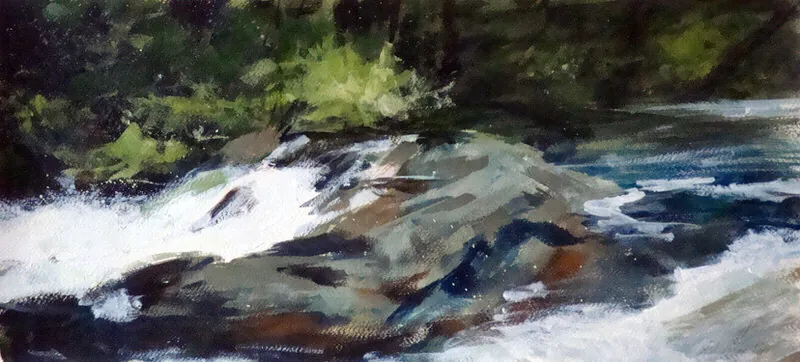
“I’m not sure if you’ve been asked this before but I wanted to ask about how you decide which pieces of work to finish and which to abandon, and what criteria you use to make this decision. I’m finding as I get close to finishing a piece the Resistance (using the Steven Pressfield term) builds and I feel a push to stop before finishing. I know a lot of time this is just Resistance, however I also feel that at least some of the time the work is objectively bad and I shouldn’t waste any more hours on it. Do you have a way you decide which sketches/works are worth taking to a finished level, and how do you decide whether you should stop with a piece that’s not working and abandon it? I’d love to hear your thoughts on how you navigate this.”

— Doug

I pretty much just go with my gut and finish the sketches that feel the best to me.

There's more to it than that, I suppose, and I'll expound on it here—but that's the gist of it. At the end of the day, a disturbing amount of choices in art comes down to "because I felt like it." I think that's why so many people struggle to teach art. But I digress.

There are a lot of considerations I take into account when I decide which sketches to paint.

But first: I do a lot of sketches. And before those, I do a lot of thumbnails. I try to develop a lotof ideas. The more the better. In fact, when I mentored artists, the first week's assignment was always to do 100 thumbnails. 100 different ideas. Different compositions, totally different concepts, whatever. I wanted to see variety and a lot of it. Sometimes an artist would find something good early on—but just as often #89 or #63 would be a real gem.

I don't do 100 thumbnails for every sketch I attempt. So for every dozen thumbnails or so, I make a sketch. Sketches take me somewhere between 20 minutes and a few hours, depending on pure randomness. Sometimes it just comes together and sometimes I have to beat my head against the tablet to pull art out of it. C'est la vie.

Now, how do I decide which ones to finish? Because finishing a painting might take me 20-40 hours, give or take. Which, in the scope of all that thumbnailing and sketching, is quite a commitment. Here are some things that I think about:

  1. Will it suck?

Most sketches are not worth painting and that's obvious. It might be a fine sketch, but I usually have a gut instinct that it's only going to be ok and nothing more. These get posted online, abandoned, and forgotten about.

  1. Will it be awesome?

Awesomeness is hard to define. But you sure know it when you see it.

For whatever reason, sometime sketches will just scream potential. They will say I WILL BE GREAT and you just have to make it happen. So if a sketch screams of potential loudly enough, all of the other considerations are pretty moot.

  1. Do I want to paint it?

Do I feel like sitting down and painting that right now? I think we should all trust our guts and follow our obsessions in art.

If I'm in the mood to paint a landscape, no amount of awesome figurative sketches will get me very excited to finish them. So the sketch has to be something that I would actually enjoy painting, otherwise I'll probably do a terrible job of it.

  1. Is it sufficiently different from my other work?

We all tend to repeat ourselves. I know some great artists who make some truly stunning work—but, I'm embarrassed to say, I often can't tell if they've made a new painting or they're just reposting an older piece. They have found a formula and it works, but one piece just blends into the next.

This was particularly important when I was freelancing and each piece had to advance my portfolio in some way. Repeating myself was fine, but only if I could make it that much better than before.

  1. Is there something to learn?

Studies are great but sometimes finished work is the best motivator to learn. If we suck at painting feet but this concept features feet prominently, well, there we go. We've got our chance to really get good at painting feet.

-

That's about it. Those are some of the thoughts that go into the decision. But as I said, sometimes I'll just feel like it. In the end, you're the artist and you can do whatever the hell you want. Make good art and that's all the justification you need.

“Recently I rewatched some of your Art Camp 3 videos in order to get a refresher on some things and I've been noticing a pattern in my work. I've seemingly been sucked into the black hole that is the comfort zone and I'm having trouble getting out. How you find the time/ability to break away from your comfort zone when your comfort zone has effectively become your career but you still need to be able to perform well within that comfort zone on a daily basis? Would you recommend switching mediums possibly as a solution?”

— Andy

I lived in my comfort zone for way, way, way too long. Most of my career, in fact. The needs of a professional career are foremost consistency and efficiency. Exploring the world outside of our comfort zone will, inevitably, make us less consistent and far less efficient.

Further, exploring out of our comfort zone even on social media is often detrimental. I didn't pursue much figurative work for a long time for this exact reason. My figures didn't live up to my landscapes and were often ridiculed, so I avoided them. I didn't do them, so they never got better.

But we need to get out of our comfort zone if we're ever going to improve, so it's good that you even have the desire. Too many artists settle into the level they're at rather than pushing forward.

I think you're best served by doing two things: developing your comfort zone incrementally and also exploring widely in your own time.

As to the first: consider how you can take the skills you already have and push them further. I'm doing that with landscapes in the last couple years. I was at a good level but I wanted to get even better. So I've been grinding out tons of studies, identifying my weaknesses, and trying to get to a new level. I think I'm starting to get there. Changing mediums, as you mentioned, is a good way to stay in your comfort zone but still develop. I did this when I got back into oil painting and started painting landscapes with those. There's an awkwardness to learning (or relearning) a medium, but at least you'll already know what you're aiming towards. Working in oils always helps my digital work, and vice versa.

Then, I think you should always explore outside of your comfort zones. As widely as possible. Too many artists get too narrow in their focus and I think that can hurt them. You don't need to master everything, but I do think you should at least try everything. There are a lot of lessons in painting figures, for instance, that will help your landscapes (and vice versa). When I got back to painting landscapes after a couple years of nearly exclusively figure paintings, my landscapes had improved! Art is art and we should try as much as we can.

Realistically, this exploration will have to be (and should) outside of your professional work. If you try something you might fail at, you might have to submit a bad piece. That's not great for anyone. Even posting that work on social media has its downsides. So there's something freeing about just making work for yourself and knowing you don't have to show it to anyone. When I was in art school I hated showing my sketchbook to anyone, because that's the place I could be free to explore and try stuff and screw up. Whether it's in a sketchbook or just on your computer, carve out some space for yourself to fail.

“When I finish a painting, I often get the response 'Nice! …is it done?' What is it that I’m not doing? What makes a painting feel 'done'? My general response is to take a little while away from it, come back and take a fresh look and say yes, I see that I struggled with edges, values, whatever. I’ll work on those skills and try to do better on my next painting. Is that what I should be doing? Should I try to fix the problems or move on? I too struggle with making myself do the work in the first place. Reworking seems like the worst.”

— Mandy

There's the old quote, "art is never finished, only abandoned." There's a lot of truth to it, though it's not quite the whole story. Another quote, "a painting takes two people: one to paint it and another to take it away from the artist when its finished."

I have never finished a painting and thought that there was nothing I could work on in it. I have never painted something so wholly perfect that it couldn't be improved. But whenever I finish a painting I feel like I've said about 95% of what I could with the piece. While there are things that could be improved, none of those improvements would materially actually improve the overall painting. Painting x or y or z a little bit better isn't going to change the viewer's experience of the painting all that much.

The finish line changes as my skills and priorities change. Finishing gets more distant when I have the capability to carry a piece further. When you develop the abilities to capture more interesting color, more faithful form, or more graceful shapes, you will probably feel inclined to do that. When you know how to paint something better, you will probably feel like you should.

At the same time you develop those skills, you will often wonder if you're going too far with your work—you probably are. It's easy to overwork your stuff, pushing things that don't need to be pushed and rendering out the life your sketch once had. I fall into this trap often. I can become enamored by my subject and lose sight of the painting until it's too late. Sometimes a little simplification at the end of a painting can claw back some verve, but not as much as I would like. I often think that I should paint more simply.

Now, as to reworking: there's no clear answer to this either. But my general policy, assuming that the painting isn't turning into a complete trainwreck, is to take the lessons I failed at in a painting and try to do them better in the next one.

This is part of why I focus so heavily on the sketching of paintings. The early stages can last a long time; don't rush to begin finishing things. The shift is subtle and you might not notice that it has happened, but I define it like this: when you hesitate to change or add or remove things in your piece, you are no longer sketching. It happens in stages and is more of a gradient than a line, but that's what you should look out for. When you paint something and you're scared to "mess it up," you're not sketching any more. That can be a fine thing *but only if the painting works as is.*If you could step away from your piece and someone would have a pretty good idea of where it's headed (and that place is a good one), then feel free to stop sketching.

But if you don't like where it's going and you also hesitate to change things: step carefully. Hold on to your freedom. Make a new layer, try some things out. Sketch it on another piece of paper. Whatever you need to do to free yourself to actually make new choices.

All of that reworking is very, very, very hard to do when your piece is really far along. You can do it—I know I've done it—but it just gets more and more difficult the further along we progress. So I generally think, for most of your work, you shouldn't bother with too much major reworking of finished or nearly-finished work. Learn your lessons and apply them better in the next piece.

A bit on the flip side of this advice, though, is thinking about cast drawings. Cast drawings are all about getting things just right. That obviously requires you to get things correct early on, but there will be inevitable corrections later on. Learning through the agony of constant erasing and redoing is its own sort of education. So maybe you can't go wrong, whichever path you choose.

“When laying out a picture, how much do you plan out a focal path for the eye to follow? In your England painting I see a nice path from Main Rock-> Down and then right along the rocky foreground ridge -> Follow the path of the background hills back up and towards the center then following the clouds til your eyes get back to the starting point. Was this intentional? I really like pieces that take my eye on a cohesive journey.”

— Matthew

Landscape study by Noah Bradley

For studies like this one, I'm not considering composition nearly as much as I do in my imaginative work. Most of that composition work came when I was shooting the reference itself—making the most of what's in front of me and trying to get a good shot through the lens. So this piece isn't the best example for how I handle composition, but I include it here anyway for context.

Now, I don't really think of eye paths much at all any more. I was taught those things by countless art teachers over the years but it just... never made sense to me. They would tell me how this or that line lead our of the picture or maybe this one lead into the picture; but it always felt arbitrary. It felt like an imperfect tool to pick apart a bad composition or to praise things that worked in a good one.

If it works for you: use it! So much of art is imprecise and we need whatever tools help us to make good images. For me, though, thinking about how the eye travels isn't one of those things.

The thing that has worked best for me and my ability to compose is quite simply: do what feels right. One of my favorite teachers, Sterling Hundley, compared composition to how we like to arrange our desk/workspace/dining area. There are some arrangements that feel right and others that don't quite work for us. This meshed nicely with how I like to compose.

So I try to put shapes and lines in places that feel right to me. If something doesn't feel right, I change it.

To develop this feeling of rightness/wrongness, it did help to look at and study a lot of master works. Find pictures that you think have good composition and look at the choices they made. Also look at pieces that you think have really bad compositions and try to figure out how you would improve them.

Most books on composition are absolute garbage, but I've always been a fan of Picture This: How Pictures Work. James Gurney also wrote some good stuff on eye tracking and how we actually look at images.

“I wanted to ask: How has your learning process developed in your years as an artist? Are there studying methods you once used that you don't use now, but would like to try again?”

— Bryce

The best attribute I had in the early years of my education was an absolute desperation to learn. I knew I wasn't good enough and I knew I needed to learn if I was ever going to have a chance of being good enough. So I sought every resource and tried nearly every sort of study. I scoured the internet for tutorials and videos. I went through old books at the library, reading and studying. And, of course, I drew and I painted and I took classes.

Some studies were more useful than others and had a more immediate impact on my skills. These were the best ones:

Master studies. There's a reason I harp on about these all the time. They really help. They helped me a lot early on. Because they can show you how a great artist really paints. In a time when process videos were much rarer than they are today, this was where I learned how to construct paintings.

Cast drawings. I only did a handful of these but they drastically and permanently improved my ability to draw accurately. There's something about spending 30+ hours on a single drawing in a highly controlled setting with a masterful teacher giving you critiques regularly that will really make you grow. There were many days on these drawings where I didn't enjoy the process at all. Sometimes I even dreaded doing them. I was impatient and felt like I wasn't making progress. But that was just the discomfort that comes with growth.

Sculpture. I'm a very tactile learner. I want to understand something by feelingit. And nothing gave me quite the appreciation for forms as quite literally building those forms with my own two hands. I think if/when I ever want to develop a more expert knowledge of anatomy, I would approach it with sculpture. I think if I could build the muscles, one on top of the other, I would actually "get" anatomy.

Plein air. Nothing taught me to paint light quite like going outside and painting light. There are so many challenges to painting outside but the experience is incomparable. Artists absolutely benefit from painting from photographs, but plein air studies should be a part of every artist's education.

So that's what I did and those all worked really damn well. But I haven't done a master study in at least a couple years, I certainly haven't done any cast drawings, and I've only done a handful of little sculptures for fun. I'll go out plein air painting, but it's hardly something I'm dedicated to like I should be. I would benefit from doing all of these more. Along with everything else, really.

One of the biggest problems of advancing in art is that continuing to learn seems to get harder and harder. It's not easy to maintain the fanatic dedication to improvement that we have early on. I miss it and I haven't found a way to rekindle it. I think that's why we see so many artists stagnate. Our natural inclination to learn fades as we get better. We settle into our grooves and it's not fun to get out of them.

There are things that I do now that I think are better than the ways I tried to do them early on.

Life drawing, for one thing. I love life drawing and I want to do more of it. But I think I learned to draw and paint figures a lot better thanks to photographs. You see, in life drawing I always felt rushed. I couldn't control the pose, the time, the environment, anything. But with photographs, I had complete control. Complete control to work at a comfortable pace, correct mistakes, and try to understand what I was seeing.

Same goes for working digitally in general. I'm glad I did a lot of traditional media work early on and I still love doing it, but digital has taught me so much about painting. I'm more inclined to correct mistakes in digital painting. I'm also not fighting the medium itself and can put down exactly the color I want. I want to do both, of course, but there are definitely some perks to working digitally that I think I discounted early on.

“What sparked your interest in art?”

— Nekko

Vanity, I suppose.

I liked drawing well enough, but it seems like the validation that comes with making art is an inherent part of that early motivation. If I drew something and didn't get to show it off, it wouldn't be nearly as appealing. Even if it was just showing it off to my parents.

I suppose I was good enough, but nothing particularly remarkable. My mother told me once, after I was already a professional artist, that I wasn't really talented as a kid. It was just something I did.

Then sometime around adolescence, I began to incorporate art into my identity. In those confusing years, we all need something to latch on to and to set us apart and make us interesting. Art seemed as good as anything else.

I also really liked looking at art, mostly stemming from my early interests in video games and other nerdy pursuits (sci-fi shows and movies, fantasy worlds, etc.). I wished I could make things like that but I knew I couldn't. Thankfully, I stumbled on some art forums in those formative years and they set me on the right path of developing my fundamental skills.

It was just a hobby for a long time and so, while I took it seriously, I didn't ever think I would do it professionally. This gave me years of enjoying art and making art without the pressure of "I need to be amazing." While sometimes I wish I had taken it more seriously, younger, well I know I would have missed out on that. I'm often glad that I didn't have social media staring over my shoulder for all of those years.

“I just wanted to ask a question that may be misdirected, since you mostly do fantasy and open landscapes. Regardless, how would you paint cities that don't look like boring blocks or too simplified? Every time I paint buildings, they seem fake and void of character, something that happens less with mountains and rocks given their natural variations and unexpected turns and tonal shifts.Too little variation in buildings makes them look like cartoons, but too much seems to make them look like 'not-buildings'.”

— Luciano

I knew I needed to paint a city anyway for my book and then this question came into my inbox and so I finally did it:

Landscape study by Noah Bradley

I did not enjoy making it, which is only one thing that I want to say about painting cities. I haven't painted a city in a long time and it was interesting to try it again. I'm better at it—all of the fundamentals still apply and I've improved at all of those. But I enjoy it about the same amount, which is precisely not at all. There was just no part of painting this where I felt "I'm having a good time." I think it looks alright and there's some satisfaction in that, but the actual process of painting a city is not fun for me. The strictures of correct perspective and the overabundance of straight lines just kills it for me. I like organic forms and I like the freedom to push and pull those elements as I see fit.

Which is why this piece doesn't have many details. I couldn't bring myself to work on it any longer. I can be a pretty dedicated person and push through unpleasant tasks, but this one was beyond me. I'm ok with that. I feel fine knowing that there are things I enjoy painting and others which I hate. I have all the respect in the world for artists who paint cities, but I'm glad to not be one of them.

Now, with all of that complaining out of the way, let me try to answer this question.

The things that make a landscape interesting still applies when you paint cities. Good values are essential, obviously. Interesting lighting is even more important. When what you're painting is not "naturally" beautiful, lighting can redeem it. That's what drew me to the reference above—at least the lighting looked good.

When you paint flat surfaces, remember to use gradients. No flat surface in a landscape is a flat color. It will shift tone as your angle to it changes. So over the immensity of a building, it will take on many different colors and values.

Spend a little extra time on the silhouettes. It's where we look first and if you're going to spend additional time anywhere, that's where to put it.

You don't have to paint every detail. Obviously I half-assed the details in mine, but at least at first glance the image reads like it should. If you want to paint details, you can. And there are plenty to be painted. But remember that your aim is to make a painting and paintings are often more interesting if we let the viewer's eye fill in some of the detail. We do not aim to make photographs, but instead to find ways to trick the eye into believing that there is more in our painting than we have put there.

That's all I'll say because I'm not an expert here. I've painted just enough architecture in my career to say that I can do it tolerably well, but I don't think anyone would accuse me of mastering it. So I'll defer to other artists for this.

“What's your history with gaming? Board games, video games, "introductory games" for either category?”

— Nario

I'm probably a gamer because of my brother. My brother's a few years older than me and he was always the gamer and I sort of tagged along behind him. That included video games from the early days—with a strong Nintendo leaning in the beginning (NES and all of the consoles that followed)—but also card games and eventually board games when those began to get better.

I always had a thing for the handheld game systems—I owned all of Nintendo handhelds since the original Gameboy. I'm not sure what drew me to those in particular, but I spent many, many hours absorbed in those games. Maybe part of it was how handhelds kept that pixel art aesthetic for longer. Pixel art is where a lot of my artistic roots stem from, so I'm still a sucker for anything that does it well.

I played a lot of card games, sometimes a bit competitively. My brother and I dabbled in Magic, but never got serious about it. We played Star Wars: CCG the longest and most seriously. A lot of fond memories of our dad dropping us off at game stores to play in small and large tournaments. My brother played a lot better than me, but I did alright.

Catan was our first foray into "real" boardgames, but we quickly moved upward from there. I love them. Rachel and I are lucky to have some friends who are much more into boardgames than we are so we get to play them whenever we see those friends.

Nowadays, most of my gaming happens with Rachel. I have a hard time deciding to play a solo game because I enjoy gaming with her so much more. Sometimes we'll play the same solo game at our PCs, side by side, but we both prefer the co-op experience. So now we're always on the lookout for more co-op games to play together. Some more games like Baldur's Gate 3 would be excellent, if y'all could get on that.

Right now we're playing Once Human, which has been quite good for a free game.

“A process question: In a future newsletter, would you consider doing a comparison of your study of Rachel from the Dryad pack, side-by-side with the actual photo reference? I'm curious to see what adjustments you may have made and why. Artists are generally told not to slavishly copy the reference (photo or live model), even if that reference is directed by the artist. But identifying WHAT to change seems to be one of those amorphous aspects of art making. I presume the intent/purpose of the piece largely dictates where an artist deviates from the reference and by how much. The closest I've been able to come to answering the question for myself is vague at best… keep what looks good, change what isn't working.”

— Germini

Here's the reference that I used and you can find the finished piece if you scroll down a bit:

Illustration by Noah Bradley

Now I stuck pretty close to the reference in this case. I loved the shot and I picked it for a reason. I'm also aiming, with these studies, to bring in new ideas into my work. That means sometimes following nature more and inventing less. Sometimes that means I end up painting something that looks odd, but most of the time it's introducing new shapes and patterns and forms into my visual library, so that I don't just keep repeating what I've already done. I've painted quite a lot of landscapes and I know the ways that I would paint X or Y or Z. But nature sometimes has other creative solutions and I wanted to find some more of those.

Some of the changes were also accidental and happened instinctually. My piece is a lot cooler overall, for instance, than the reference. That's neither good nor bad but is just the way I happened to paint it.

There were a few intentional choices, though, that I think helped my piece a fair bit:

I clarified the silhouette of the head. It can often feel awkward to have a line in the background intersecting a head. There's a lot of complexity there and the head will always be a focal point, so sometimes I like to make the area behind the head a bit simpler. In this case it was a trade-off, as there was something nice about the interchange of values around the head (the illuminated side was against a dark background and the shadowed side of the face was against a light background).

I did the same thing with the arms. It was intersecting just at the wrist and a tangent just at the other elbow, so I fudged some things so that those areas were a little clearer. Pictures are confusing enough and organization is the artist's duty.

I bumped that foreground rock off to the side a bit so it would take care of that corner in the lower left. Compositional choices are largely instinctual and that just felt better, so I did it.

These latest studies aren't necessarily the best examples of artistic choices—I still classify these as studies and not paintings. It's a bit of a cop-out, but I really do want to expand my ways of doing things. A decade of feeling like I was repeating myself can have that effect.

In general, though: what you said about "keep what looks good and change what isn't working" is right on the money. Unfortunately or fortunately, there's a point of art that just comes down to "I felt like doing it that way." That choice can look good or bad, depending on who is the one doing it. Those choices become easier and look better as you become more skilled. You develop an eye for what looks good by painting well. You also develop that taste from looking at and understanding the work of other artists. We all have our own peculiarities and it's a good idea to steal those when you're starting out.

There's sometimes logic to it. If something looks odd and would look odd even if you painted it perfectly, change it. If something distracts from what the piece is about, don't paint it. If an area bothers you in your painting, add something to it or take something away.

But for every logical change I make to a painting, I probably make a dozen just because I felt like it.

“I would like to ask about where your income mainly comes from? I suspect you have several smaller streams that add up? You sell references packs, you paint for clients, you have some other products or digital paintings that also make you money if and when people buy them…? I wonder because I am considering creating some mobile games of my own, with the purpose of them churning in the background and producing some passive income while I do my day job. How important is it for you to have these smaller streams of more or less passive income? In general I wonder how much people strive to get to a point where much/most of their income comes from sources that require little or no time from them.”

— Simo

I've talked about my income a little bit before, but it's usually worth talking about again because it's a weird subject. Everyone tends to very hush-hush about income and finances and all of that.

After my cancellation back in 2020, my income changed dramatically. Every client abandoned me, so my freelance income went to precisely $0. I've had a trickle of offers come in over the past 4 years, but none of them have worked out (mostly because of my prices & their budgets not lining up, but some because they ghosted me after the offer, presumably because of finding out about the cancellation). So I've had to make all of my income from other means. This is where the "passive" income comes in.

Passive income is a bit of a misnomer, because it's only passive eventually. It takes quite a lot of upfront work. That's where the investment is. It can also take some amount of ongoing marketing so it doesn't fade into obscurity.

But thankfully, I've put in a lot of effort in the 14~ years of my art career to establish a whole portfolio of passive income. The bulk of my income comes from Reference.Pictures these days. It was a lot of work to create, but it continues to pay. It does fairly well from organic search traffic, too, so I don't always have to advertise it for it to do well. I also still sell my Art Camp courses, which sell much more rarely now but are good income when they do sell. I also have brushes, books, and my online store. Beyond that, I make a little money from affiliate accounts, Youtube ads, and now even from my X account. Most of the sources aren't much, but they all add up. It adds up to a small percentage of what I used to make, but we get by.

I was also very, very fortunate, responsible, and damned lucky to save and invest a tremendous amount of money in the more successful years of my career. I always lived fairly frugally and invested aggressively, which has left me with a comfortable safety net.

Beyond all of this, Rachel makes a fair bit of money too (again, mostly from her own reference packs). DINK (dual income, no kids) has served us well.

We would not be doing well right now without our "passive" income sources, so I'm a big fan of setting those up. Mobile games definitely sound like a good option. A lot of work, probably, but possibly a source of income for years to come. Part of the trouble with creating these passive forms of income is that they're very hard to predict. You can devote a year of effort into something and only make a few hundred bucks. Or you can get lucky and a day's work will somehow net you tens of thousands of dollars.

In a way, my new landscape painting book is another shot at creating a new piece of passive income for us. I'm hoping to create a book that will endure for years/decades and keep selling. It's a gamble, sure, but part of the blessing that all of these other forms of income have given us is the freedom to take chances on these things. If you've got the time and the motivation, I think it's worth gambling on yourself like that.

“I have had a very tough year trying to follow my dream. I left my nine to five and was jobless and studying and trying to animate so I could put together a great portfolio and get into the industry. And I know this isn't your field but you talk about the idea of reaching for greatness and not giving up! I haven't yet. Even though I came to the point of taking up another job which is mind-numbing. I still do believe I can become more than good. If only i can manage my time and scattered mind. You have a lot of things going on and you manage them but have you ever felt that something is unachievable no matter how hard you try to see the result? I love drawing and art and i can't see myself doing anything else. But in this day and age I fear I am missing something because being great is not always enough... Or is it?”

— Diana

Fear and doubt are an artist's constant companions. I don't know of any artists who don't have these doubts. They might not talk about them or they might cover it up with bravado, but it's there. I was terrified and uncertain for so many years early on. The only way I felt I could keep going was to put on a front—"fake it till you make it," as they say—which led to my reputation of being a bit of an asshole. I forced myself to express confidence because it seemed like the only way to keep myself going, to keep working, to keep putting my work out there even when I was afraid of failing.

The fear hasn't gone away, not exactly. But at least that front of dumb, asshole-ish confidence has.

There's no cure for fear. It's going to be there and you will need to recognize it for what it is. Steven Pressfield calls it Resistance, which is a good way to think of it. It's always going to be there but it doesn't need to prevent us from working. We simply (but painfully) find ways to keep working even though it feels like slogging through mud. Even though it feels like we'll never break through.

Persistence is one of the most powerful predictors of success. Success in art requires quite a lot of luck. You can (and should) improve your skills so you increase your odds of getting lucky. But even if you're great, you're not guaranteed success. But if you're great and you just keep trying? Then you've got a damn good chance of finding the success you're after.

I don't know if every person can be a great artist. I truly don't know what it takes. But I think wanting to be great seems to increase the chances that you can be great. Once you have that and you have the dedication to stick at it, the main pitfall to watch out for is stagnation. Dodge that one, keep working, and I think you'll have a pretty good shot at getting where you want to be.

“I'm a very novice painter and I've picked it up while going through an emotionally tumultuous phase in my life. I know some people get energy from painting, as in 'it's their escape time,' as in 'they come out more replenished than they go in' (some people get this from running and I hate them). To me, I don't know, it's difficult and doesn't feel like rest, it feels like something else. What do you think are the differences in approach that make art either a source or a sink for personal vital energy?”

— Gabriela

I, too, hate people who get energized from running. But actually that makes a good comparison. Because I didn't understand that feeling for a very long time and then, eventually, I started to at least get how people were feeling so good after running.

A lot of it comes from the right balance of ease and exertion. Most beginners run way too hard. They get out there, huffing and puffing, their chest is exploding, their legs are screaming, and then the run is over. It's all-out, balls to the wall effort for the duration. A few masochists might enjoy this, but generally it's not very pleasant. But if you ease up, go slow, and take breaks, you might find that running's not so bad. This also happens to be better training, in the long run (look up zone 2 training if you care). Once you know how to run easy and you've built your cardio base, you can choose to run harder or longer. I think you'll be more likely to find a buzz from running once you're better at it.

So now let's talk about art. Art is very hard and you will be very bad at it for a very long time. Even drawing or painting an apple will require considerable concentration. Any skills or knowledge you may have are entirely conscious. If you're not actively paying attention the entire time, you're going to make mistakes and your piece will look bad.

Further, your taste in art is probably better than your skills for a while. It's rare for someone to start drawing who doesn't like art. And in those first years of drawing, nothing you draw will be as good as the art you enjoy.

Eventually you will get good but that doesn't necessarily mean that art will leave you energized. Art is always a struggle and if you're learning or growing or just trying your best, there is a discomfort in that effort.

Most of the time I paint, I don't find it particularly energizing, not in an immediate sense anyway. There are fleeting moments of flow states, but they're few and far between. For the most part, the buzz I get from painting is more of a "fulfilling my life purpose" sort. Where I can look at what I made that day and feel proud. Tired, but proud. It's pretty rare for me to feel energized by the act of painting itself.

That said, I have found a few instances where I do get more of a buzz and maybe you can take some of these ideas (and look closely at your own energy levels and what might boost you):

  • Oil painting. Traditional work can still be exhausting and a drain, but it's probably more likely for me to have a great time if I'm slinging paint around than just scribbling on a tablet.
  • Plein air painting. I fucking love being out in nature. I am not a good plein air artist, but man I have a good time when I sucker myself into doing it.
  • Painting with others. I get to paint with Rachel most days, so that's great. But painting with other folks around has always been one of my favorite experiences. It was one of the best parts of art school. You could always go into the studio and paint with other people around. I still love this experience.
  • Listening to a really good book. I will only listen to audiobooks while I'm painting. So if I've got a really enjoyable one on the go, I usually find myself itching to paint.
  • Streaming my painting. I used to do this more, but live streaming my painting online—even if just a couple people are watching—can be a ton of fun.
  • Painting when I should be doing something else. The best way to be productive is to procrastinate on something you want to do even less. So if I can get out of something I desperately don't want to do and sneak in some painting? Delicious.

“I'd like to ask you about the topic of talent. We've all heard many professional artists say something like "talent doesn't matter, the reason I am where I am is simply through my hard work." And there's obviously a lot of truth in that. I have to imagine that you have been touted as a talented artist by many who see your work. Do you think that's true, that you have inborn talent as an artist? And what is your opinion on the topic of talent? How much does it matter, if it all?”

— Justin

Talent is weird because nobody can agree on whether it exists or not—nor, if it does, whether it matters.

Talent tends to be a label applied to people who have worked tremendously hard for a long time. It's rare that we find an artist just starting out who is producing bad work and label them as "talented." Why should we? They're making bad drawings, so clearly they're not talented. If they practice for a while and start making good drawings, then sure, let's call them talented.

So to say that talent exists would mean that either these people never make bad work—highly unlikely—or simply that they seem to learn faster than their peers. But to really measure this, we would have to take different people and track exactly how much they were practicing and then compare. But even that wouldn't be enough, because one person could be paying closer attention to their studies while the other was mindlessly going through the motions. Skill acquisition is hard to quantify, which is why we just look at the results—and then throw around the Talented label wherever we see fit.

But none of that is to say that talent doesn't exist. Absence of evidence is not evidence of absence. It's hard or impossible to find any evidence, but that doesn't mean it doesn't exist. It might. It might not.

I might be talented. I'm not really sure. Some things seemed to come relatively easily to me, while others felt painfully slow. But maybe I just cared more about the easy things and put in more work and attention? I can't possibly know.

So faced with the unknowable: what do we do?

We make the best decisions that we can with an unknowable variable in play.

We could assume that talent exists and we may or may not have it. Thus, we may be wasting our time in practicing at all. So if art does not come easily, we can safely assume that we are untalented and would be best served by giving up sooner rather than later.

Or we could assume that talent doesn't exist or at least that it doesn't matter that much. Then our skills would be entirely our responsibility. When we fail, it's our fault. When we succeed, it's because we worked hard. In this mindset, your results are a direct consequence of your efforts. So if you want to produce good work, you will work hard. If you fail, you will work harder.

No one can guarantee you success but I would gladly gamble on the latter mindset. While talent might make some things easier to learn, I don't think a lack of talent makes art impossible to learn. Art is foremost a craft and most of the lessons can be learned, in time and with effort. Too many artists use talent—both its presence and absence—as an excuse to not work harder.

The greatest risk I have seen in my years of teaching are students who seem to stagnate too early—who seem to get stuck at some subpar level of skill. This has frustrated and confounded me for years now. These people put in a lot of hours, seem to do the right things, have excellent teachers, but still just... don't go anywhere. You look at their work years later and there's next to no improvement.

A lot of people see stagnation and probably see a lack of talent. That might be true, but it just as easily might not be. It could be a hurdle that we all have to pass through and some do it unknowingly and others are permanently blocked. If there was an easy solution to stagnation, I like to think I would have heard about it by now. I wrote a post on stagnation where I get into it further and offer some solutions, if you're interested.

“How would you approach adding texture to your work? I've always struggled with adding texture & preserving my brushwork. I love seeing the brush strokes on others' works, or how they utilize texture to add visual interest; whenever I work on my own pieces, however, there's an incessant need to remove any stray brush strokes and make things smooth. Any texture that remains by the end of the painting process feels accidental.”

— Viet

Texture either comes intentionally or accidentally out of laziness. If you're too lazy to polish something, it will likely have a fair bit of texture. But once you develop the patience to finish your work, you will probably have to work towards texture.

The other problem is that digital painting is very anti-brushwork. Even good brushes don't look that great a lot of the time. They tend to be flat and uninteresting. You'll often have to work at the mark to make it interesting. This isn't nearly as much of a problem with traditional work. When you put down a brushstroke in traditional media, it will probably look quite good.

I think one of the most important things you can do to make your brushwork and texture more interesting is: be confident. A confident mark looks good. A doubtful mark looks weak. Avoid tickling the brush. Petting the canvas is fine when you're rendering, but it won't do if you want the brushwork to stand out. If you get the mark wrong? Do it again. If I'm working digitally and I need a bold mark, I might have to attempt it half a dozen times before it comes out alright.

The other thing, which seems to surprise a lot of people: oftentimes the bold brushwork happens at the end of a painting. You'd like to think that artists start with these big textural marks and slowly get more and more refined. That happens but it's not the only way. I will usually reintroduce some big brushstrokes at the end of a painting to restore some of the verve of the sketch.

As with other things in art, brushwork feels like one of the more difficult things to actually teach someone. But whether or not it can be taught, it can certainly be learned. Look at artists who you think do it well and imitate them. Because they probably learned it by imitating some other artists as well.

“One thing I’m really struggling with is how to place X item within a landscape. There’s something about having to highlight a giant creature / epic structure but ALSO make a cool background to boot that makes my brain short circuit. I love love love wide angle shots, but the moment one of the pieces is locked in place, I end up not knowing how to focus and all my composition thumbnails become samey and lame. So… how do you approach a landscape painting where the focal point isn’t necessarily the landscape? ”

— Mia

The more choices are made, the fewer options we have.

That can be a great thing when we're the ones making the choices. But when those choices are handed to us? It can get a lot harder. The biggest, main focal point is decided and locked in. We have to work around this obstacle and make it work.

Obviously camera angle allows us a fair bit of leeway. We can try some radically different shots while still showing off X. We can also play with the lighting and atmosphere. These aren't always obvious in simple thumbnails, but as we move into the sketching phase we can experiment with how lighting can change everything. So too with color palettes. With the lighting decided, consider how you can color key the scene.

You can also get creative with how your foreground obscures the focal point. I think a mistake that we often fall into is assuming that we need to see 100% of X with nothing in the way. But there's something tantalizing about a partially obscured focal point. Just like a scary monster that you only catch partial glimpses of, if we obscure parts of our focal point, we make people want to see more. If you're working for film or games, eventually they might see everything. But tease them where you can.

Ultimately, you're not going to have infinite freedom. That's what personal work is for. For professional work, you have to work in a box. A lot of people thrive in a box—hell, a lot of people do much, much better work and feel more comfortable inside a box. Limitations often breed creative solutions. But if you find yourself itching for more freedom, take time for personal work.

I realize this isn't much of an answer. Just Be Creative! sounds like a lot of an excuse. But as far as I can tell it is the only answer. You've found a part of art that's hard and a little annoying—and not just for you. It's just part of the struggle that comes up especially with professional work.

“A couple questions about portfolio reviews: if we want to try to rationally analyze our own work, which things should we ask ourselves? Also, are there any recommended websites where we can submit work for review?”

— Dina

Portfolio reviews give us a realistic perspective on our work, which is a damned rare thing. Art is a nebulous journey, full of uncertainty and lacking in milestones. It's hard enough to tell if we're progressing, much less how our work is holding up overall. Just like bodybuilders develop body dysmorphia and are unable to objectively assess their own bodies, I'd say that most artists have some sort of art dysmorphia. We see all of our problems, forget our strengths, and assume our works (and perhaps ourselves) are wretched. Or perhaps worse still, we become the Dunning-Kruger of art and fail to see our faults and become a walking embarrassment that can't identify our own weaknesses.

Teachers and grades help a bit with this, while we're in school. But they're only a metric of how we're doing in the context of that school, that course, that teacher. They don't give a professional assessment, usually. But often at conventions and workshops and things like that, art directors and artists will offer portfolio reviews. They'll sit down with us, look at our work, and tell us things that we should work on or things that we're doing well or how realistic it will be for us to get jobs. It's very useful. I had some portfolio reviews before my career began that encouraged me to go down the road of a landscape artist.

But they're hard to find, if you're not at one of those events. And even then: nowadays there are so many artists and so many aspiring artists and only so much time to review portfolios. A lot of artists will still be happy to do one if you find them at an event and they aren't too busy. If you ever see me at an event (and I'm not incredibly busy, running to get somewhere, or eating at the time) I'd always be happy to take a quick look at your portfolio.

I don't know of any sites to get them online. You could sign up for a mentorship program with an artist—that's probably the only sure-fire way of snagging one. I used to give out critiques or reviews to anyone who emailed me, but I don't do that any more. I just got too many of them and got way too discouraged by the number of people I would spend half an hour reviewing their work and then would never even respond to my email to tell me thank you.

Now, for the good stuff: how to review your own work.

Not easy, but that's why this is a good question.

One of my tricks was taking a recent copy of Spectrum (it was an art annual that no longer exists, for you whippersnappers out there) and look through the work. Then I would either physically or mentally put one of my pieces in there. Did it fit in? Did it seem finished enough? Interesting enough? Were the technical, conceptual, and design skills up to snuff? It can be hard to tell where we're at but it's a lot easier to compare. So take one of your pieces and compare it to a really good painting. Where does yours fall short? How can you fix that?

Obviously, you don't need to be in the top 1% of professionals to make it as an artists. But you do need to be in the top 1% of artists in general if you're going to make it. You don't need to be at the top of the field on your first day. But you will need to be competent on your first day.

Another thing you can ask yourself: "what work do I avoid or dread?" Sometimes you avoid something because you don't like it and that's fine. You don't need to and shouldn't do everything. But sometimes it's because those are the things you're just bad at and not practicing. You know what they are, even if you're unwilling to face them.

I suspect a lot of us know what our problems are, we just struggle to actually face them and work to remedy them. We're working towards self-awareness, which comes slowly (if at all).

Outside metrics can be an ok aid in self-analysis. It's a fuzzy tool and sometimes dead wrong. You might get a lot of likes or comments or compliments about a piece that's actually not very good at all. I know I have. I've had people say how much they loved some of the worst professional pieces I've ever made. But also, if you're doing well, getting attention, and perhaps even being hired to do something: you're probably doing alright. But if you're not getting those things, don't immediately assume that your work is a failure. Success is fickle and gives incorrect feedback constantly.

Lastly, you can develop your taste in art. Look at great art, study it, analyze it, and figure out why it works (and, eventually, how it can be better). Without sufficient taste, we'll never create great work. If we don't even know what great art looks like, it's incredibly unlikely that we will stumble into making masterpieces. A safe bet is to figure out what artists inspire your favorite artists. And then find out who they were/are inspired. Go up a few levels and you'll have a stock of excellent artists to build your taste upon.

Self-review will always only be a facsimile of an outside, expert opinion. But we should still try. Because portfolio reviews—even from great artists or art directors or whoever—come with their own drawbacks. We receive some condensed feedback on what they're feeling that day. Maybe they're working on their drawing lately and so they spot problems in drawing wherever they look. Maybe your drawing is just fine but they have a stick up their ass. There's no telling, really. So multiple, objective, expert opinions are best. Thus the whole challenge with this mess.

That's a long answer and hopefully I actually answered it, though I'm not sure that I did. Because it's hard (and maybe impossible) and something we all should work on. But I don't think there's a straight answer to be found.

“I've taken a long break from art and now, deciding to get back into it I find it hard to choose a direction to go in. My first instinct was to go get my foundations right so I have some classes I'll be taking to help with doing studies/digital painting, form drawing and perspective. Beyond that however, I'm not sure what comes next, people say things like you should do "personal art", but after such a long break I don't even know what that means for me. I prefer to plan ahead but I'm struggling with figuring out the next step.”

— Josh

You can't go wrong with fundamentals. When in doubt: fundamentals. You will never regret improving your skills. Learn to draw better, to understand values better, to draw hands, faces, etc. better. The stronger your use of these tools, the more doors will be open for your art in the future.

Further, I have found in my years of painting that you will always return to fundamentals, because you will realize time and time again that mastery has little to do with anything fancy but everything to do with performing the basics of art exquisitely. Even simple lessons seem to be relearned again and again, each time bringing a new level of understanding and application.

But study is its own trap. The pursuit of mastery is a fine goal and a personal favorite of mine, but it can't be the only direction for your art.

I suppose the only way to learn what direction you want to take your art is to try out a lot of different directions. Your own preferences in what you like to look at can be a good starting point, but they're insufficient. There are plenty of types of art that I adore—but when I have tried to make those types of art, it's made me incredibly unhappy. The sort of art you enjoy looking at is very likely going to be different than the art you enjoy making.

So try out the things that interest you. See how you like it. But if you don't like it, it might not be that you don't like it. It might merely be that you're bad at it, because you just started doing it. This isn't easy to identify, but do your best to identify whether you dislike the whole style/form/process/medium or whether you will love it once you become good at it.

Ideally, we find things that we enjoy doing and don't mind being bad at. Those are golden, but can be hard to find.

Plans are fine but I think in art you can only plan so far. You can dream and head in those directions—but experiment broadly and stay flexible. Your dreams will probably change.

“What are your thoughts on the challenges of merging figurative study and landscape study to create better illustrations? I've spent most of my life studying figurative work and while I still have a long way to go, I'm realizing one of the biggest weaknesses in my illustrations is the lack of environments or figures not feeling truly grounded in their environments, both compositionally and well as in color/value. To that end, I'm becoming more interested in studying landscapes to create more holistic narrative images. You share quite a bit of both landscape and figure studies, and obviously you combine both in your Sin of Man & MTG work, but I'm curious if you even think of them as separate crafts that took effort to combine, or if it's all illustration (composition, form, value, & color) no matter what you're painting.”

— Germini

Figure painting is hard, landscape painting is hard, and combining them is harder than either of them.

I learned them separately but also together. I've done plenty of no-background figure drawings and countless figure-less landscapes. But then, I also combined them in many illustrations, both personal and professional. Their combination is a damn pain, though. Because you are likely to be better at one than the other. And it will be your worse skill that dictates the level of a piece.

So for many years my figures lagged behind. I tried to keep them as minimal as I could and used whatever cheap tactics of photobashing or tracing that I could to make them look at least somewhat decent. It worked well enough but it also kept me from exploring a lot of paintings and subjects that I wanted to tackle.

After my cancellation, I got into figure drawing and painting. I started with a lot of no-background work.

Figure study by Noah Bradley

I continued to do a lot of almost-no-background work during this time, but at a certain point I was curious how to make a figure exist in a space. How to, at least, incorporate the values and edges of an environment to make a more cohesive picture.

It wasn't a comfortable process and I often still struggle with it. Because it's hard!

Art is always a symphony of a bunch of different skills, applied simultaneously. Figures in environments only make that harder. It's why I have a special admiration for artists who do it well (Sargent, Sorolla, etc.).

So I guess I do see them as different skills. They have overlap, of course. Values work like values, no matter what you're painting. But the peculiarities of each are immensely deep subjects and should be studied individually—and together.

“I noticed you've done quite a bit of pixel art in the past. Do you think you'll ever return to it in the future?”

— Andrew

My artistic roots lie in pixel art and a part of me will always love it. I grew up nerdy and playing games. Mix that with a bit of artistic interest and one of the first online communities that I was a part of was one dedicated to pixel art. It felt a little more accessible than painting and aligned more neatly with my passions.

I've dabbled with it in the years since, anytime I've needed a fresh hit of nostalgia. I love the deceptive simplicity of it and the lessons it teaches. How to imply details. How to work with limited palettes.

I haven't had the patience to do any refined pixel art in quite a long time. The work I have done has been pretty rough—amounting to little more than a sketch, at least in traditional pixel art terms. As with most things, the time it takes to properly finish a pixel art piece is substantially longer than the time it takes to sketch something cool.

But maybe someday. I fantasize often about a little pixel art collection or book or something like that. And with the way my interests fluctuate and wander, I wouldn't be surprised if I end up going down that road someday.

“Any tips for switching to digital art for a person that's primarily learned in physical mediums? It feels like too many parts of my artistic thought process get lost when trying to do the same things on a computer screen. Maybe it's because the lines are perfect every time, maybe it's because the screen doesn't have texture like a page or canvas. A digital brush feels so... limiting to me. Which intuitively feels wrong, because technology can allow things that a physical medium never will. My main coping mechanism has been doing sketches on paper, then scanning them in to use as a base layer to paint over. (trying to sketch and pose digitally seems to kill any ability to create a dynamic/interesting composition for me). This has helped significantly, but I still struggle throughout the entire digital painting process afterwards. Feels like aimless flailing to approach the rendered end-result I'm envisioning. And regardless if my rendering turns out 'well' or not, I feel extremely emotionally drained. Practice feels so demotivating compared to practicing physical ink or paint. I need a paradigm shift for digital work, it seems. Losing the physicality of the tools is a great challenge.”

— Lexi

I love painting traditionally but I also love painting digitally. But switching to digital comes with a lot of unique challenges.

The biggest problem I find is that digital work inherently looks... meh. You can have the best tools, the best brushes, a lot of skill, and still your marks are going to come out looking kinda ok.

If I take any old oil paint, pick it up with whatever brush is handy, and slap it on any surface, it'll look great. It'll have texture and variety and interest and depth. With digital, you won't get any of that.

So a lot of artists will seek out the digital programs that seek to imitate traditional media (Rebelle seems to be the current trendy one). That might work for you! It does for a lot of artists. I personally don't usually like them, as I think they try too hard to look like traditional media but they never quite make it there. I usually feel like I have to deal with some of the annoyances of traditional media (why is this color mixing with what's underneath it—I just want to put this color right there), without the upside of every brushstroke looking great. Your results may differ, though.

Taking a traditional start and finishing it digitally is a good approach. I did a lot of that in my early years of digital painting. Most of my initial fantasy environment portfolio was drawn in pencil in a sketchbook, scanned, and painted. A lot of it didn't remain till the end, of course, but I felt a whole lot more comfortable drawing in pencil at the time than I did drawing on the computer.

Along those lines, adding more textural elements to your digital work can help to get some of that feel back in there. The perfection of digital is a hard thing to get away from, but it's possible. Start on a textured ground (either scanned or find one of the available paper/canvas/misc. textures online) and then use textured brushes. Anything that adds a little character to it. I also tend to avoid using layers, partly for this reason. The more layers I have, the harder time I have of creating an integrated painting with nice edges.

At the end of the day, digital painting is a whole different beast than painting traditionally. Until we begin painting with little nanobots or a stylus with perfect haptic feedback and immense 3d modeling to perfectly imitate traditional brushstrokes, digital painting will be its own medium. And that's ok, we just have to take on those new challenges. Because digital painting does have its own perks, to balance out its negative aspects.

Or, hell, don't bother at all with it and just paint traditionally? It's always an option.

“I've started getting back into art after taking a 10 year break. When I practice with traditional mediums I have a vague idea of what I'm doing when I get to the color stage, but whenever I try digitally I feel as if I hit a wall and can't wrap my head around the process. Is this disconnect common or is it just me being out of practice and just needing to remind myself to just trust myself it'll work out if I just keep at it long enough?”

— Alyssa

This is similar to something Rachel and I have been talking about lately. There's a lot of emphasis on studying other artists and the images they make. But sometimes not quite enough effort in studying how they make images. In the past couple weeks, Rachel has taken to studying some artist process and it's been helping her a lot.

One of the benefits of art school is the array of instructors who will each teach their own particular methods of working. Some insist on lines, others on big masses of color. A particular favorite from RISD was one who insisted in started with looping scribbles of a crayon marker on a toned surface, slowly building up the light values.

As we sample the idiosyncratic methods of others, we come to find our own comfort zone. It takes a while. It might look exactly like another artist or it might be entirely our own.

So if you're struggling with the process, I would suggest finding an artist—preferably one who paints subjects similar to you—and directly copy their process. A lot of artists have process videos at this point, so you have an abundance of options out there. Try a few different artists and see how you feel after that. It will, most likely, make you feel a little more comfortable in the process.

“I have a question that I hope your experience with MtG can provide insight for. What is needed to get good, quality scans of traditional artwork? Say, if I was painting, and wanted it to be put onto a playing card, what would the process be? I have hopes of submitting some artwork to a TCG company, and would love to impress them with high quality images.”

— Tyrell

I wish I could tell you, really.

This was and remains one of the more annoying things about painting traditionally. A painting can look good—great even—but then you photograph or scan it and it suddenly looks like flat, lifeless trash. Every time. I don't know what fell magic occurs when a traditional painting is seen on a screen, but it sure ain't doing the art any favors.

Complaining aside, I've tried photos and I've tried scanning and I find that scanning usually gets me better results. I'll scan it in pieces for the big stuff and stitch it together on the computer.

But regardless of what I use, one of the more important factors is just that I have to do a decent bit of digital touch-up to the work. Even if it's as simple as color/value correction, removing excessive canvas texture, or just fixing errors that seem glaringly obvious when the image is on my computer. I can get away with minimal modifications sometimes, but there's always something that needs to happen.

“What software are you using? And maybe your hardware if you want to speak to it. I’m aware of half a dozen programs and I’m not sure which is worth buying. Corel Painter looks amazing but it’s expensive. Photoshop CC is an expensive subscription, Krita is free but somewhat limited, and Rebelle looks like a pretty good deal. Just wanted to know your thoughts on those if you have any. And any suggestions you’d make in general for digital art.”

— Scott

I use Clip Studio Paint almost exclusively these days. It's an excellent program and not a subscription! Their pricing is really confusing these days because they do offer a subscription version (and I think the tablet version is only a subscription?). I just know that I bought a license for the program and it's on my computer and it works great.

I never thought I'd switch away from Photoshop after about 15 years of working in it, but here we are. I made the switch about 6 years ago and I've loved CSP. It's everything I want out of a painting program.

I've tried Krita but I found the brush engine far too lacking for what I wanted. The lack of dual-brush settings destroys all of the brushes I've made, which sucks.

Rebelle is quite cool, but there's something about a program that tries to be more like traditional painting that never works quite right for me. I think I could love it, if I tried. But the comfort of CSP keeps drawing me back.

Painter is fine but I rage-uninstalled it when it popped up with *a window covering ad on my desktop when it wasn't even running.*Now I just think of it as spyware, whether it is or not.

Procreate is nice on the iPad, though I haven't worked on that for a while. I really like the iPad for drawing, but I've always struggled to get that last bit of refined finish on it. Not sure why.

Hardware-wise, I have a Windows desktop that I built about 5 years ago. They were very good when I built them (Rachel has an identical machine), though they're probably showing signs of aging at this point. I'll probably build new ones at some point. If you don't know how to do it or what hardware to pick, just hop on /r/buildapcforme. Here's the thread I posted and got a bunch of good responses for what to build.

“I’m working on my largest oil painting right now as well, a mere 30x48, and the bugger of it for me is managing edges. I want to paint things into each other wet into wet and it feels more challenging on a large scale. As I type this out though I suppose there isn’t a different between 8x10 and 30x48 in that sense. How do you manage controlling edges and organizing where and when you paint something? Especially with liquin!?”

— Charles

This is one of the more trouble aspects of traditional work and it's made way worse when you start getting to bigger sizes like this. The freshness of paint application that you can achieve in alla prima work is damned hard to match in extended, more refined pieces.

You will often paint and repaint the same areas so that you have wet paint to mix into. This means learning to mix exact colors very well—but I usually find that slight discrepancies are quite nice, as they add some nice color variation to your paintings.

You can also add more transparent layers, either from glazing or scumbling. These work, though you have to be careful about that. Glazing can often weaken the values in those areas and scumbling can often make things appear really ghostly. I usually need to work back into areas after doing either of those.

Sometimes I can get the right edges by slowly working up to the right values, relying on softening out the edges with successive passes of opaque-but-not-too-sharp layers of paint. It's slow, but liquin is actually your friend here.

In the end, it pays to get things as correct as you can, as quickly as you can. The more right your first pass is, the less of this you have to worry about. When in doubt: I like to start very soft, as I find soft edges harder to achieve. I know I can go back in with another layer if I want some harder edges. But it's really, really annoying to blur out an edge in a dried painting.

“I’m 22 and in my 3rd year of art college. I’m in the early stages of my concept art career. I have a couple decent contracts under my belt and if I’m lucky one of those will be a shipped and successful indie title by the end of this year. Both of those contracts ended over 6 months ago though, and as my focus has half-heartedly shifted back to art school I’ve realized that it’s been a long time since art has felt like my secret mission, or like an escape from responsibility. I actually seem to thrive doing professional work which was relieving to find out, but art school, at least the ones I’ve attended, really drains me. Anyway, I’m curious how you were feeling after a couple years at art school. What was the transition like for you as art became a responsibility and not just a personal mission?”

— Martin

I was fortunate to also kick off my career while I was still in art school. I started taking on work long before graduation and was working full time on art while I finished up my degree. I'm damn glad I did, too—I had student loans to conquer and a desperate fear driving me to make a name for myself.

I liked freelancing. I liked the recognition of my skills, the money it brought in, the feeling that I was a "real" artist.

I was also fortunate to have a lot of instructors in those final semesters who understood, encouraged, and facilitated the transition. One of my professors let me use my freelance jobs as my homework for his class. I didn't show my work in class critiques, as it was under NDA, but was able to get his personal feedback still. It helped free up the necessary hours to complete all of the work I had to do.

But I understand that feeling, all too well, that art is no longer "yours." Because we all start to draw and paint for the fun of it. For that irreplaceable joy of seeing an image emerge on the page.

For the decade of my professional career, I lost sight of that joy too many times. I focused on producing, on succeeding, on becoming popular. Sometimes I remembered the joy of art and caught it for a while, but inevitably I would slide back into the need to meet deadlines and pay bills. It's not that those things can't coexist, it's just that it's really hard to balance.

My refuge, then and now, was always personal work. The work I made for myself was the stuff that reminded me why I was an artist. I didn't need to fulfill a brief or meet a deadline. I could just make whatever it was that I wanted to make.

But even then, there's something about pursuing art professionally that means you'll lose out on some of the sheer joy of art. It's why I encourage a lot of artists to just keep art as a hobby. It's a great hobby. When money enters the picture, it can quickly corrupt that joy. School can do that too. Suddenly it's not about making art, it's about getting good grades or showing off or whatever.

Part of the growing feeling of responsibility just seems to be maturing, in life and art. But with more responsibility, we have all the more need to carve out a niche in our creativity that leaves room for the playful pursuit of just making images.

“I’m in a position of struggle with my art (of course who isn’t at any given moment). I’m turning 30 in a few months, I’m enrolled for the painting program at MassArt, I paint and draw most days I can—but I’m fighting a battle between the art I want to make and the art I’m capable of making with my current skills. I have to remind myself life isn’t a race and my journey doesn’t have to happen in a given timeframe but I do feel like my art should be more developed by now for having done it for the last 10 years. I know my issue — I’m not consistent, I rarely do studies, I almost always make art from imagination than reference. So my question isn’t what should I be doing as I know that already, but what it really is: If you were to recommend a method of setting up a way to practice and study the most efficiently to reach a place where I make art confidently how I want it to be made what would that look like? Any advice you give is a worlds of help, I just feel like the ideas I have, my art doesn’t do justice, and I would give anything to get there, to be past the 'mediocre plateau.'”

— Eric

You know what you need to do: you need to study more. But you don't. Because you want to paint the things inside your head and that's more enjoyable—even when it doesn't turn out how you want it to—than spending your days meticulously studying still lives, figures, and landscapes.

We all want to paint what we want to paint. But primarily painting from your imagination is, as you've found, not a road that leads you forward. It's just a circular loop: you're moving, inconsistently or constantly, but you never seem to move forward.

Your desire to paint your ideas well does not match your efforts. Either you need to let go of the desire to make better images or you need to do what it will take to make better images. Art is a slow road and a lot of it is terribly uncomfortable. But in those years of study, you will discover a certain joy in making art that can't be replicated without taking that journey. Trust me. It's there.

But that's a long road and there's no sense in making yourself miserable while you go down it. So have fun! Fun is highly encouraged as it will keep you at work and continue to motivate you. So: continue to paint what you want. But do so after your dedicated time to studies. Study for three hours and then, with your remaining energy for the day, paint something that you want to paint.

Too many people let the fun and imaginative work completely disappear as they study. They lose that boldness it takes to just go for it and make something from imagination. That takes a lot of work to get back if you lose it—sometimes more so as your skills improve, as you come to expect from yourself better paintings. So don't lose it. Hold on to it. Keep playing with pencils and brushes and sketching crazy things.

Just do your studies first and with maximum attention and diligence.

“Recently, I've found myself struggling to balance professional and personal growth with the various plates I have spinning. I have a salaried illustration job (that doesn't even require full time hours) and is a huge blessing, but not what I want to do forever. Thus, I've used my extra margin to explore teaching art mentorships online, on the side. My hope is that as I produce enough instructional content, the mentorships could scale beyond what my side freelance work brought in. Perhaps to do my own practice full time one day. All that is well and fine for professional growth, but I've barely even sketched for myself in weeks, and I hear burnout knocking on my doorstep. If you have any advice on how to set one's perspectives and boundaries in this regard, I'd love to hear about it. ”

— Cameron

I've covered burnout a couple of times before, but it's something of an eternal problem so I sure don't mind talking about it again.

Sometimes, to advance professionally you do the things that promote burnout. You have to. This is a dirty secret of the art world. Professionals will tell you to take care of yourself, not work too hard, take breaks. But advancement and exceptional work comes at a cost. In rare and fortunate cases, you can keep living the way you are and enjoy extra success. But that's rare. Usually to get to a higher level, you have to make sacrifices.

Sometimes—and this still blows my mind—it means drawing and painting less. All of the other things to do with art are the things that bring the greater success. Once your skills arrive at a certain point and once you can achieve a certain output, more painting will often not bring more success—especially not in the short term. Non-art things, like networking, selling, promoting, teaching, social media, streaming, and whatever else the kids are doing these days: those are what will bring you more success.

You either need to sacrifice art-making time or life time. If you're young and ambitious enough, you can sacrifice some life time. Sometimes that short term investment away from fun life things and into grinding art things will pay off exponentially in the future. The comfort I now enjoy came from earlier discomfort (and a heaping load of luck, of course).

But if you want to maintain a healthy lifestyle, sometimes that means you need to make less art. As you make less art and less art for yourself, you begin the headlong run towards burnout.

You do what you can to stem the bleeding, but that's where you're headed. Maybe you'll arrive at "success" before you burn out, maybe you'll find time to counteract the impending burnout, maybe you'll let some good things in life go so that you can spend more time on your work. Or maybe you won't. Maybe you'll burn out. But if you do? Then in burning out you will find a new balance. It's a terribly unpleasant way to find balance, but it'll probably work.

All of this might sound a little hopeless. I don't think it is, I think it's just a force we must combat. Even when conditions are ideal, making art is hard. As the cards stack against us, it only gets harder.

Do what you can, get your life in order, rest (mindfully, intentionally) as you can, and remember always that the phase you're in now will not last forever.

“I'm very into fitness-related things, doing HIIT, strict healthy eating/calorie counting, weightlifting, all that jazz. When I started out over ten years ago, it was as you say, a trigger pushed me. But that trigger helped me stick to it long enough to see some indicator that what I was doing was working. I could weigh myself and see numbers go down, I could *see* myself getting leaner, *feel* myself getting stronger. It easily helps push me to keep doing it, becoming intrinsic motivation. So I've also picked up trying to learn the piano and drawing in the past. With piano, I could once again feel myself getting better as my hands moved more swiftly with practice, proprioception hitting the correct keys more often, understanding sheet music better. This leads to the same intrinsic motivation to keep pushing myself as fitness did above. With drawing and art... I'm not getting that. It feels to me like it's hard to gain any indicator that what exercises I'm doing is working or if I'm actually getting better, making intrinsic motivation hard. I guess this is where I'm wanting your opinion. Maybe my view of art progress is wrong in general, but can one actually easily gauge this progress for creative endeavors in a concrete way? I guess I don't want to end up spinning my wheels and wasting time like I did in the past, not getting close to where I'd like to be artistically. It would be nice to see somehow that what exercises I'm doing is actually helping me get closer to goals.”

— Shuro

Art skills develop painfully, awfully, terribly slowly.

You feel like you suck so you practice, you read up on things, you do studies, and your reward is to still feel like you suck. There are fleeting moments in your progression where you feel like you're getting a handle on things—inevitably followed by your taste once again surpassing your skill and the return of feeling sucky at everything you do.

Progress is happening, usually, but it's hard to see. The easiest way to see it is to look back on the work you've made over the last year. Odds are, you'll notice clearly in hindsight when and how you've improved. But that's not very useful in day to day life. You're slogging through the mud, unaware that you're climbing a mountain at all.

I guess this is where you get phrases like "trust the process." Because I guess you have to, day to day. In the grand scheme of things, when you've attained some degree of mastery, it's a lot easier to trust the process. Because then you have proof. But without proof, blind faith must suffice. Trust the fundamental exercises. Try your hardest, every time. Put in the hours. Correct your mistakes. Eventually, slowly, finally, you might notice improvement.

This is where a good art teacher or mentor can come in handy. They've been down that road before and they can see your work more objectively than you. A good mentor makes learning art more efficient. They might not necessarily teach you anything you couldn't learn on your own, but they keep you on track and help you avoid the major ruts you'd otherwise stumble into. Too much time can be wasted, unknowingly, doing the wrong things or in the wrong ways. Often there's no way to know it's happening without someone telling you or waiting for months or years to pass and looking back on it all.

Art ain't easy.

“I also have problems painting small details, but even more problems with COLOR. From choosing a color palette or using the basics (but which basics?) or analyzing an image digitally and based on it creating a template or I don't know? I distinguish values well, but when adding color, I struggle to match them and the value, especially in portraits.”

— Raymundo

Color isn't easy and it never has been. There are thousands (millions?) of choices—many of them correct—but the ones we choose always seem like the wrong ones.

Making color charts will help if you have the patience to endure them. For very detailed instructions and examples, Alla Prima is the best book about that (and oil painting in general). I've done... some of them. They helped! They also made me want to rip my hair out in both frustration and impatience. But they really do help.

I've also always been an advocate for starting with a limited palette and slowly expanding it. Working in pure value is great for getting a feel for values. But jumping from that to working with a full palette is one hell of a chasm. So moving to three colors (black and white being two of them), then four, then five or six is probably a smart way to progress. You'll understand your colors and your paints all the more.

These are traditional techniques, obviously, but similar things can be done digitally. Something that helped me a lot is doing master studies. Now, you shouldn't use the color picker when you're doing master studies, but you absolutely should use the color picker to check yourself. So eye the color on the original, try your best to pick it, put it onto your study, then go and check yourself. Too light? Dark? Saturated? Whatever it is, go and manually tweak the color you've got and fix it. Repeat a million times and you'll find you have to make fewer and smaller corrections.

A good and accurate color sense is built slowly. It's almost an instinct, at a certain point. Just like many things in art, eventually, with enough diligent and uncomfortable practice, you will find yourself making more correct choices.

“I have been thinking about starting a newsletter myself and was curious about what caused you to start one in the first place? When you did start a newsletter, did you have any concerns about what valuable thing you were going to say to people or did you just say "Eff it"? Lastly, if you were to recommend an e-mail newsletter tool which one would you recommend?”

— Moe

I first started a newsletter a long, long time ago because that was the oft-touted advice from all of the online entrepreneurs back then. The popularity of newsletters has waxed and waned, but they've always been present and I've found them one of the best ways for actually reaching the people interested in my work.

I had the blessing of being screwed over by Facebook in the early days. I had a page on there and it did pretty well, got a bunch of followers, and then... one day that all disappeared. I knew I couldn't trust Facebook or any other platform. The quick downfall after my cancellation just further confirmed that. I realized how easily platforms could kick you off and your network could disavow you.

But newsletters? They're still kicking. Google (and others) might try to kill them by rerouting the emails away from recipients, but I don't think they'll fully kill newsletters. Old technology tends to stick around and I don't see email going anywhere for quite a while.

Now, about having something valuable to say: absolutely. Which is why I was so bad with sending newsletters for so long. I felt that it only made sense to send one out if I had something really good to share. I felt like I would bother people with regular emails. So I didn't send enough of them, people would forget why on earth they signed up, and the list suffered. That was a mistake.

But then last year I thought I'd try this current format. A set of prompts and a weekly schedule. If people unsubscribed (and about a dozen people do every week), that was fine. Because thousands of other people were still reading and some of them even seem to enjoy it (thanks y'all!). I try to make these as interesting and honest as I can—because those are the newsletters that I love to read. I try to write the sort of newsletter that I like to receive.

My list was originally on Mailchimp (before they became a massive company), then I switched to Buttondown for a while, and now I'm on EmailOctopus. Their rates are super affordable (and free for the first 2500 subscribers) and their design/writing tools are everything I need. They have an easy integration with Payhip, too. So if you want to start a newsletter, try making something free like a brushpack and offering it through Payhip and get those people on your list automatically. It's a solid way to get those first subscribers, who are notoriously hard to find.

“I've been going through Art Camp and for some reason, when I try to apply the same techniques of composition and perspective in practice, there is a strange feeling that everything 'falls apart.' As if there is 'too much air' and unfilled space. Can you please tell me if this is normal or am I doing something wrong? Perhaps I lack the skill to work with this scale - this is my first formal training in many years of self-study. I've always done it by eye. Taking into account the elementary techniques of dividing into thirds but not on a constant basis. And so, when I tried to apply the sound methods of composition and correct perspective to those artworks that are already in work... they fell apart. Maybe they became more 'correct,' but all that 'empty' space. And when I start doing everything 'by the rules,' I have no idea what to do with all this empty space. Here's one point of interest, here's another, but at the right distance it's like they don't communicate with each other.”

— Mirra

This is both entirely normal and painfully relatable.

I remember a long period in my learning journey where my art, inexplicably, got a whole lot worse. My images became stiff, uninteresting, compositionally inept. I knew I was improving, yet my paintings looked worse. I knew the rules, I was using the rules, but the pictures just turned out bad.

There are two things happening here. First: sometimes we need to go backwards to go forwards. We need to deconstruct our bad habits before we can progress. All of us lean on tricks and habits to create better work. As we learn, though, some of those habits will have to be suppressed or discarded if we want to make better work. Sometimes the skills we use to make good work prevent us from making great work. This is one of the reasons that mediocre artists never progress. It's not comfortable to let go of the bad habits—because those bad habits might be serving us very well.

The second thing that's happening is that when we learn new skills, we tend to stiffen up too much. We accidentally forget how to make pictures and obsess over following rules. Following rules does not make good art. But sometimes to best learn a new skill, we need to be uncomfortable with it for a while. We can't expect to take on a new skill and immediately integrate it into our work seamlessly.

Now, that's what's happening in general—let's get it into this one specifically.

Correct perspective is a bunch of rules. But good perspective has very little to do with those rules. Good perspective is whatever looks and feels right. You can break all of the rules you want as long as the result feels right. But as you work on refining those rules of perspective, they feel so gosh-darn immutable. You're dealing with measuring, straight lines, exactness. Fudging exactness feels a lot more wrong than tweaking a fuzzy impression.

Doubly so with composition. The "rules" of composition are mostly stupid. Do what looks good, feels right, and forget the rest.

Some of the hardest things to paint are the "dead" areas of a painting. The spaces in between. I have always had an easier time painting a cluttered scene, edge-to-edge stuffed with things, than great, wide expanses of nothingness. Struggling with that is normal, I think. Making it interesting is a pain in the ass, which I think is why it usually looks better to reduce the boring areas to a minimum.

“What other novels have you read recently? Richard Garfield suggests that a game designer must play games of all types regardless of what he or she is making so maybe reading a book that's a different genre from the one you are making will help your book's story?”

— Robert

I love to read widely. There's something about getting a lot of different influences that feels like a good thing.

I suppose my novel is going to be a fantasy book, but fantasy is hardly the genre I read the most of. Besides the plethora of non-fiction that I devour, I try to range from the classics to pop fiction. You really start to get a feel for the authors who have a way with words, the others that can tell a damned good story, and that a books "fame" doesn't always correlate very well with how enjoyable it is to read.

I'm not sure if any of my reading has made me a good writer—time will tell, I suppose—but it certainly hasn't made me a worse writer.

“Reading books helps idealise better the forms and scenarios for a painting by reading the author's descriptions. Do you think reading expands creativity?"

— Mauro

It certainly might. But maybe not in the way that you suggest. I think we all visualize the scenes of books as we're reading and I'm sure, to some degree, reading a fine written description will help spark some exciting visuals in our heads. But I think there's more that reading offers us.

Reading encourages us to expand our horizons, our awareness, our range of possibilities. A good author might write about things we hadn't ever considered, elements left forgotten, and that focus might show us areas that we've missed before.

Further, we can act like a great illustrator of the books we read. Great illustrators don't always simply pick a scene from the book and paint it. There's nothing wrong with that but there are other options: we can learn to read between the lines and paint the scenes that are never described. Imagine these characters, this story, and what must happen between the descriptions. That could be a great way to make us all a little more creative.

"But I have a question, what book(s) do you recommend, if you recommend any? I saw Alla Prima II, or Color and Light by Gurney or some in Spanish by Parramon."

— Raymundo

I still stand by my 10 Books Every Artist Must Read list, because it's still damn good. Tragically, there seem to be fewer and fewer great books on art coming out. You'd think with how many excellent artists there are and the heights that art is reaching, there would be better books. Alas. Multi-author books are cash grabs and most of the others are meant for an amateur audience. Or the artist is just a terrible writer/teacher and probably didn't invest the considerable time into making a useful book. That's not all books, sure, but it's far too many of them.

One of the best new-er books out there is Anatomy for Sculptors. Excellent stuff.

I'm hoping my new landscape book ranks among the best, most useful art books out there. I'm fairly confident that it will be. I just need to finish it.

“What are the big differences that you always have to keep in mind (i.e. CAN do this, CAN'T do this) between doing a landscape study vs. making a landscape for an MtG card? I know that readability is important, but from what I can tell, everything is detailed enough to be a normal-size painting, so what makes it more or less readable at 2" versus normal-size? I also notice that MtG cards tend to have a super-epic perspective or fantastical land composition (as in an unnaturally spiral-shaped mountain range), so what about it compositionally makes it a 'high-fantasy' landscape over a well-designed, but realistic landscape? I'm aware that the dynamism or 'drama' is cranked way up on an MtG card, but what makes a mountain range dramatic? Feel free to note any books or videos that pop in your head specifically regarding dramatic fantasy landscapes or composition for board game cards, MtG or otherwise.”

— Clinton

The line between "normal" landscapes and "fantasy" landscapes is a blurry one. But you tend to know it when you see it.

I suppose the primary factor is the quality of more. More extreme shapes. More dramatic lighting. More dynamic composition. Usually it's a combination of those things, pushed to an extreme, that sets a landscape out as "fantasy."

The easiest one to push, on its own, to make a fantasy landscape is probably the shapes. Creating shapes and forms that are beyond reality will almost always make your landscapes fantastical. In our world, there are usually limits to forms. But in fantasy, we see a lot of those limits vanish. Mountains can be impossibly steep, waterfalls impossibly large, and rocks, somehow, impossibly floating.

From there, adding fantasy elements to a normal landscape is a surefire way to make it a fantasy landscape. Throw a fantasy castle into a landscape and boom, you've got yourself a fantasy landscape. Knight on a horse, dragon, whatever it takes, that's an easy path to fantasy and drama. Not all landscapes need to be uninhabited—in fact I'd say you're mostly better off adding some indications that the world is lived in, at least by something.

I realize this is a somewhat unsatisfactory answer, but I think that's the nature of the question. Fantasy always has a foot (sometimes just a toe) resting in the natural world. We only depart in some ways, in some areas. But that's enough.

In many ways, on something of a tangent, landscape painting has usually been fantasy painting. Looking back at most of art history, the vast majority of paintings we see are not literal transcriptions of the world around us. They were studio paintings that tried to capture and idealized view of what nature should be. Even when we get to the 20th century and see a gradual rise in plein air and more natural work, there's still extensive selection, adjustment, and enhancement to what they were painting.

“You mentioned in this newsletter that you are no longer painting or producing art professionally as a primary source of income. Would you be wiling to elaborate on how you've off set that income? Are you earning enough from your writing and classes to continue to live at the same quality of life or did you have to make adjustments to compensate for the change?”

— Steve

“You mention art isn't your money maker these days. What is? The reference photography? Secret crypto investments? Always curious how other guys on the path are making it happen.”

— Vincent

I've had a few people ask something to the extent of "how the hell do you make money" after I mentioned that I don't freelance or do commissions any more. They're fair questions—it's a bit of a mystery, sometimes to me as well, and it might be good to talk about it. I think too many people are way too opaque with money stuff. They're scared of the subject, or ashamed, or something. I find money pretty fascinating.

Put simply: the vast majority of my income these days comes from sales of Reference.Pictures. But the story is a little more complicated than that.

I have always diversified my income streams. As soon as I could, I began selling videos, courses, prints, whatever else I could think of. I set up affiliate accounts, I enabled ads on YouTube, I tried to add as many different income streams as I could. I knew that any of them could dry up—or vanish—at any time. I didn't want to put all of my eggs in one basket so I kept a whole lot of different baskets since the early days of my professional career.

I have also been an eager saver and compulsive investor. I started young—still in college, as I recall. I paid down student debt aggressively and then invested a lot, mostly in index funds. I lived as frugally as I could, not spending on things that I didn't care about. I came across the cheesy-sounding book, I Will Teach You to Be Rich, when I was still in college and basically just followed all of the advice in there. Ramit's still around and still teaching financial advice and he's still one of the most sane and smart voices on the subject.

Before my cancellation, Rachel and I were earning more money than we ever had. We were (seemingly) loved by the art community, our stuff was shared widely, and big artists used and recommended our reference to everyone else. Things were great. We lived comfortably, but we saved and invested a lot of that money. Thank God we did, because it was a short run.

After the cancellation, our income gradually declined. It wasn't as much of a cliff as I expected—I thought it would go to $0 the next day. For many of those anxious first days, I checked our daily earnings way too often; I was looking for those $0 days to prove that we were doomed. But they didn't come. Our income trended downward, but we weren't doomed (yet). In the end, our income eventually stabilized at, well, let's just say a livable-but-not-ideal level.

That's pretty much where it has stayed for the last few years. We're doing well but not super**great. We know we could make more money, but we've both come to realize that, beyond a certain point, more money was not making our lives noticeably better. Because a happy life for the two of us is painting in the studio, listening to audiobooks. Or sitting on our laptops and writing novels together. We don't need a fancy car or designer clothing to do that.

Our financial freedom is also what allows us to experiment with new projects and invest in the long term. When you're concerned primarily with maximizing income, it's easy to fall in the trap of optimizing for the short term. You'll probably increase your income for the next year, maybe two. But what about 10 years from now? What are you doing now that will make you most successful in the next decade? That might have a different answer.

I'd be lying if I said that I didn't miss making that pre-cancellation income. It was great. And feeling a pay cut like that is apparently harder than never having experienced that income at all. So sometimes it's hard, remembering how well we were doing and remembering how that was all taken away. But in remembering the good times, I can forget what it was like to live those times. It was hard, a hell of a lot harder than our life right now. We walked a daily tightrope of social media acceptability. We stressed about how to be more successful--where we squandering the opportunities we had? We danced around the relational minefield that is the online art world.

We were earning so much more, but for what? Eventually, to live a life like we have right now. And that turned out to be a lot more accessible than we assumed.

I'm an amateur devotee with zero formal training and just graduating past Paint-by-Numbers, but I'm reading through your book-list and trying to learn what I can from Master Studies and value practices. It's challenging to gain much skill and produce anything I'm remotely proud of, but I am enjoying the process of art-making. Anyway, I was hoping to hear from you anything you might share on where to learn techniques or tricks. I recently learned a trick on how to make stones on a beach by loading a filbert with stone-color and black on alternate sides, and I'm delighted by such a simple means to make convincing stones. Clearly your knowledge-base is much larger than mine so could you share some basic tips on how to achieve such vivid effects as you demonstrated on your rock painting you shared? Or perhaps there's other tips on landscapes in general or specific you'd care to share. Or is there technique book you'd recommend?”

— Scott

Tricks can be sirens, tempting us to crash our ship/painting on the rocks.

It's not that tricks are bad--they're really not. Tricks like the one you mentioned can make painting a lot quicker and look a lot better. Especially with traditional media, where we take such crude materials to make beauty, it can be very, very hard for a new painter to make a good looking painting.

But sometimes that's the point. In many ways, I would encourage you to take the dumbest, simplest approach to paint. Mix the color, put it down. Try your best, sure, to achieve good edges, but the first concern should always be with good drawing and then good color. Good edges are essential to good painting, but they are not our first priority when we are learning. If an artist can draw well and master color, I have no doubt they can figure out edges as well.

The sad reality of my paintings is that I am not very clever in how I paint. I simply mix the color I want, as best as I can, and I put it on the canvas where I think it belongs. Sometimes--often, really--it's wrong in either color or placement or both. Then I either scrape it off or paint over it until it's more correct. Along the way, a nice surface quality might emerge, but not always. I'm usually too concerned with not screwing it up.

I'm trying for more interesting paintings, though. I look at paintings in museums and my favorite pieces have far more exciting brushwork than I manage. So I'm working on it. And I think those things can be worked on and I think there are some simple ways to do that:

Use more paint. This is one of the biggest struggles for most new artists and one that I, somehow, still struggle with. I'm not the worst but I definitely do not use enough paint on my canvases. But I should.

Use more paint in some areas. It'll help for the shadows to be painted thinly and the lights to be painted thickly. So play up that contrast.

Use palette knives sometimes. This is always a good way for me to get texture in my work. Sometimes I'll shovel the paint on, other times I'll drag it along the surface. Start to think like a sculptor. Note: I never quite like the edge produced purely with a palette knife, though perhaps that's my own lack of skill. I will almost always have to go back in with a brush in some areas to fix things.

Don't mix your paint too much. It's ok, and probably better, to slightly undermix your colors. Don't blend each color into a uniform soup. Let some of the disparate elements that you mixed in there remain. It'll add a little natural scintillation to your surface.

“Do you think creativity is connected to spirituality?”

— Avigail

It sure can be and I tend to think so. It depends, of course, on your definitions of terms and your intentions, but the spiritual and the creative can easily intertwine.

The spiritual is about what lies beyond our understanding--outside of our material reality. Creativity is there also. It's not only there, because a lot of creativity has to do with reality. We take in the natural world, think about it, and use our material, technical abilities to create things. But there's an aspect of creativity, a certain je ne sais quoi, a mysterious component that is the reason we can never adequately answer the question "so where do your ideas come from?"

So I think every bit of creativity has a little touch of that unknowable. It's something we accept with this weird pursuit. We accept not knowing. We accept trusting the process. We accept the mystery. Which, when you think about it, sounds a little like faith.

“Do you have any tips on simplifying your art style for when you want to draw comics, for example? I love storytelling and comics, but in my journey to become a better artist, I get caught in trying to draw and paint more realistically and spend more and more time on one drawing. ”

— Joost

Illustration by Noah Bradley

The strange reality of simplification is that it often takes a long time to get there.

Because simplification is the process of taking tremendous detail and distilling it to its essentials. It's like editing writing. We start with a big, ugly, overwrought first draft. We edit, cull, reduce, and end up with (hopefully) cleaner prose. The same goes for art and simplified styles.

But that's not the whole story, because sometimes it doesn't take much time at all. Because it's easy to skip all of that, pick a style of already-simplified work, and imitate it. Now you have simplified work in a fraction of the right, but it's not built on the same strong foundation. You'll struggle to bend and break the rules, because you didn't make these rules.

That's not inherently a bad thing, sometimes it's ok to imitate and pick a style. Shortcuts are fine, but know what you're doing.

So to finally answer your question: it's not a terrible thing to accidentally end up too realistic. Because you can simplify afterwards. There are three exercises that will help you from getting too realistic or spending too long on your work:

  1. Set a time limit. Make it shorter than you're comfortable with. Shorter than you can practically complete a drawing. Whatever that is for you. It'll teach you focus and keep you sharp and on the path to simpler work.
  2. Begin to merge styles. Find the artists and styles that you like and begin to explore them. Don't just pick one--pick several. It'll make you more interesting and well rounded. Once you've found the styles you most enjoy looking at and creating, then find what you want to do differently. How would you make this chosen style better?
  3. Redraw and draw from memory. Get in the habit of throwing out your first drawing (literally, if you have to). Wipe out your first painting. Get a fresh sheet and start over, working only from your memory of it. This will train you to remember the essential elements and forget the extraneous.

“I like doing portraits, but I'm struggling with what to do with the background. Typically, I darken by the face and/or lighten by the hair to create some contrast, but in this specific case it doesn't seem so simple. What would you do?”

— Peter

Artsy portrait backgrounds can be deceptively tricky to do. Even the just "generally dark" backgrounds are usually better when there's something going on back there.

For me, the thing I've found that has worked best is adding some amount of directionality to the background. It's too easy to end up with a background that's just a general halo around the head and it looks weird. That might come from the hesitation to put overly-contrasty values next to the face. Or perhaps the opposite. But left unchecked, a lot of us will just kinda end up with this weirdly floating head.

So I usually try to get some sort of diagonal movement to the values. You can keep it pretty subtle, but it usually helps to solve that problem.

You might also hint at a background, an environment of some sort, but that's obviously a bit more commitment than we always want to devote to a portrait.

Big, bold brushwork is always good, if you want to be a little less subtle. There's something about a massive brushstroke in the background that contrasts beautifully with a delicately painted portrait. It's almost telling the viewer that, yes, you painted this exquisite portrait with a humongous brush, even when you obviously didn't. Bold brushwork is often the last thing done to a portrait. Do it slowly and surely.

“I’ve been visiting a lot of art museums lately and am always astounded by the amazing creative works that are displayed. Despite this, I and many others often find themselves stumped by some of the seemingly “simple” paintings. You know the ones, the blank canvases with a line or abstract blobs where most struggle to understand the meaning. I have lots of respect for obvious technical skill, so I always walk away feeling a little bad when thinking “a child could’ve done this”. You are an artist with lots of technical skill and experience, I was wondering what your and maybe the general opinion of artists like you have of these million-dollar plain canvases?”

— Justin

I hate most of them and love some of them.

I'm not quite clever enough to distill the whole weird and wonderful and awful diversion of art in the 20th century. I'm sure the wars had something to do with it and I'm sure some of the philosophies and existential questions of the day played their parts.

Perhaps too there is a desire, particularly among artists, to push against limits. Tell an artist that they can't do something and they're already halfway to doing it. Limitations exist to be tested and artists love to see what they can get away with.

For whatever reason, here we are and most of the art on the walls of modern museums is terrible. It's soulless and confusing and boring. Modern art has alienated museum goers. Imagine if modern art museums were filled with work by Richard Schmid and other masters like him. Alas.

But I still love some of those non-representational canvases. I've always loved a good Mark Rothko. They have a presence in-person that is entirely lost in reproduction. But they have an emotional weight that surpasses a lot of what passes for art.

One of the reasons I love landscape painting is its connection to abstraction. I like to keep both feet firmly planted in representation, but landscapes give me the freedom to play with abstraction too. I can move and push and change and form the painting however I'd like. So I get the allure of abstract work. But I don't have much interest in it.

I find art interesting because of the craft of doing it. Art without craft seems terribly boring to me and I don't think I'm the only one.

A lot of art is also purported to be a venue for money laundering or the fashion of the ultra-rich. There's probably some truth to that. I just wish they could launder their money with better art.

“Noah, what are you trying to say with your art? Is there a meaning behind your personal work, e.g. for Sin of Man, or is it more about the enjoyment of the process and 'pretty image' making? Could you elaborate with a specific painting?”

— Josh

This is a follow-up to Oleg's question last week about meaningful work.

Artists avoid this question. We run the risk of being pigeon-holed into a certain genre, a certain message. We risk alienating viewers who now see all of our work through the lens we have described--sometimes not quite the one the artist intended. We risk sounding pretentious, ascribing far more meaning to the work than it might justify (see: nearly all artist statements).

Don't worry: I'm actually going to answer the question. I just wanted to share why most artists don't answer this question.

Some of my paintings are more meaningful than others, or at least in different ways.

Let's address my landscape work first. My landscape work is my attempt at capturing both the visual beauty of the natural world but also the feeling of being in nature. I spent a lot of my childhood playing in the woods (both on our property as well as on an empty lot that adjoined ours). I could be out there for hours and never get bored. It was the fertile soil for my imagination. So even now I feel more at peace, more stable, more right when I'm in nature.

On the visual side, it is the quality of light that I am most enamored with. Landscapes are less beholden to rules than figures or still lives. So I feel more free to play with light for the sake of light. There are other qualities about landscapes that I try to capture, but those are the big ones.

Now, let's talk about The Sin of Man.

The Sin of Man is about a lot of things and has shifted focus as I have grown and changed and learned. But overall, one of the biggest drivers for the whole project is about spirituality and my relationship with it. Religion and spirituality have always been a part of my life--I was raised a good Christian--but their presence has also shown me their many good and bad aspects, for both people & society, adherents & detractors.

Specific paintings also carry their own individual meaning, often revealing what I was thinking about or going through when I painted them. We'll take one example, because you asked:

[Our Grasp of Heaven by Noah Bradley](https://noahbradley.com/wp-content/uploads/Noah-Bradley_Our-Grasp-of-Heaven_highres.jpg)
I painted this soon after Neal Armstrong's death and in some ways this is a tribute to him--his initials are in there, very, very tiny.

But the title reveals the larger meaning for this piece: Our Grasp of Heaven. I loved how it has 4 meanings, thanks to the double meanings of the words "grasp" and "heaven".

  1. Our understanding of space

  2. Our reaching for and desire to go to space.

  3. Our understanding of heaven/God.

  4. Our reaching for and striving for heaven/God.

I usually spend a long time on my titles. When you only have a few words to work with, usually, you have to make the most of them. But there's a lot of meaning you can imply with a title.

“Does artist have to say anything with their work? I don't think I've ever painted anything with a very particular idea. Subconsciously? Maybe. To convey a fleeting mood? Maybe. But I'm not that self-centered to have Very Important Things to say to the world. Even if I wanted to, it'd take years to learn how, by which time my worldview would have likely changed. So, does art have to be purposeful and say something or do you just quit trying to make sense of it all and go with the flow? Sometimes I feel like a privileged pseudo-artistic asshole not contributing anything meaningful.”

— Oleg

Art is both entirely meaningless and one of the most meaningful things that people do.

You can create art that illuminates the human experience, casting light on our existential questions and fears. Or you can just make pretty pictures because you want to make pretty pictures. You can make art out of the purity of expression or you can make art for a paycheck. You can make art because you want to show off or you can make art because you simply love the process of making art.

There are many things that are considered art and many reasons for making it. I'm not about to rank those different pursuits and instead I'll leave us all jumbled into a big old heap: Image Makers.

Without the pretensions of capital-A "Art," we're all unified in our desire to make images, no matter the purpose. We're right there with illustrators, who are often (still) derided for their low-brow sub-art creations. Yet a lot more people enjoy a Norman Rockwell than a Willem de Kooning, so make of that what you will.

Even those artists we consider to be Great Artists did not necessarily consider themselves artists. Art was craft and craft was art. Art served God or crown or gold. Art did not carry the expectation of self-expression. I see more of that here in the 21st century, more of a return to art making for the fun of it all.

So, yes. It's fine to make unpretentious art. It's also fine to make pretentious art, if you want to or feel called to do that.

“I recently took a job illustrating after freelancing for roughly 3 years. With my new job taking up a considerable amount of my time, I only have a few hours left in the day to continue my now “side hustle” of painting on cars and bikes. Can you share some time management tips that have worked for you and Rachel?”

— Jimmy

We've always struggled to manage our time and I think most people can relate. From the outside looking in, you'd think we'd have it easy: we're both artists and we have very few responsibilities or draws on our time. But still, somehow, it seems that there are always a thousand things to do and only limited time to do it in. Here are some things that have helped us:

  1. Remember that a few hours is all you need. Painting for a few hours a day seems great--so shouldn't 12 hours a day be that much better? Maybe, but probably not. I have often found that a few hours is truly all you need if that time is focused and you work diligently. You will be amazed at what you can produce. The most productive times in my life consisted of two 3-ish hour sessions in the day. Plenty of time to work and plenty of time to let your mind and body rest and attend to the rest of life.
  2. Activity stacking. Multi-tasking is frowned upon. But sometimes I like to do it. Sometimes it's ok to listen to a book while you drive. Or a podcast while you exercise.
  3. Make less money. If it's possible and desirable, you can choose to make less money by working less. Too many of us are too wrapped up in maximizing income and "success" without considering what would make us happiest or most fulfilled. Sometimes you may want to work less, earn less money, so that you can carve out more time for more meaningful work.
  4. Don't do what doesn't matter. Choosing not to do things is sometimes as valuable as choosing what to do. Cutting things out of your life that you truly don't care about or benefit from is incredible. This could come from delegating chores or from declining social engagements. Whatever it might be, cutting out some of the fat lets you focus more time on the stuff that really matters.
  5. Work sprints. Rachel and I do well with occasional periods of complete work/life imbalance. Let most of life crumble into anarchy and go whole hog on doing one thing for a period of time. Maybe the next time you have a vacation from work, don't just relax. Try to use that time for an insane work sprint, using as many hours in each day as you possibly can.

“What are your thoughts about artist sketch-cards? I found some artists online selling their own little hand made collectibles and although most are portraits of movie characters and pop culture, it seems to be something interesting for sharing, exchanging, and even selling (having an original for the price of a print). It looks super fun to do those miniatures and place them inside those pvc protections.”

— Dina

I've done sketches on Magic: the Gathering cards for quite a long time, which I guess is similar to what you're talking about. Tiny, collectible, kinda-affordable originals.

It's great.

Originals, as you say, are usually prohibitively expensive. I would have a hard time justifying the purchase of my own art, much less all of the art that I would like to have. It's an expensive collection to acquire and I'm damn glad that people do collect. But I also understand that it's out of reach for most people.

So an original that you can probably get for less than a hundred bucks? Amazing!

With this small of a piece, though, there's still a fair bit of base costs to handle: the shipping of the piece, any display/framing costs, the time of actually sketching something (not always a linear scale based on size), etc. So I wouldn't want to only do microscopic originals. But variety is key in making it as an artist. Having products for different income levels means you have a greater chance of making everyone happy.

“What best practices do you recommend to create an artist newsletter that is interesting and has the ideal length? What kinds of things should we share, while preventing information overload (like focusing exclusively on selling, etc)?”

— Dina

I wish more artists would have their own mailing lists. They're some of my favorite content that I consume these days and it's a damn shame that more artists don't have them. So first off: don't worry too much about getting it just perfect. Do it and figure out what you want to do!

I think the thing I value most is a personal voice. Overly-corporate, impersonal emails just aren't that interesting to readers. I can only imagine how dull they are to write, too. So be yourself, show us a peak of who you are.

Sharing art is obviously a must, if you're an artist. But you can share more than that. Show me some of the behind-the-scenes stuff. Or the experiments that don't quite fit on to your Instagram feed.

If you like to write or want to write, then write. Share what you're thinking or tell me some stories from your life.

Consistency is good but sporadic emails can be alright too. Just don't go too long between emails. A week or a month is fine, by try not to let it go three months before I get another email from you.

I think that's the gist of it: make an email that you can make regularly and enjoy making. I've always been terrible with this until I found the current format. It gives me just the right amount of structure and flexibility. And a weekly email is the right pace for me. More than that might be exhausting, less than that and it's too easy to procrastinate on. Find the way that works for you.

As for sales and such, try not to be too sales-y. I'm a lot more sales-y on my Reference.Pictures mailing list because I mainly use it to announce new products. That's fine, for what it is. But I sure don't want every list to be like that. You definitely can and should try to sell stuff on your list; there's nothing wrong with making money while you're doing this. It's not pure charity to make these emails for people. Just don't beat me over the head with it. I think that's what I try to do on this list. I try to sell you stuff, obviously, but I also just like sharing cool stuff with you. Find that balance.

So get to it! Make a mailing list! Right now, today. I use EmailOctopus for mine and I really like them (and they're also a lot more affordable than most of the competition).

“What's your take on agents (literary or otherwise)?”

— Bob

I've always been morally opposed to agents.

I grew up in a very "tear down the gatekeepers" sort of atmosphere and I guess that stuck. I don't like that one person can make or break my entry into a field. I also don't like someone taking a portion of my pay when they're not the ones actually doing the work.

I realize that's not exactly the whole story but that's how I've always felt. That said, my moral stance on it doesn't always make sense. If you want to work in a field that expects you to have an agent, you should probably have one. Also if you're dead set against doing your own marketing and networking, maybe it's a good idea.

“I'm a bit anxious about what I should focus on at this moment of my freelance illustrator career. I love doing complex digital illustrations (things you would find on a metal album cover, or a MTG card, etc), but I'm not sure if I would be able to make as much money as if I focused on illustrations for advertising, which pays more per project and it's more frequent. But it's not the portfolio i want to build. How do we deal with this situation? No matter what path I choose, I always think I should be doing the other.”

— Lucas

This is a hard one and doesn't have a simple answer. There are times when you should absolutely pick the path with more money. There are times when added security is the most important thing. When making more money is incredibly important.

But I would say that in general you should do the sort of work that you love to make. Not only because you love to make it, but that's a hell of a big factor. You can make your money doing a lot of things in this life and art isn't an easy one. If you are going to make money from your art, you may as well pick a sort of work that you actually enjoy making.

Further, I think you'll have the greatest odds of success "making it" professionally if you go into a specialty that you love. I succeeded as an environment painter for a long time in large part because I loved painting environments. If I had tried to force myself into doing it, I don't think I would have done as well.

“I did a portrait painting for a friend. Many have now seen it and have encouraged me to try and make a side job out of portrait painting. I have no idea how to go about getting that off the ground. Could you offer some advice on how get going and how to figure out what I should ask for compensation?”

— Tyrell

I fucked up the other week and didn't type the whole answer to this question in the email and then felt bad. So I'm gonna readdress it now. Yay! I'm pasting in what I had before with all the other stuff I didn't write before:

Getting started professionally is one of the most confusing things that we artists can do. It's almost straightforward to learn how to paint. But learning to make money is pretty confusing.

Obviously I can't give you every step in this email, but I'll share a few key steps to get going:

  1. Build a good portfolio. Show exactly the sort of work that you want to do. In this case, portraits. Pick your medium(s). Show your preferred style & subject matter.
  2. Put together some sort of website with your own domain name. Make sure you include an email address so people can contact you easily. It's fine to use an artstation portfolio if you have to--but at least link it to your own domain name.
  3. Social media sometimes helps. Not always. A lot of people develop a following of, you guessed it, other artists. Which is great if you want to sell to other artists. But it's less great if you want to find people to commission you for work who aren't also themselves artists.
  4. Tell everyone you're doing it. Particularly with something like portraits, this is a great option. Most people have never been painted and the idea of being the subject of your very own portrait has a nice bourgeois air about it. When people ask what you're doing, just say, "I'm getting into portrait painting." This doesn't work quite as well if you're doing something like "getting into production design for movies," but even that works. It just might mean you need to adjust the social circles you hang out in.
  5. Do some free work. Ask people, maybe locally, if they would be willing to be painted. It's good practice and great networking. Try to paint the social butterfly and they might share it with all of their friends and their friends might be interested in paying you.
  6. You probably won't make a lot of money at first (unless you're already incredibly good) and that's ok. But also don't work for peanuts. If a painting takes you, say, 10 hours? Do not, for the love of God, ever do it for $50. You really shouldn't do it for $100. Try for at least $200. Don't be afraid at scaring off customers. If someone is scared off by $200 for a 10 hour painting, they were never going to be your customer.
  7. Keep improving. The best way to do well in art is to be very, very, very good at it.
  8. Treat your customers super well. Be an absolute blast to work with. Work on those social skills. Do timely work, be professional, be friendly for fuck's sake! Professional doesn't mean lifeless. Leave your customers feeling great about the exchange. Not just with the painting but with the whole experience. Overdeliver, especially early on. Your best customers are going to refer you to their friends.
  9. Go where your customers are. Don't just think about the internet. Yes, there are a lot of customers on the internet, but there's also just a lot of *everything.*You need to stand out, in some way. This might mean showing at a local craft fair or something. Bring some paintings and show them off. Be sure to have some portraits there and let people know you do commissions. I'd say a good 99% of people have never even considered commissioning a painting. They're not going to go looking for you, you have to put the idea into their head.
  10. Don't. Just don't do any of this. There is nothing wrong with painting for fun and a whole can of worms to be opened by turning art into a job. I have very successfully and happily done that but it is not for everyone. Painting for fun is great. Since my cancellation a few years back, that's basically what I do. It's great. I probably enjoy painting a lot more than I used to. When there's always a paycheck involved with making art, it can suck a lot of the joy from it. Just think about it.

“I believe in celebrating wins small and large. How do you like to celebrate when you finish a painting, milestones in a project, the project itself?”

— Sarah

I usually have to remind myself to celebrate.

The thing about creative pursuits, I've found, is that there isn't usually a clearly defined moment when it's "done." Rather, everything feels like a mushy continuum of abandoned projects bleeding into other projects. Even when there is a finish line (submitting the file to the printer, dropping off a painting, publishing a blog post), it often feels anti-climatic, at least in my experience. Even when I do notice it, it doesn't feel amazing. It usually feels a lot like any other day, any other moment. Often there are higher highs during the creation than at the end.

Which I suppose is a lesson in itself.

That said, I am a big fan of celebrating our accomplishments and I think it's a good thing to do. For most of us, a bit of extra validation won't kill us. Acknowledging your own achievements is a ritual that you should fit into your routine.

Having a partner who's also involved and invested helps a lot. Makes it feel a bit more real than just putting on a party hat, alone, in your apartment. Thankfully, I have Rachel. We're usually pretty aware of where the other is at with a project. We're often extremely eager to celebrate each other's accomplishments (and the ones we achieve together). Sometimes it's easier to get excited about someone else's accomplishments than our own.

Wine is usually our go-to. Sometimes a dinner or night out. Sometimes a cheat meal and staying in (cheap Chinese food or pizza is always a good idea).

For a sufficiently big project, I like to reflect on the experience. Just sit and talk and relish in the journey, the challenges you faced, how you overcame them.

Mementos are good. A physical testament to that time and what you did. Maybe a photograph on the wall of you working on that big project. Or the project itself. I keep a copy of my first book on my desk as a reminder that I'm capable of doing it again.

“In a lot of artists, I’ve seen that there is a feeling of obsessive compulsion to create art. In the words of many that I admire, it seems that there is always a desire to paint or draw, that if they have a spare moment of time it will be spent making a small doodle on a notepad or scribbling on a sketchbook. I fear that I will never be a great artist if I don’t have that same compulsion, as I have always struggled with artistic motivation and discipline. Would you say that this type of compulsion is necessary, and if so, where does that feeling come from and how can one channel it into their life?”

— Justin

I've always struggled with this.

I've never had that compulsion and I've always felt guilty about it. I guess I still do, to some degree.

I suppose we all have this particular vision of what an artist "should" be like. And artists, clearly, should be eternally working. They should live in their sketchbooks. They should go stir-crazy if they can't paint for hours or, god forbid, days.

The rest of us, though, bumble along and make art, inconsistently, in a cloud of guilt and imposter syndrome. We do not feel like real artists, because we do not match the lofty stereotype that we keep in our mind. That we make art and even good art is irrelevant--there is more to an Artist than merely making art.

I love making art, but I can very happily spend the day not making art.

I make a lot of art, but I don't think I've ever actually felt a conscious need to make art.

Sometimes it's easy for me to focus on making art, but usually it isn't.

I'm fairly disciplined with making art, but it's taken me a lot of work and years to force myself to be like that.

Sometimes I'm tempted to think that those who claim to have an obsessive compulsion to make art are just faking it. That they struggle the same as the rest of us but they're better at acting like they conform to the artistic stereotype. But I don't think that's the case. I've known some of these types and they really do seem to twitch if you deprive them of a sketchbook for too long.

Which means they exist and that we just don't have it. Great.

Now, let's consider: is this an inherent quality or one developed with time and practice? Now that is a good question.

I really doubt that these gifted artists are genetically gifted with an artistic obsession. Sure, it might happen. But I doubt it. I imagine that some tendency to obsess is inherent, but I imagine that's a quality all of us have, to some degree.

So this is developed, not given. Which means that us lowly non-obsessed mortals can probably develop it. Here are a few ideas on how we might do that.

  1. Craft the habits you want. If you want to be the person who makes art at all times and in all situations, begin doing that. Stop pulling out your phone, pull out a sketchbook. Wake up early and draw. Stay up late and draw. Draw during your lunch break. All of this will feel forced at first and potentially for a long time. But as these habits solidify beyond effort and into routine, everything will get easier.
  2. Fake it. Ok don't just lie and tell people you're obsessed when you're not. But act like how you imagine a Super Artist would act in your shoes. This is a surprisingly effective tool both here and in other difficult areas of life. The funny thing about performing the actions of who we want to be, is that we are very likely to become that person, in thoughts and deeds alike.
  3. Remove all other options. You do not have to make art, but you're not allowed to do anything else. You can't read, fuck with your phone, or take a walk. You can't exercise, play games, or talk to your friends. You can only make art. Simply ban yourself from all other activities for, say, a month. See what that is like. Turn off the internet and lock away anything fun. It's just you and your art supplies. I imagine, after a fleeting moment of existential dread, that you will probably start to make some art. You will then, repeatedly, face walls of hating art and wanting to do anything else. But you can't. You can sit there, but nothing else. This will train you to make art and, possibly, eventually come to see art as the only relief from a lifetime of absolute nihilism.

What do you think? Have you managed to cultivate an obsession for yourself?

“I feel so ungrateful. I have the experience of a lifetime and often feel I am throwing moments away or being unappreciative because I am less content than I feel I should be. Almost anybody else would give a lot to have my opportunity, yet life doesn’t quite sit right. In the face of everything you have fought through, it is humbling to see how you have embraced what life has offered. How do you appreciate what you have, or just feel fulfilled in your work and life and could you offer any advice?”

— Ben

Reaching for fulfillment can be a bit like grabbing for smoke.

We do all of the things that are supposed to make us happy, only to realize that those mountaintops are usually underwhelming. We know, in our heads, that we've made it, but it doesn't feel that way. We're still us and things feel about the same. The momentary rush of excitement or improved circumstances quickly passes, leaving us struggling onward on the hedonic treadmill.

When you see this happen time and again, you might begin to notice the pattern. But it is not a reason to forego goals. Goals and striving are great. But we shouldn't delay our happiness until those goals are met, till we've achieved X, until we have more time or less responsibility. Because we know that the end of the race isn't all that special. We know that when we get there, we'll still just be us.

Knowing this, I've worked to stay more present. I do a few things to help with that. I write something I'm grateful for in my journal every day. I meditate (sometimes regularly) and learn to focus on the present, on what's happening right now. I find joy in the work itself. I love the process of learning, painting, writing, and spend as much time as I can on those things.

It's not always easy and therapy probably has a place here, depending on how hard it is for you in particular. But I'd say it's not too unusual to find yourself not feeling the way you "should" feel when everything is great. I think a lot of us struggle with that.

“When you put something out there, how do you deal with colossal difference between how often you should be checking various metrics (upvotes, likes, traffic, conversions, etc) for practical purposes, and how often you're subconsciously driven/craving to check them? Do you have any systems or practices in place to deal with being vulnerable to criticism or, worse, crickets? If I don't resist, if I let my impulses take over. I'll be hitting refresh every 5 seconds, which is bad enough from a time management perspective, but it's how triggering it can be if my expectations aren't met that's the real issue.”

— Simon

This is surprisingly tricky. I used to be awful at this, but I'm at least a little bit better at it now.

First I will say this: in some ways, it's not a problem to obsess about how your stuff is performing. In many ways, social media and promotion and marketing is a game. It's a game that can be hard to play but it can be immensely rewarding if you get it right. So in some ways you might want to take more time to refine your online marketing game. To spend a bunch of time in figuring out how to get more popular and, thus, probably make more money.

But it's one thing to be on there a lot to research and write more. It's quite another to just obsess over nothing. Watching the likes trickle/pour in can be demoralizing or simply easy dopamine. It feels like you're winning every time you press refresh.

To get away from the dopamine trap, I try a few strategies:

  1. When you launch/post things, get away from the internet. Go outside. Do some in-person activities. Put your phone in a different room and then go paint. Get your mind off of the post, as much as you can. I've always loved launching things on days when I'm taking long haul flights and can't get online.
  2. When possible, schedule your posts to go live sometime in the future (hours/days later). Do your best to not remember when they go live and not think about it. I often find if I'm scheduling posts like this, I tend to forget when they actually happen.
  3. Create more non-social-media stuff. Like mailing lists. I find the metrics far less alluring to obsess over. Maybe it's because they're so private. We're all vain, I suppose.
  4. Get an assistant to post for you. I haven't tried this, but it might be a good idea.
  5. Set up Zapier, etc. to post automatically from your blog. I did this for a while and it was good. Probably tanked my social media accounts while I was doing it, but at the time I didn't really care. Then I just never logged into social media or checked my profile. It was great.
  6. Hide likes/comments/etc. from view. There are some browser extensions that will help with this.
  7. Only look at metrics that really matter. Depending on what your goals are, that might be as simple as: monthly income. Followers gained in the last month. Stuff like that. Bigger objectives, ones that really count. Don't get lost in the minutia.

“What is your health routine for your hands/wrists/arms and or do you have best practice tips? How do you avoid strain or pain in your hands/wrists and keep them healthy, when you draw basically full time as a professional, and also work out and I assume lift etc.? I've been having some issues and it worries me a bit since I need my hands to work.”

— Artur

I thought this was a useful enough answer for people that I just put it on my website, in case you want an easy thing to refer people to.

I used to struggle with wrist pain. My right wrist was inflexible, weak, and prone to overuse pain.

But now it's a lot better. There are a number of things I do for good wrist-health. I don't know which of these helps the most and which are completely useless, but here you go:

  1. I never sleep with a clenched fist. I think I saw a thing online for drummers when I was very young that suggested sleeping with straight-ish fingers. So I've done that. To this day I will make a point of always keeping my fingers fairly straight. I just googled this and couldn't find much about it, but I did see that a lot of people sell hand braces to sleep in to prevent you from clenching into a fist. So maybe it's a thing.
  2. I stretch. Pretty much anytime I feel like fidgeting, I'll stretch my forearms. Sometimes people will ask me what's wrong with my wrist. Nothing. Totally fine. I just do these stretches throughout the day, without thinking about it. I found an image of basically the stretches I do and attached it below.
  3. Strength it. Weak things are easily injured. Strong things are fairly durable. One of the things that cured some persistent wrist pain a few years back was not resting it or heat or compression or anything. It was actually doing more with it. Building the muscles in the forearm to better support it.
  4. Being careful with how I lift. A lot of people lift (benching, for instance) with their wrists totally extended. I can't do that at all, it hurts. So I'm sure to keep my wrists aligned with my arm. Think of how you'd punch someone. Keep that alignment strong and you'll probably be safer.
  5. Stop deathgripping things. Too many people grip their pen/stylus/brush like their life depends on it. Chill. Relax a bit. If you just can't seem to do that, try some of the weird alternate grips that are out there. Variety is good.
  6. Lots of breaks. ADD is great for encouraging this.
  7. Compression sleeve. I don't know if it's a complete placebo, but I like wearing it sometimes. I use it when I paint sometimes and it serves a similar purpose to those weird two-finger gloves that you see artists wear. That is, keeping my wrist from sticking to the screen.
  8. Cold therapy. This one is rare but if it really does feel painful I'll dunk my hand/wrist in a bowl of ice water for a few minutes.
  9. Fish oil. Every day. Supposed to help with joints. Probably one of the better researched supplements you can take.
  10. If your computer setup is causing discomfort, fix it. Get a good chair, an ergonomic keyboard, a better mouse. If you're going to spend significant time at a computer, don't actively hurt yourself.

[Illustration by Noah Bradley](https://www.bruderkaitlin.com/)

“What do you wish you knew about soft skills when you were younger? Could you talk about any soft skills you developed along your journey from a hotshot young artist at conventions to where you are now? I like how you talk about empathy on IG and would like to hear how you came to a deeper sense of empathy and if you think its important to develop as an artist even if its not a visual or practical skill? It might help a lot of young people who might be on a similar path now to avoid any pitfalls you feel you fell into years ago!”

— zuz435

I often wish I could go back and act like a different person 10-15 years ago when I was beginning my art career. In some ways I was a nice guy--but in plenty of other ways, I was a bit of an asshole. I was self-centered. I acted callously to other (mostly in those nascent attempts at setting boundaries). I assumed others were dumber, weaker, or lazier if they were struggling with things. Put simply, I lacked empathy.

I developed empathy slowly, and then all at once.

I think I struggled with empathy for a long time because my life was, in many ways, very easy. I had some early advantages: my childhood was idyllic, I was pretty clever in school, and I had loving parents. And then my life went from good to great. I achieved my dreams, made great money doing it, and was often showered with validation.

I was, for a long time, a poster child of survivorship bias. Also I was young. As clever as I may have been, I wasn't precocious in my social understanding or empathy. I was a dumb, young kid and viewer the world through my own rose colored lenses. I learned to empathize, but I learned slowly.

Then, a few years ago, I was cancelled. And almost immediately, my empathy increased tenfold.

There is a special empathy on the other side of tragedy. Assuming you don't go down the path of bitterness and hatred, a personal tragedy can spark tremendous growth in empathy. When you have been judged unfairly, you hesitate before judging others. When you are depressed, anxious, and fearful, you allow a bit more understanding when other people struggle around you.

So I guess that's it: I wish I had taken the time to develop empathy more. I'm not sure the best way to do that, aside from inviting personal disaster into your life. I know I've read that some studies suggest reading novels improves empathy. I imagine there are other things like that. Whatever it takes to begin to imagine things from someone else's point of view.

“I don’t understand how to effectively 'finish' my art. This is not a matter plastic rendering but something closer to a personal expression of polish. My art is lacking something in the execution that I believe is keeping it from leveling up. People say that an artwork is never finished and that may be true to an extent. However there does come a time when it is done or you’ve said everything you can say with it. How did you discover when your paintings were finished? What is it that you’re looking for in your finished paintings?”

— Jose-Luis

My paintings used to be finished when I was sick of them. I lacked patience and I was eager to move on. When I had created something that seemed presentable enough and worked at the scale I intended, I called it done.

Then I tried to extend past that line. My art got a lot better.

Eventually I hit a ceiling, though. At a certain point, usually somewhere around 40 hours for most paintings, I realized I was achieving rapidly diminishing returns. Further time invested wasn't going to drastically improve the art, my skills, or anyone's experience of my work.

The easy cop-out answer to this question is "my art is done when I've said everything I want to say with the painting." When I communicate the point I want to get across, effectively, then I can call it done. But that's not all of it, because I also want the art to be exquisitely done. Sometimes I want to show off a bit, not just churn out another image.

I guess I have a few objective-ish criteria:

  • There's nothing I was intending to change or add to the painting. Sometimes I'll put off adding, say, scale birds till the end.
  • There's nothing that's really bothering me about the piece. I'm not saying everything has to be perfect, but I'd rather not hate the end result.
  • There aren't any more major problems I'm willing to fix. Sometimes fixing awkward parts of a painting would involve more repainting than I want to invest.
  • I'm no longer learning anything or making the work better.
  • If I can't tell that I've really improved the painting after a day of working on it.

Sometimes a lack of finish is indicative of a poor start. Other times, though, you really just need to spend more hours on your painting. Finishing is its own skill.

“What is your day to day schedule M-S? Could be a cumbersome answer, but I’m genuinely curious what fills all the hours. How long between waking up to working. How long/often do you work out? How much do you read? Do you ever reserve time for watching a movie or entertainment? Do you socialize as a couple with others in your area regularly?”

— Joseph

As a long time fan of Daily Rituals, I've often wanted to write about this.

But I've always felt guilty. Because I've never had much of a routine, at least not one that has lasted for very long.

Rachel and I are cyclical creatures. We work and travel seasonally, shifting our work routine to best match our interests at the time (and other demands in life). But here's a shot at an example day. This isn't always how things go, but it's a good, approximate ballpark:

0500 - Wake up. We've toyed with earlier and later, but this seems to be the sweet spot of enough sleep but not so much that we struggle to fall asleep at night.

0505 - Make coffee, play Wordle, sit down to read.

0600 - Go to the gym to lift. The routine varies, but it's nearly all weight training and currently focused on getting back the strength I lost from the spinal cord injury last year.

0700 - Come back and shower. Sometimes a bit of breakfast, sometimes we skip that. Move on to light work, journaling, reading emails, responding to messages.

0715 - Team meeting, where Rachel and I discuss our plans for the day.

0730 - Meditate

0745 - Work. Depending on the priorities, this will either be writing, painting, or business-y activities (say, launching a new reference pack). Usually not painting in the morning, except during phases where art is all that I'm doing.

1000 - Another work session, usually changing what I'm focusing on. There are quite a lot of breaks while we're working. Don't expect laser focus from Team Bradley. Misc. housework (watering plants, laundry, dishes, etc.) is usually scattered throughout these breaks.

1200 - Lunch (sometimes) and discuss our afternoon. This is usually around the time that we're sick of other work and really want to paint.

1230 - Paint. Lately that's meant downstairs in our traditional painting studio. Sometimes it's at our desks, doing digital work. We try to sync up, though, so that we can listen to an audiobook together while we paint.

1400 - Short break, sometimes a small snack. Then back to painting.

1600 - Dinner. We usually meal-prep and make enough food for 5+ days at a time. We both like cooking, but cooking a different meal every night is really hard to justify. We usually either watch a tv series or a movie (broken up into several sittings) while we eat.

1630 - Take a walk around the neighborhood, usually about a mile. It's nice to move and chat about life and what we've been thinking about during the day.

1700 - On work-heavy days, we will try to fit another painting session in here. Alternatively, there are some days we might do martial arts, see friends, or be absolute potatoes and eat/drink more.

1900 - Lazy-time. Usually this means watching something or playing some games together (currently: Tears of the Kingdom).

2030 - Start winding down, getting in bed, reading. I usually always have a fiction book on the go for pre-bed reading (currently: A Portrait of the Artist As a Young Man).

2100 - Sleep.

I'm not sure if any of our days have perfectly matched this routine, but that's the flow we're currently in and the one we tend to gravitate towards.

“Might be too much of an existential question, but: why even do art? Why bother? For online fans? For honing the craft itself? For the money? I'm not looking for a simple answer, more how to find said answer. I don't see much value in my work in the face of society. Just something I like doing and occasionally getting paid for. Silly little fantasy drawings I put on the internet. Just a bad career choice, honestly.”

— Oleg

Faced with the enormity and insignificance of existence, art can be hard to justify. We are blessed with the miracle of life and yet an unremarkable cosmic blip--and for whatever reason we feel this compulsion to make images to capture our imagination or how we see the world.

It's pretty weird.

Years back, I did an interview with the Good Life Project. I walked in on the guy before me doing his interview: he had survived cancer and was doing charity projects to help others battling cancer. Here I was, a kid who drew cool pictures. Great.

When I began my interview and was asked what I think makes for a good life, I said that it was "to make the world just a little bit better." I explained that I was just an artist, I just made pictures. So I continued, "I hope to add just a little bit of beauty to this world."

Which I think is still one of the driving motivations for why I do art.

I'm not particularly famous nor am I making bundles of money from art any more--but I still love making art. Because in my very small way, I get to make the world just a little bit better, a little bit more beautiful than when I entered it.

Life is a precious gift. But life without art is merely survival and stimulation.

Make art to help us all transcend the mundane.

“Please help me about this mindset! What could I try to not hate my work and still appreciate using reference now and again? And how can I consider a critique but still keep with my own vision and enjoyment of the craft? Why must it be perfect? I'm frozen when I try to do anything and I haven't shown a sketch to anybody for a long time.”

— Jazz

Criticism and perfectionism can infect our work. We focus on the need to create perfect work. We obsess over mistakes. We see every error in everything we do. Because nothing we do is ever good enough—people will always tear it apart. They will always find something that could or should be changed and improved.

Faced with inevitable failure, we often stop trying.

I had an art director who seemed to think it was his mission to give me feedback and to change things. It didn't matter if I sent in a bad sketch or a great sketch, he would always see the need to drastically change what I had made. So, before long, I just stopped sending in good sketches. I wasn't going to waste my time developing a fantastic idea if I knew it would be shot down. I would send in sub-par work and know that on the second round I could do an actually good sketch.

This is how learning art can feel. Our every effort is never enough. You will never show your work to an art teacher and they will just say, "yeah, looks perfect." Or at least not very often—and with some teachers not at all.

So what do we do?

  1. Create and share some of your work without accepting critique. Post it on instagram. If someone critiques it, without the invitation to do so, just delete their comment. If you're feeling mature, shoot them a message and thank them for the critique but tell them that unless you ask for critique, you're just sharing your work.

  2. Get really angry at them, but then move on. I generally don't handle critique well. I'm too personally invested in my art and resent unsolicited critique. But sometimes, when I'm being really good, I'll circle back around to the advice after that initial emotional reaction and look at what they were trying to tell me. And sometimes, they've got a good point.

  3. Cultivate a student mindset. This is perhaps the greatest antidote. When we are willfully clueless—say, if I signed up for a dance class tomorrow—I would not feel offended about them correcting my form. Because I know I'm clueless and I'm there to learn. The trouble comes when we begin thinking we know what we're doing, when we no longer fully feel like a student. But there is an aspect of being a student that I think you can keep. A curiosity and a humility that will be one of your greatest helpers.

  4. Just make art for fun. Get a shitty sketchbook you don't show everyone and just go nuts! Make whatever you think is cool and fuck everyone else. If you do that for long enough, there's a decent chance you'll make very interesting work that way.

“What are some of the hardest parts of your job and how do you prepare for them to make the process easier or smoother for yourself?”

— Jo

Focusing is the hardest part of my work. And in the whirlwind of life, that just becomes 10x as hard for me. It often feels like a terribly boring life would be the most conducive to creativity. But here are a few things I do that help to make it work:

  1. Deadlines. Particularly external deadlines. I've never managed to find sufficient pressure from self-managed deadlines. But jobs and kickstarters have gotten me moving, usually.

  2. Habits. If I make it entirely routine and not a decision, I have an easier time actually sticking to my work.

  3. Binge a work sprint. 100% focus on one thing for a short-ish period of time is great for me. Monthly challenges are great. Sometimes a week-long sprint is even better. All day every day on one particular type of work.

  4. Accountability. Similar to deadlines. Similar problems, though, if you're accountable to someone who loves you and will let you off the hook.

  5. Forced focus. Use apps like Rescuetime and Freedom to block access to distracting things. If the most exciting option available to me is to do my work, I'll usually do my work.

  6. Meditation. It can be easier to ignore the impulse to be distracted if you recognize the impulse.

  7. Headphones, ideally noise cancelling headphones. If I'm painting, usually audiobooks. If I'm writing, music or beta waves are nice. Hell, sometimes just having them on but not playing anything can be a useful tool to keep me focused. They have the added benefit of signaling to anyone else around you that you're focusing and would rather not be disturbed.

  8. Time blocking, pomodoro, etc. Something about both a minimum time and a maximum time make doing the work feel more possible.

And then the big one: switching between these all the time. That's the real advice. You've probably used some or all of these and they've probably not worked perfectly for you either. But the real secret seems to be to keep trying and when one stops working? Do something else. Just keep going, keep trying.

“How do you keep motivated and inspired to keep doing art even after all those years? Because I find myself struggling to find new goals after reaching a certain amount of what I wanted to achieve as an artist, and I feel like I'm stagnating.”

— Siba

Striving to become a "professional" is often the mountaintop that a beginning artist will aim for. It seems daunting, sometimes impossible. It takes years to achieve and a hell of a lot of hard work.

But sometimes I think the road after cresting that rise is where the real challenge begins. Because reaching a professional caliber can take, say, 3-7 years. But your lifetimeof art can span 3-7 decades. That first mountaintop is only the warmup.

So how do you keep going? How do you continually find that motivation to create and grow? Obviously, you can set higher goals--achieve more, get better clients, make more money, be more famous, whatever it might be. That might be a good idea, but sometimes higher goals alone aren't enough to keep us going. In those cases, here are some things I do to keep me going:

  1. Learn for the sake of learning. Learning is one of my favorite parts of art (or most things). And thankfully, there's always room to learn. Try other subject matters, styles, etc.

  2. Make meaningful art. Once you can make art, why should you make art? The answer to this will be different for everyone, but what are the messages that you would like to communicate with your work? What is the legacy you want to leave behind? These are big and scary things to ask yourself, but even attempting to answer them is good practice.

  3. Make fun art for yourself. What's the most fun art for you to make? The sort of stuff that doesn't fit your style, that doesn't feel professional, that you would never post on instagram. Taking art a little less seriously sometimes can rejuvenate my love of it.

  4. Get around other artists. Working alongside artists in a shared studio space or figure drawing class can be a remedy to the loneliness of creation. Even just going to conventions and workshops and feeding on the collective buzz.

  5. Try some totally different art forms. Try pottery. Or woodcuts. I find that stagnation often comes in tandem with repeating myself.

“Lately, after pursuing art as a career for such a long time, honing my craft and trying to find the exact field that I would be a better fit, I'm feeling stuck. I mean, I still love art, but I can't seem to create anything anymore. I felt inspired to do more, but it faded away pretty quickly. I don't feel like I'm the same person I used to be anymore. How do you know if it's time to let it go, or if one should just try to take some time off? I really don't believe I'm burned out, since I had to spend a couple of years working on something totally unrelated and because of the long hours I couldn't actually grab a pencil for a long time. I don't know if I just need to wait for the wheel to refuel or if it just really dried out. I really don't know what I should do.”

— Bruna

Burnout, discouragement, de-motivation. They're companions to many of us who pursue creation.

Rachel and I talk about these things a lot. We're always trying to diagnose the reasons for these feelings and how to make them less destructive to our creative process.

Increasingly, I think that the cause of so much pain and discouragement is the way and the frequency with which people take breaks. Breaks are fine, but there are bad ways to take breaks that I think are net negatives on your mental and creative well-being.

If you take a break from art--a process that is sometimes wonderful but often a difficult grind--and go have a chocolate millkshake and play video games and scroll social media and generally be a potato, how motivated are you going to be to get back to art? Probably not at all. Because you've made not doing art so damn appealing. It's not a struggle, there's no pain involved, and you're mainlining dopamine into your system.

If you keep this up for weeks or months, you're rewiring your reward system to find pain in art and pleasure in taking breaks.

I/we are still working on a better solution to this problem, but for now I will say this: pick up a pencil and make it a habit again. Not something that's painful but simply a necessary part of your day. Further, examine how you're taking breaks. Are you making the non-art parts of your day so damn enjoyable that you can no longer find much joy in art?

I only like doing art if I'm doing it regularly. It's very easy for me to not do art. And when I don't, it's very easy to continue not doing art. So many times I have to trick myself into doing it anyway, for a while, and then the joy will come back.

“Is it possible nowadays to make a living from selling digital assets, courses, books, or do you still need/want to do freelance work to complement that income?”

— Mariano

It is, but you still might want that freelance income.

I make all of my income these days from selling digital assets and such. I've been doing that since my freelance career ended three years ago. It's been hard sometimes and I've certainly seen my income dip pretty low, but we've been making it work.

So yes, I'd say you can do it. It's not easy and it requires a fair degree of luck. But as much stuff as there is out there, it's still possible to stand out. You just have to make something exceptionally good and useful. It's easy to feel like you can't compete with everything that has ever existed. But there's still room for new/better/different. There's a good chance that the way you teach can be uniquely useful for enough people.

I think people freelance because they understand freelancing. It's a simple system--you do the work, you get the money. With digital products, you make the product, you pray, and you slowly (or quickly) make money for years to come. Some stuff flops, others are stellar. Our top Reference.Pictures packs, for instance, are about 30x as profitable as the less popular packs. Some products are slow burns; they feel like flops on launch day, but sales trickle in and after a few years you realize you've made a bunch of money.

I have a lot to say about making money (which is why I'm writing a book on it), but I think every artist should have at least something besides freelancing to supplement their income. Diversification is powerful. I often find that I love an artist's work, but all they offer are prints for sale. I'm not usually in the market for more prints, so there's no reasonable way for me to give them money. If they offered a book of their work, though? I'd buy it in a heartbeat. That's something to always think about: let people give you money.

“I'm training to be an environment concept artist, and I'm looking for a mentor. I want a fairly heavy workload, almost as much as if i was working full time, and i an hoping for a one on one mentorship. How much should i expect to pay for a 6 to 9 month time period? How much would you charge if i were to ask you? Also, where would be the best place to ask? ArtStation? Youtube artists? Then finally, how do i find out if they are a good teacher? It's one thing to be and to make better art than me, but another to be able to help me get to the same level.”

— Enoch

There are obviously a lot of questions in this question, but I'll try to cover the overall gist of it: mentors. Mentors are amazing. I am a huge proponent of mentors as one of the better ways to develop as an artist, particularly in making the leap from good-intermediate to acceptable-professional. That tipping point can be hard to navigate and I think a mentor is one of the best ways to do that.

Right now, there's not a great way to find a mentor. Aside from reaching out directly to your favorite artists (or the few who openly accept mentees), I don't have much to offer you. I have an idea for solving this problem, but I haven't done anything with that idea yet, so I'm no help there. Same goes for finding out if they're a good teacher. Aside from word of mouth and review they might share, you kinda have to try to find out. It's not ideal and it's a problem I'd love to fix.

As for price, that will vary wildly. If I were to mentor someone, I would expect to charge something like $1k a month for, say, a weekly one hour check-in. That seems expensive and it is. But there's a lot of added time and energy investment outside of that one hour. And if a few grand spent on a mentor sets you on your professional path, it seems like a reasonable expense.

Are you interested in mentorship? Would you be interested in 1. being mentored by me and/or 2. having an easier way to find and compare mentors?

“How do you pick a lane? A little background might help extrapolate what I mean. I've been in the creative industry for about 10 years now. Most recently as an artist that does landscape oil paints and watercolours, a graphic designer before that, a photographer both commercially and artistically, and before that a video editor for film and tv. But at the moment I feel like if I try to put my energy into all these pursuits it's tough to get traction. But at the same time I can't decide what's best for me to sink my teeth into as some pursuits are immediately more commercially viable than others. I would be curious if you have the same issue as I know you have a fair few pursuits.”

— Sam

I am continually distracted, always tempted by the shiny new thing that's just around the corner. I have hundreds of ideas for projects that might be cool to pursue, hobbies that I'd love to take up, and am always enticed by different styles and subjects for my work.

I think a lot of us struggle to finish things. I felt really bad about that for a long time and I still do sometimes. Because finishing is an essential part of it all. Buckling down and pursuing, single-mindedly, one thing. When you are so completely devoted, you often have a good chance to achieving great things.

But range is good. Being in the top 25% of multiple skill-sets simultaneously is good. Experimentation leads to breakthroughs. If I hadn't tried stuff out, my biggest career successes simply wouldn't have happened. Keep in mind, though, that I probably failed with at least 95% of the things I've tried.

I do think, if I had to do the whole art-thing over again, and my main concern was "Success" (by which I mean here commercial success), I would focus like this: create 3-5 separate pseudonym identities with totally different specialties. Focus on work that is fast-but-marketable. The quality of work that is beyond a sketch but not too much further. 2-5 hours for a piece is good. Comment and follow people relentlessly with all of the profiles. If one is simply not working, discard it and start another one.

Eventually, if something starts to gain traction, double down.

I don't know if that's the path to greatest happiness, but if success is the goal, that might be a good path to try. If happiness is your goal, however, and you're anything like me, keep experimenting! There is a lot of joy to be found in trying different things. It does help to have one strength to lean on, but I think a diverse skill set is a good path.

“I was thinking about doing some modelling for reference drawing (I guess for me first). I wanted to know about your experience on starting Reference.Pictures with Rachel. What technical hurdles you found when starting, what emotional hurdles, maybe? Was shyness a thing?”

— Nairo

We had a lot to learn when we started shooting for Reference.Pictures. I had shot for myself for a while, so that helped a bit. But honestly, my standards for personal reference has always been a lot lower than the quality of work I like to produce for RP.

The awkwardness and shyness is definitely there. Even with all of the shooting we do, sometimes the first ten minutes or so still feels kinda awkward and stiff. This is why we encourage ourselves and our models to try to act as expressively as possible. Going over the top is a better start than the opposite. Spend a few minutes doing crazy, goofy poses. It might loosen you up.

Further, it takes a while to get a feel for the poses and angles that just look... good. There are things that will feel really cool, but look awful in the camera, and vice versa. A lot of our beautiful, floating, mid-air shots? They're really clunky and sometimes we fall over when we land. But the shot looks good, so that's all that counts.

On the technical side, it took a while to convince myself to learn how strobes work. But it was worth the investment in time and effort. It was the single biggest leap in the quality of my reference shots.

So: do it! Try it out, see how it goes. And have fun with it. Our best shoots are the ones where we're all having fun. Pro tip: sometimes a glass of wine is just the lubricant you need to get you to act like an idiot in front of the camera.

“Do you have any advice for someone who's 35 and trying to make a jump from being a pretty successful graphic designer/UX designer to becoming an artist (concept, background, or otherwise)? I've got some decent skills—not the same level as my design—but probably enough to start somewhere, but I can't seem to get my foot in the door. With my portfolio, I've recently trimmed a lot and I'm working on making pieces to bring up the overall level and maybe fill in some gaps.”

— Aaron

Art is an incredibly difficult field to get started in. Probably more so that most other fields. The chief trouble is that art is extremely difficult for a long time and the skill acquisition takes a long time. With other fields you could hope to get an entry level job after a year, but you're not likely to find that as an artist. The jobs don't really exist at all until you're quite good--and getting quite good takes a damn long time.

Improving your work is always a safe move. It can do nothing but help your career.

But it's not the only thing you can do. Creating a social media presence is a good move, usually. It increases the likelihood of being seen/noticed and increases the quality and reach of your network. Then, I'd start to look at meeting people in-person and developing friendships there. If you can, move to the hub of the field that you want to work in. Either way, attend workshops/conventions/etc. Don't focus too much on "networking," just make friends, be helpful, and make a positive impression. Meeting people is an investment for the future, both personally and professionally--not a transaction.

Cold emailing can work, but that's a hard grind. Expect a lot of rejections.

Again more generally, do everything you possibly can. The more approaches you take, the more surface area you create for luck to stick to. Landing cool jobs is not a pure meritocracy--it will always involve a bit or a lot of luck.

“What advice you can give for how to move to adding imaginative elements to studies? Or making the jump from strictly studying references to being able to reference images/objects while creating something unique from them? This has been the hardest part of creating for my brain to understand, and even now it's intimidating to try to think through.”

— Logan

Imaginative work is always a leap. For so much of art, learning can be relatively methodical. Look at this, paint like this, don't do that. Just make it look kinda like the reference and you're in the right ballpark. But imaginative work isn't quite like that. Because you can make it look like anything.

Here are a few tips to get you going in this direction:

  1. Focus on learning and painting forms, rather than just 2d copies. This is what gets most people. We learn things like the sight-size method and learn to excellently copy what's in front of us. But that doesn't impart any true understanding of what's in front of us. If we have to draw it from a different angle, it's hopeless. So when you're painting, try to really think about what you're painting. When you paint forms, you realize the similarities in painting totally different things—because the forms have a lot in common.

  2. Start small, add and subtract small things. Choose not to paint something. Or choose to add an extra thing into your piece, perhaps similar to what's already there. Little tweaks like this that make for better images is a good place to start. As you get more comfortable, you can add bigger and bigger things.

  3. Play! Imaginative work will always have an element of exploration and play involved. You can't logic your way into good imaginative work. Keep a sketchbook that's only for imaginative doodles and put no pressure on yourself. Just learn to draw for the sake of drawing. It will teach you a lot that you don't know, which is part of the point of it all.

“How the hell do I get noticed? And get my first job? I know the simple answer is don't wait to get noticed at all but get out there and get your work under people's noses, but an awful lot of people don't or can't bring themselves to! They don't seem to know what to write or how to approach when taking that leap from 'I'm doing this for fun!' to 'How do I make money at this?'”

— Graham

It's not easy. The quality bar has only gotten higher in the decade since I started and there are tens of thousands more artists online. But on the flip side, there are more jobs for artists and more ways to make a living online. Even still, it's really damn hard to get started. When I made The Art of Freelancing, there was hardly any information on how to make it as a freelance artist. It's still hard to find good info, which is a shame.

I think there's a two-prong approach that will help in those first stages:

1. Develop work that stands out. It can stand out by being better, more interesting, different, etc. But take a look at the front page of Artstation and you'll find a hell of a lot of art that looks oddly same-y. Stand out. Do something that's different than the status quo.

This is much easier said than done, but it's a target to aim for.

2. Systematize your self-promotion. You do need to get your work out there, if you want to make money at all of this stuff. That can (and should, sometimes) happen in-person. But most of it is going to happen online.

Pick places where you will post art. Pick a frequency that you will post that you can maintain. Spam everything online, everywhere.

Put yourself into the self-promotion, as much as you can. I know how uncomfortable that can be, but I do think some of it is beneficial, now more than ever. It might help you stand out.

Art-making is a process and one that you practice at. Treat the business/marketing side of it the same way. It's just another skill and it can be pretty creative too.

"I'm a book cover illustrator, and sometimes feel a little overwhelmed during the sketching process. What would you recommend as a protocol or method of study for someone trying to improve their intuition for composition when they're sketching for a new piece of art? How do I strengthen my composition muscle?"

— Josh

Composition is hard and confusing and probably the worst taught of all of the fundamentals of art. It is one of the most essential aspects of making images and when it's taught (which is rarely), you have a bunch of people spouting nonsense about the golden ratio and not actually teaching you how to compose an image. Composition is actually an idea I'm toying with for a future book.

I'll give two major tips to get you started, since I can't teach you everything about composition right now:

  1. Master studies. I harp on about master studies a lot, from fundamentals to landscape painting. And guess what, they're also amazing for working on your compositions. Find some artists who compose images in ways that are interesting to you and do some simple studies of them. They don't have to be super complex or pretty studies to be useful. Pay extra attention to where they're placing the focal points, arranging the values and colors, and telling a story.

  2. What you're painting is probably the most important thing to figure out. "Formal" composition, where you're talking about the abstract arrangement of shapes on a canvas, I think takes second place. I think the first place goes to the what. You can talk all you want about values and ratios and all that, but at the end of the day you're still going to look at the character's head if there's one figure in the painting. James Gurney has talked about eye-tracking and what it's told us about how people actually look at pictures.

I'm going to cut myself off here, this email is getting too long. Maybe I should write a book on composition.