
I just wanted to ask a question that may be misdirected, since you…
“I just wanted to ask a question that may be misdirected, since you mostly do fantasy and open landscapes. Regardless, how would you paint cities that don't look like boring blocks or too simplified? Every time I paint buildings, they seem fake and void of character, something that happens less with mountains and rocks given their natural variations and unexpected turns and tonal shifts.Too little variation in buildings makes them look like cartoons, but too much seems to make them look like 'not-buildings'.”
I knew I needed to paint a city anyway for my book and then this question came into my inbox and so I finally did it:
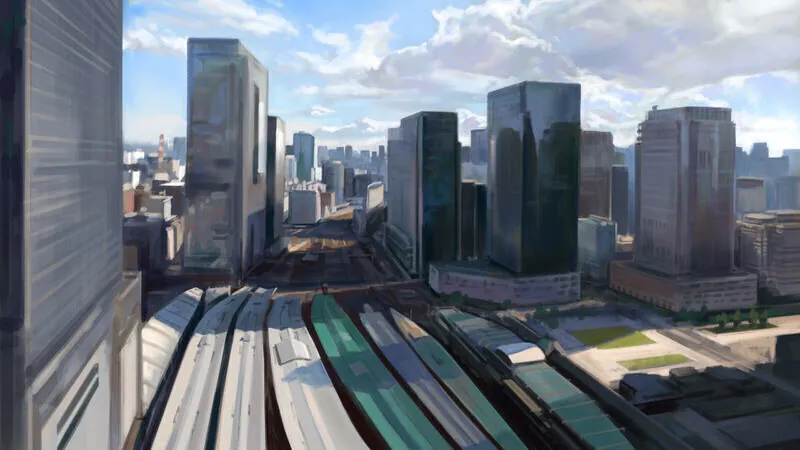
I did not enjoy making it, which is only one thing that I want to say about painting cities. I haven't painted a city in a long time and it was interesting to try it again. I'm better at it—all of the fundamentals still apply and I've improved at all of those. But I enjoy it about the same amount, which is precisely not at all. There was just no part of painting this where I felt "I'm having a good time." I think it looks alright and there's some satisfaction in that, but the actual process of painting a city is not fun for me. The strictures of correct perspective and the overabundance of straight lines just kills it for me. I like organic forms and I like the freedom to push and pull those elements as I see fit.
Which is why this piece doesn't have many details. I couldn't bring myself to work on it any longer. I can be a pretty dedicated person and push through unpleasant tasks, but this one was beyond me. I'm ok with that. I feel fine knowing that there are things I enjoy painting and others which I hate. I have all the respect in the world for artists who paint cities, but I'm glad to not be one of them.
Now, with all of that complaining out of the way, let me try to answer this question.
The things that make a landscape interesting still applies when you paint cities. Good values are essential, obviously. Interesting lighting is even more important. When what you're painting is not "naturally" beautiful, lighting can redeem it. That's what drew me to the reference above—at least the lighting looked good.
When you paint flat surfaces, remember to use gradients. No flat surface in a landscape is a flat color. It will shift tone as your angle to it changes. So over the immensity of a building, it will take on many different colors and values.
Spend a little extra time on the silhouettes. It's where we look first and if you're going to spend additional time anywhere, that's where to put it.
You don't have to paint every detail. Obviously I half-assed the details in mine, but at least at first glance the image reads like it should. If you want to paint details, you can. And there are plenty to be painted. But remember that your aim is to make a painting and paintings are often more interesting if we let the viewer's eye fill in some of the detail. We do not aim to make photographs, but instead to find ways to trick the eye into believing that there is more in our painting than we have put there.
That's all I'll say because I'm not an expert here. I've painted just enough architecture in my career to say that I can do it tolerably well, but I don't think anyone would accuse me of mastering it. So I'll defer to other artists for this.