When laying out a picture, how much do you plan out a focal path for…
“When laying out a picture, how much do you plan out a focal path for the eye to follow? In your England painting I see a nice path from Main Rock-> Down and then right along the rocky foreground ridge -> Follow the path of the background hills back up and towards the center then following the clouds til your eyes get back to the starting point. Was this intentional? I really like pieces that take my eye on a cohesive journey.”
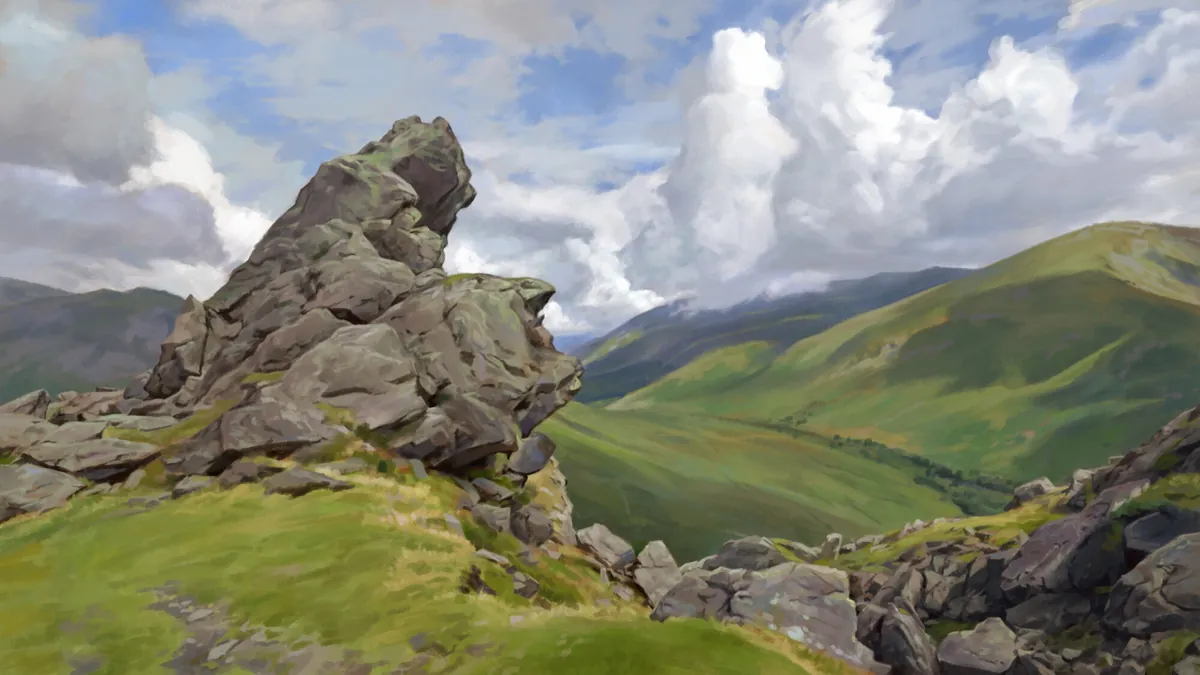
For studies like this one, I'm not considering composition nearly as much as I do in my imaginative work. Most of that composition work came when I was shooting the reference itself—making the most of what's in front of me and trying to get a good shot through the lens. So this piece isn't the best example for how I handle composition, but I include it here anyway for context.
Now, I don't really think of eye paths much at all any more. I was taught those things by countless art teachers over the years but it just... never made sense to me. They would tell me how this or that line lead our of the picture or maybe this one lead into the picture; but it always felt arbitrary. It felt like an imperfect tool to pick apart a bad composition or to praise things that worked in a good one.
If it works for you: use it! So much of art is imprecise and we need whatever tools help us to make good images. For me, though, thinking about how the eye travels isn't one of those things.
The thing that has worked best for me and my ability to compose is quite simply: do what feels right. One of my favorite teachers, Sterling Hundley, compared composition to how we like to arrange our desk/workspace/dining area. There are some arrangements that feel right and others that don't quite work for us. This meshed nicely with how I like to compose.
So I try to put shapes and lines in places that feel right to me. If something doesn't feel right, I change it.
To develop this feeling of rightness/wrongness, it did help to look at and study a lot of master works. Find pictures that you think have good composition and look at the choices they made. Also look at pieces that you think have really bad compositions and try to figure out how you would improve them.
Most books on composition are absolute garbage, but I've always been a fan of Picture This: How Pictures Work. James Gurney also wrote some good stuff on eye tracking and how we actually look at images.